
Diwali Lakshmi Puja Samagri List 2026
Diwali is on Sunday, 8 November 2026. See the muhurat and timings for your city
Diwali Lakshmi Puja is the evening worship of Mata Lakshmi with Lord Ganesha on Kartika Amavasya, in a home that has been cleaned, decorated and lit with diyas.
Amazon links on this page are affiliate links: as an Amazon Associate, Bhakti Angan earns from qualifying purchases, at no extra cost to you.
Tick items off as you go. To keep a paper copy, print this page: the checklist prints on its own.
The altar and kalash
Set the altar in a clean, uncluttered corner; many families choose the north-east of the home and sit facing east or north for the puja. Any clean, low wooden stool can serve as the chowki.
- Find on Amazon ↗
The raised chowki is the seat of the deities, and most families spread it with red, the colour of Lakshmi and of auspicious beginnings.
- Find on Amazon ↗
Ganesha is worshipped first as the remover of obstacles, and Lakshmi beside him is welcomed as the goddess of abundance and well-being.
- Find on Amazon ↗
Some families also place the yantra, the sacred geometric form of Lakshmi, before the murtis and worship it with kumkum and flowers.
- Find on Amazon ↗
Filled with water, a little Gangajal, a coin, supari and akshat, the kalash is a symbol of fullness in which Varuna and all the sacred rivers are invoked.
- Buy fresh locally
Fresh mango leaves are set around the mouth of the kalash as a sign of life and auspiciousness, and the same leaves often go into the door toran.
- Buy fresh locally
Wrapped in red cloth or kalava and set on the mango leaves, the whole coconut crowns the kalash as a complete, unbroken offering.
The puja thali
Keep the powders in small katoris or neat heaps on the thali, so each one is ready to hand as the puja moves from Ganesha to Lakshmi.
- Find on Amazon ↗
The thali carries everything offered during the puja and the aarti, and a brass or steel one serves every Diwali for years.
- Find on Amazon ↗
Roli marks the tilak, the swastik and the Shubh Labh on the door and the account books, and kumkum is offered to Mata Lakshmi as a sign of saubhagya.
- From home
Haldi is offered to both deities as the most auspicious of colours, and many families use it for the tilak alongside roli.
- From home
Akshat means unbroken, and these whole grains, often tinted with roli, are offered at every step of the puja as a sign of completeness.
- Find on Amazon ↗
Cool, fragrant chandan is applied to the deities and used for tilak as the offering of gandha, fragrance, in the puja.
- Find on Amazon ↗
The red and yellow sacred thread is tied around the kalash and the coconut, offered to the deities as vastra, and tied on the wrist of everyone at the puja.
Diyas and aarti
One ghee diya burns before the deities through the puja, and the rows of oil diyas for the house are lit from its flame once the aarti is done.
- Find on Amazon ↗
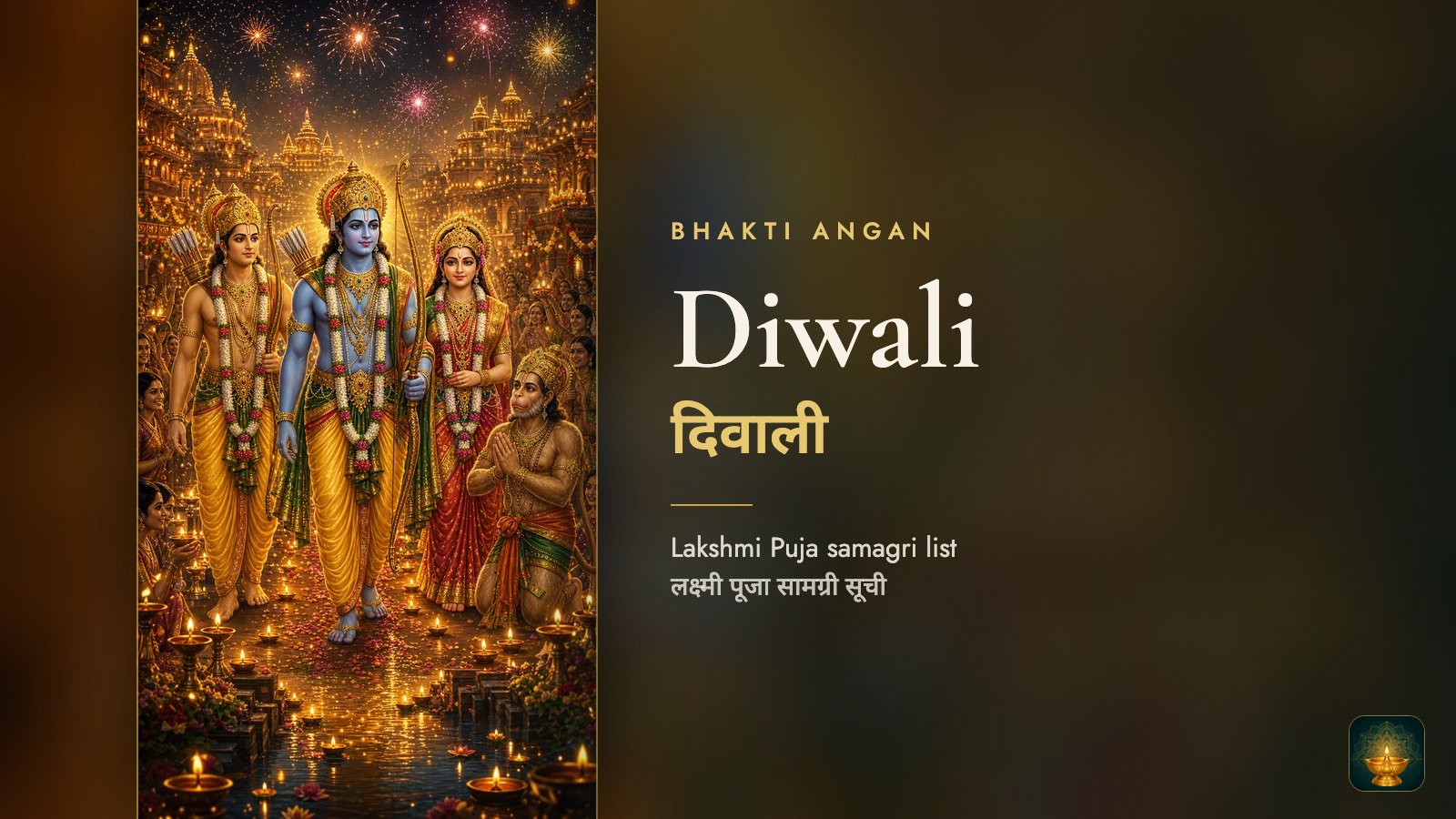
Rows of clay diyas on every ledge recall the lamps with which Ayodhya welcomed Rama home, and are believed to light Lakshmi’s way into the house.
- Find on Amazon ↗
Many families keep one large brass or clay diya burning before Lakshmi through the night, so the home stays lit on the darkest Amavasya.
- From home
Ghee is kept for the diya and aarti before the deities, while mustard or sesame oil fills the many diyas around the house.
- Find on Amazon ↗
Round phool battis suit the ghee diya and long wicks the oil diyas, and ready-made packs save a great deal of rolling on a busy day.
- Find on Amazon ↗
Camphor burns away without leaving a trace, which is why it is lit for the closing aarti as a symbol of the self offered completely.
- Find on Amazon ↗
Fragrant smoke is the dhoop offering of the puja, filling the room with a sense of sanctity before the aarti.
Bhog and prasad
Offer the bhog on a clean plate or banana leaf in front of the deities, and share it afterwards as prasad with the family and neighbours.
- Buy fresh locally
Kheel, puffed from the new rice of the season, and sugar batashe are the signature Diwali bhog for Lakshmi, often with sugar toys for the children.
- Buy fresh locally
Laddoos, Ganesha’s favourite, and the household’s own sweets are offered as naivedya and become the evening’s prasad.
- Buy fresh locally
Fresh fruit is offered whole, and many North Indian families include singhara (water chestnut) and sitaphal, fruits of this season.
- Buy fresh locally
The five nectars are used to bathe a metal murti or the silver coin, and are then sipped as the first prasad.
- Find on Amazon ↗
Makhana, cashews and raisins join the bhog, and boxes of dry fruits are the customary Diwali gift carried to family and friends.
- Buy fresh locally
Whole betel leaves carry the supari, cloves and cardamom offered as tambool, the closing courtesy shown to an honoured guest.
- Find on Amazon ↗
Whole supari goes into the kalash and onto the paan, and in many homes a supari wrapped in kalava is worshipped as a form of Ganesha.
- From home
Cloves and green cardamom are placed on the paan to complete the tambool, a fragrant offering made after the bhog.
- From home
Whole coriander seeds, whose name echoes dhan, are offered to Lakshmi, and many families keep a few in the cash box or sow them afterwards.
Coins and account books
Traders and shopkeepers worship their new account books along with the coins; at home, the silver coin, the cash box or a wallet is placed before Lakshmi in the same way.
- Find on Amazon ↗
Coins, often including the silver one brought home on Dhanteras, are bathed, marked with kumkum and worshipped as a form of Lakshmi, and many families then keep them in the safe for the year.
- Find on Amazon ↗
The red, cloth bound account book is marked with a swastik and Shubh Labh in roli and worshipped, and the first entry of the new trading year is written with the new pen.
Flowers and garlands
Buy flowers on the day of the puja and keep them in a cool place; lotuses sell out early at Diwali, so ask your florist to keep some aside.
- Buy fresh locally
Lakshmi is Kamala, the one seated on the lotus, so the lotus is the flower most dear to her, with red roses for the pushpanjali.
- Buy fresh locally
Bright marigold garlands adorn the deities and the doorway, the colour of the festival in almost every Indian home.
- Buy fresh locally
Durva is dear to Ganesha, and a few blades placed at his feet open the puja that always begins with him.
Decorating the home
Decoration is part of the welcome: the house is cleaned first, then the door, the floor and the windows are made ready for the evening lamps.
- Find on Amazon ↗
A rangoli at the entrance, with small footprints of Lakshmi walking into the house, is the traditional sign of welcome for the goddess.
- Find on Amazon ↗
A toran of mango leaves and marigolds, or a lasting one of cloth or beads, hangs over the main door to show the home is ready for the festival.
- Find on Amazon ↗
Electric lights carry the glow of the diyas to balconies and windows, and many families use them wherever an open flame is not safe.
This list covers everything for a full Lakshmi-Ganesh puja at home, grouped the way you will set it up: the altar and kalash, the puja thali, diyas and aarti, bhog, coins and account books, flowers, and the decoration of the house. Buy the durable items a few days early and the fresh ones on the day, and check the muhurat for your city on our Diwali guide. If you cannot gather everything, a clean altar, a ghee diya, flowers, akshat and one sweet offered with devotion still make a complete puja.
Setting it up
- Clean the house and the puja corner during the day, hang the toran on the main door and draw the rangoli with Lakshmi’s footprints walking inward.
- Place the chowki in a clean corner (many families choose the north-east) and spread the red cloth over it.
- Make a small heap of akshat on the cloth and seat Ganesha and Lakshmi side by side as your family tradition places them, with the yantra in front if you use one.
- Prepare the kalash: fill it with water and a little Gangajal, add a coin, supari, akshat and a flower, set the mango leaves at the mouth, crown it with the coconut wrapped in kalava, and place it on a small heap of rice beside the murtis.
- Arrange the thali with roli, kumkum, haldi, akshat and chandan in small katoris, along with the kalava, flowers, a ghee diya, dhoop and camphor.
- Set the silver coin, the everyday coins and the bahi khata with its new pen before Lakshmi, and mark the swastik and Shubh Labh in roli.
- Lay out the bhog: kheel and batashe, sweets, fruit, dry fruits, panchamrit, the paan with supari, cloves and cardamom, and the coriander seeds.
- When the muhurat for your city begins (check it on our Diwali guide), light the large diya, worship Ganesha first and then Lakshmi, and close with the aarti.
- From the flame of the puja diya, light the rows of diyas through the house, the first one at the main door, and share the prasad with the family.
Tips
- Buy durable things such as the murti, diyas, wicks, bahi khata and decor a week ahead, and keep only flowers, paan, fruit, milk and sweets for the day itself.
- Soak new clay diyas in water for a few hours and let them dry fully before use, so they drink less oil and burn steadily.
- Roll or set out a few ghee wicks the day before and keep a tray of filled oil diyas ready, so lighting the whole house after the aarti is quick.
- Keep diyas away from curtains, piles of rangoli powder and loose clothing, keep a bucket of water or sand nearby, and in apartments open a window while camphor and dhoop burn, since the smoke can set off alarms.
- For an eco friendly Diwali, choose plain clay or reusable brass diyas and a rangoli of flower petals, rice flour and haldi, and return the used flowers to the soil instead of throwing them away.
- Living abroad: Indian grocery stores stock kheel, batashe, diyas and marigold garlands in the fortnight before Diwali, and they sell out, so shop early.
Across regions
In Uttar Pradesh, Bihar, Delhi and much of North India, kheel, batashe and sugar toys are the heart of the bhog, and many families bring home new clay murtis of Lakshmi and Ganesha every year. In Gujarat and among the Marwari trading families of Rajasthan, the evening centres on Chopda Pujan, the worship of the new account books marked with Shubh Labh, and the new account year opens with the Gujarati New Year that follows. In Maharashtra, Lakshmi Pujan includes dhane (coriander seeds), jaggery, lahya (puffed rice) and batashe, and in many homes a new broom is worshipped as a form of Lakshmi. In Bengal, Odisha and Assam this night is widely kept as Kali Puja, with red hibiscus and lamps, and Lakshmi is worshipped on the earlier full moon of Kojagari Lakshmi Puja. In South India the festival centres on Naraka Chaturdashi with its oil bath before sunrise, and some families add a Lakshmi Kubera puja on the Amavasya evening.
Questions
What are the essential items for Diwali Lakshmi Puja?
Kept simple: a Lakshmi-Ganesh murti or picture on a clean chowki with red cloth, a kalash of water, a ghee diya and some oil diyas, roli, akshat, flowers, kheel-batashe and a sweet. The rest of the list deepens the puja, but these make it complete.
Should we buy a new Lakshmi-Ganesh murti every Diwali?
Many families bring home new clay murtis each Diwali and give the old pair a respectful farewell, by immersion in clean water or by placing it in the soil under a tree. Metal or silver murtis are usually kept and worshipped year after year. Follow your family custom.
Why are kheel and batashe offered on Diwali?
Diwali comes with the harvest of the new paddy, and kheel, puffed from that rice, is offered to Lakshmi as the first of the new grain. Batashe add sweetness, and together they make a simple, sattvic prasad that is easy to share with everyone who visits.
Which oil is best for Diwali diyas?
There is no single rule. Ghee is used for the diya before the deities and for the aarti, while for the many diyas around the house mustard oil is common in North India and sesame oil in much of the South. Whatever the oil, many families keep one large diya burning through the night.
What should we do with the puja items after Diwali?
Share the kheel, batashe and sweets as prasad, keep the coins in the safe or cash box, and sprinkle the kalash water through the house or pour it into your plants. Many families break the kalash coconut the next day and share it as prasad, and the flowers are best returned to the soil rather than thrown away.
The Bhakti Angan app reminds you of every festival and vrat, with the date and timings verified for your city.
The full Diwali 2026 guide
More samagri lists: Karwa Chauth · Dhanteras · Chhath Puja