

The Complete Story · For First-Time Readers
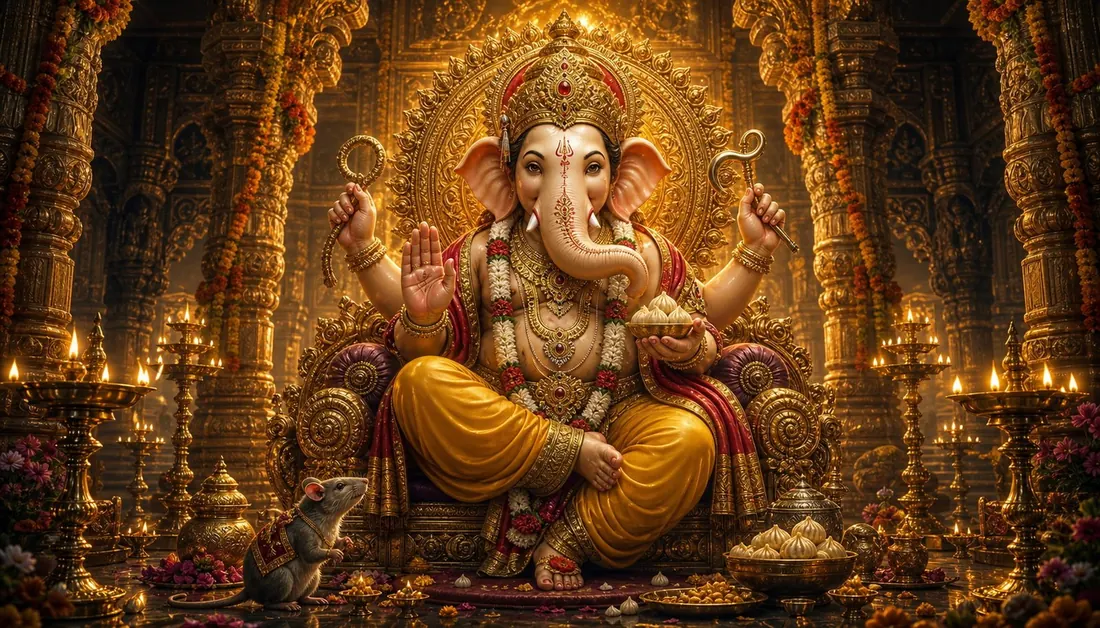
GaneshaFrom the boy at his mother’s door to the scribe of the Mahabharata: the whole story of the remover of obstacles, told gently.
Who is Ganesha?
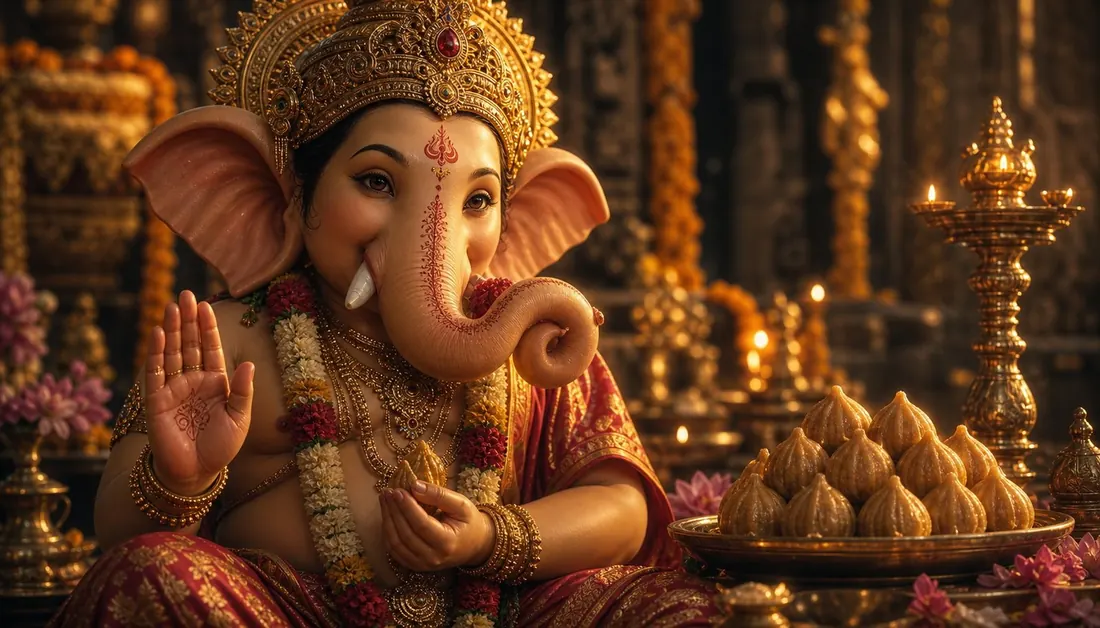
Before any prayer in India begins, before a wedding, a journey, a new shop, a new book, a new venture of any kind, one god is remembered first. He has the head of an elephant and the round belly of a well-fed child, he rides a mouse, and he holds a sweet in one hand and a blessing in the other. He is Ganesha: the remover of obstacles, the lord of beginnings, and the most instantly beloved figure in the whole Hindu world.
His titles tell you his work. He is Vighnaharta, the one who takes away obstacles, and, in a detail newcomers find surprising, also Vighnakarta, the one who can place them, because the power to clear a path and the power to block it are the same power. He is Vinayaka, the supreme guide; Ganapati, lord of Shiva’s hosts; and above all Prathama Pujya, the first to be worshipped, honored before every other god, even his own father.
That last fact is the key to him. How did a child, the youngest in the family of Kailash, come to be worshipped before the great gods themselves? The answer is his whole story, and it is a story unlike the others in this library. Ganesha is not a warrior. He fights almost no battles. His power is of a gentler and stranger kind: wisdom, wit, and an understanding of what things really mean. He wins by being clever and by being good, and in a pantheon full of thunderbolts and armies, he is loved most of all.
He is the son of Shiva and Parvati, and his story begins, fittingly for the lord of beginnings, with a mother making something out of love.
Chapter 1 · The Boy at the Door
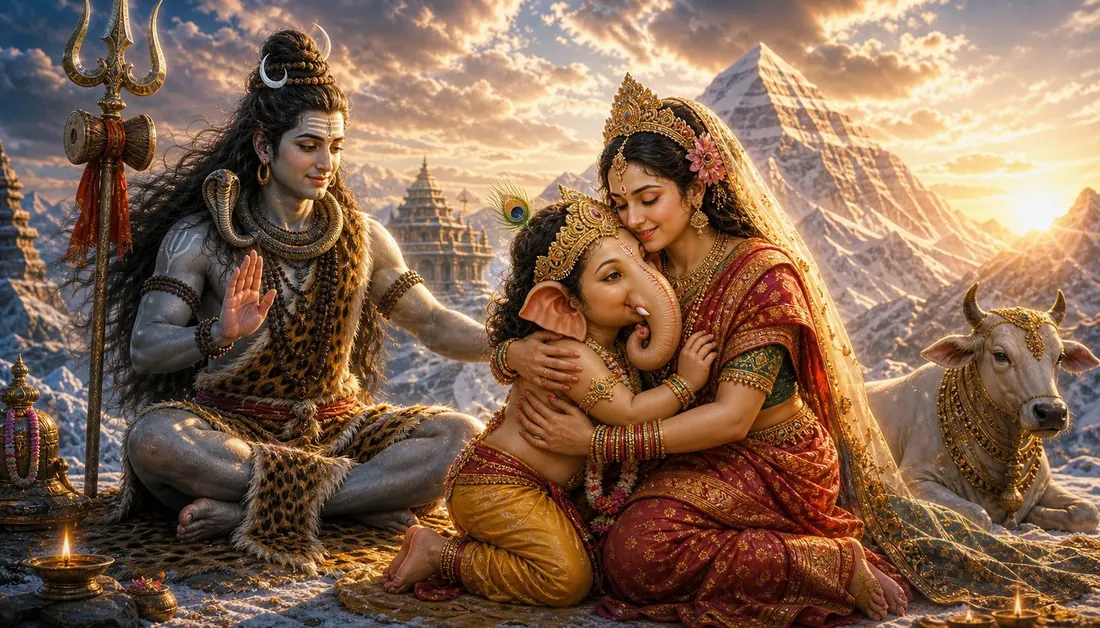
Parvati, alone on Kailash while Shiva wandered the worlds in meditation, wished for a companion of her very own, a child who was hers completely. So she did what a goddess can do: she gathered the sandalwood paste and turmeric from her own body, and from it she shaped a boy, beautiful and strong, and breathed life into him. He opened his eyes and knew her at once as his mother, and loved her with a whole heart, and she loved him.
She gave him one task. Going to bathe, she set him at the door with an instruction: let no one enter, no matter who they claim to be. The boy took the duty with absolute seriousness, as children do, and stood guard.
Then Shiva returned home. And a strange child he had never seen barred the door of his own house and would not let him pass. Shiva, the great god, was refused entry to his own home by a boy with a stick. Words failed; tempers rose; the boy would not yield his mother’s command, and Shiva would not be kept from his own door. And in a flash of the wrath that even the gods fear, Shiva struck off the boy’s head.
Parvati came out to a grief that shook the mountain. This was her son, her own creation, killed at her own door for obeying her. Her sorrow turned toward a fury that threatened the worlds, and Shiva, seeing at last what he had done, gave his word to make it right. He sent his hosts out with a single instruction: bring the head of the first living creature you find sleeping with its head to the north. They returned with the head of an elephant. Shiva set it upon the boy, breathed life into him once more, and the child rose, transformed: the elephant-headed god, restored to his mother, now something greater than he had been.
And then Shiva did the thing that made Ganesha who he is. To console Parvati completely, and to honor the boy who had kept his post even against a god, Shiva decreed that this son of theirs would be worshipped first, before all others, at the start of every rite and every undertaking, for all time. The fuller telling of this beloved story is in our katha, The Birth of Ganesha.
Why this story matters
Every parent and every child has felt some corner of this story. It begins in a terrible misunderstanding between a father who did not recognize his own son and a son who was only doing what he was told, and it ends not in punishment but in exaltation. The boy who was killed for his loyalty is not merely restored; he is raised above everyone. The tradition is saying something tender and profound: what looks like the worst thing that can happen, the loss of a head, a life, a face, can become the doorway to a greater self. Ganesha is loved partly because he was broken first, and made glorious afterward.
Chapter 2 · The Race Around the World
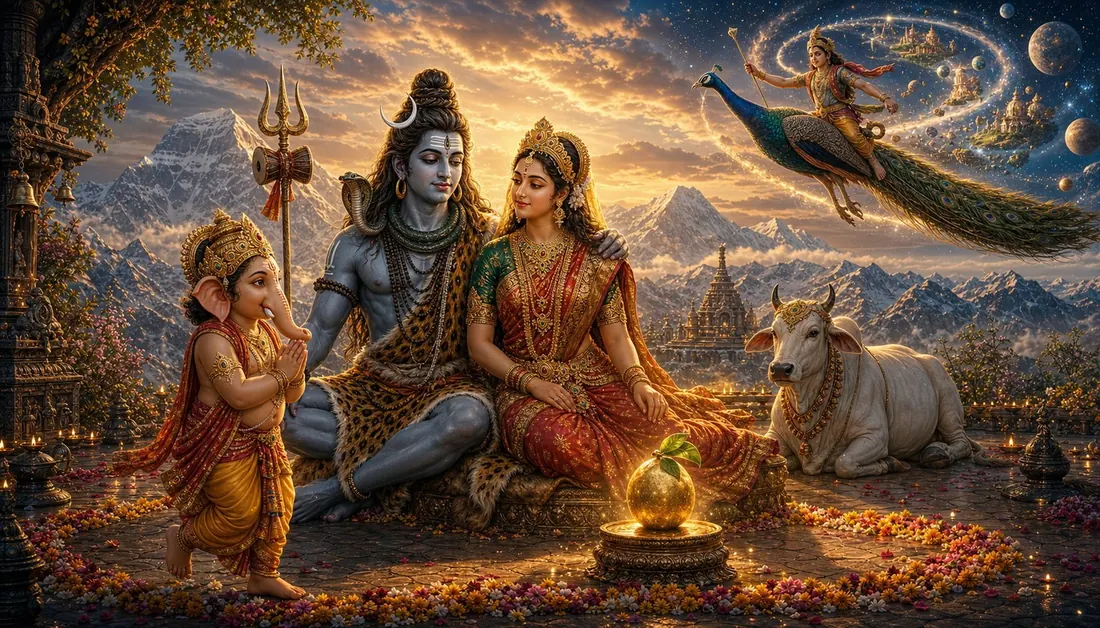
One day a single divine fruit came to Kailash, a fruit of wisdom and immortality, and there were two sons who wanted it: Ganesha and his elder brother Kartikeya, the radiant war-god. Shiva and Parvati set a contest to decide: whoever circles the whole world three times and returns first shall have the fruit.
Kartikeya, swift and mighty, leapt onto his peacock and shot into the sky to race around the seven continents and seven seas. Ganesha looked at his own mount, a small mouse, and at his own round body, and understood immediately that he could not win that race. So he did not run it.
Instead, he rose, walked slowly around his mother and father where they sat, once, twice, three times, folded his hands, and asked for the fruit. When they asked what he thought he was doing, he gave the answer that has echoed for three thousand years: my mother and father are my world. To circle you is to circle all of it. There was nothing to argue. Ganesha was eating the fruit of wisdom when his exhausted brother returned from the far edge of the earth.
This, as much as anything, is why Ganesha is the first worshipped. He did not win by speed or strength, the currencies of every other god. He won by seeing what the contest was actually about, and by an act of love so simple it could not be beaten. The lord of beginnings is, at heart, the lord of understanding what really matters.
Why this story matters
India tells this story to its children before almost any other, and it never stops being true. The race does not always go to the swift; it goes to the one who understands the question. Speed, strength, and cleverness of the ordinary kind streak off around the world; wisdom walks a small circle and arrives first. And the deeper claim is the one Ganesha made with his folded hands: the whole world you are chasing, all of it, is already sitting in front of you, in the people who love you and the life you have. To honor that is to have already arrived.
Chapter 3 · The Broken Tusk
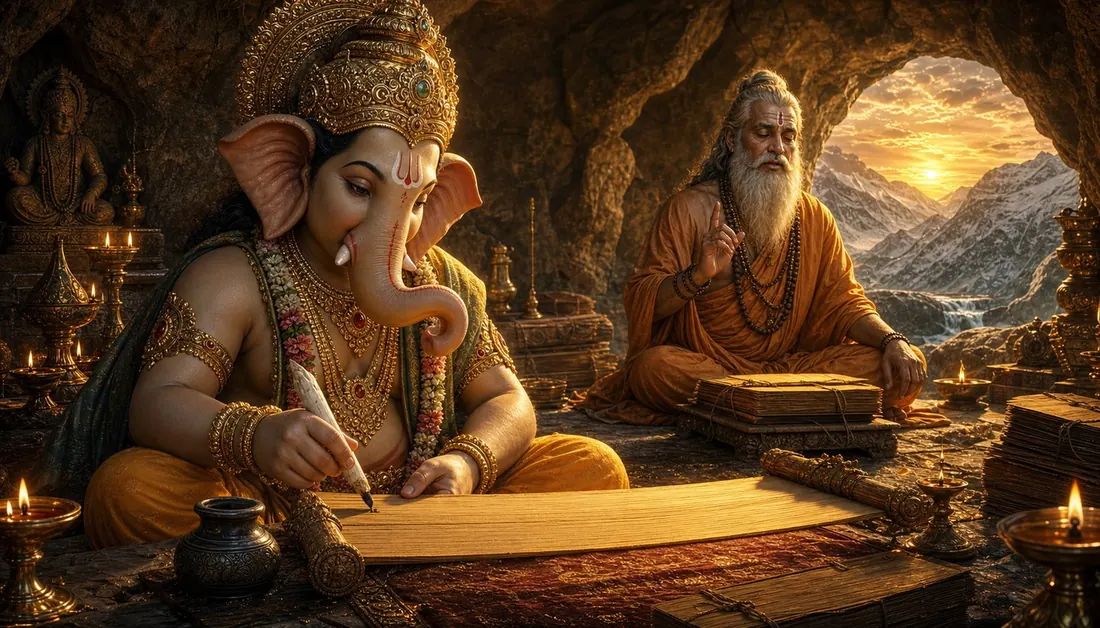
When the sage Vyasa was ready to compose the Mahabharata, the vast epic that holds the Bhagavad Gita and the whole moral universe of India, he faced a problem: the poem was too enormous, and came too fast, for any ordinary hand to write down. He needed a scribe who could keep pace with a mind speaking scripture, and only one being in existence was equal to it. He prayed to Ganesha.
Ganesha agreed, but with a scribe’s sly condition: I will write, but my pen must never stop. If you pause in your telling, I stop, and I leave. Vyasa, no fool, answered with a condition of his own: agreed, but you must not write a single line until you have fully understood its meaning. And so the greatest poem in the world was composed as a contest of wits between the sage who spoke it and the god who wrote it: Vyasa, whenever he needed a moment to compose the next verses, would utter a knot of language so dense that even Ganesha had to pause and unravel it, and in that pause the sage would race ahead in his mind.
They wrote for years without stopping. And at the climax of the telling, Ganesha’s pen split and failed. The words were still pouring out; he had sworn not to stop; there was no time to find another. So the god reached up, snapped off one of his own tusks, dipped the broken point in ink, and kept writing, without a word, to the end.
This is why almost every image of Ganesha shows him with one tusk whole and one broken, and why one of his dearest names is Ekadanta, the one-tusked. He gave a piece of his own body, uncomplaining, so that wisdom would not be lost to the world.
Why this story matters
There are two teachings folded into this one story. The first is Vyasa’s condition: write nothing until you have understood it. Ganesha, the lord of wisdom, is bound by the rule that knowledge without understanding is worthless, that the point is never merely to record but to comprehend. The second is the tusk itself. Faced with a choice between his own wholeness and the completion of the work, the god chose the work, and gave his body without hesitation or self-pity. Ekadanta is the tradition’s quiet image of sacrifice in the service of knowledge: sometimes to finish what matters, you must break off a piece of yourself, and do it in silence.
Chapter 4 · The Moon Who Laughed
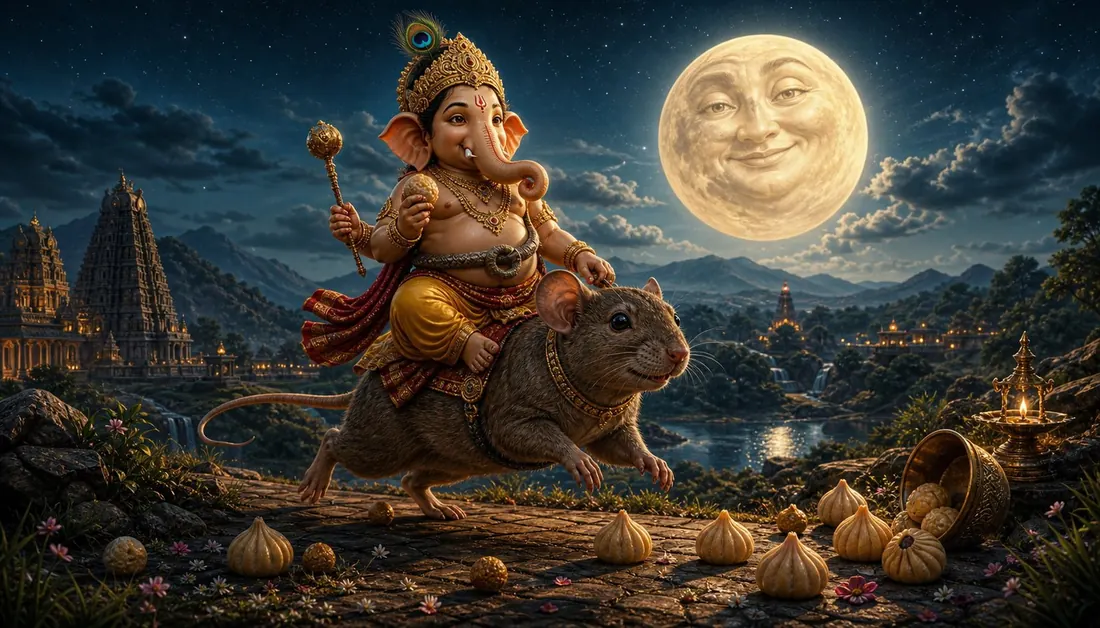
Ganesha loved sweets, the round modak above all, and the tradition tells this next story with a smile. Returning home one night on his mouse, his belly full to bursting with the modaks of a feast, Ganesha was jolted when his little mount startled at a snake. The god tumbled off, and his over-full belly split open, spilling the sweets across the road.
Unbothered, Ganesha simply gathered up the modaks, packed them back in, and, for good measure, caught the passing snake and tied it around his belly as a belt to hold everything in place, which is why many images show a serpent at his waist. But one witness to all this could not contain himself. Chandra, the moon-god, looking down from the sky, burst out laughing at the sight of the elephant-headed god sprawled in the road with his sweets everywhere.
Ganesha, stung by the mockery of his mishap, laid a curse on the moon: that anyone who looked upon him would be falsely accused and disgraced. The moon, horrified, begged forgiveness, and the gods pleaded on his behalf, for a permanent curse on the moon would darken the whole world. Ganesha, whose anger never lasts, softened it: the curse would fall only on one night a year, the night of his own festival, Ganesh Chaturthi. And so to this day, tradition holds that one should not gaze at the moon on that night, lest one be blamed for something one did not do.
It is his most human story, and Hindus love it for exactly that: the great god, undignified, sweets everywhere, laughed at, and then, being Ganesha, forgiving.
Why this story matters
Under the comedy is a real teaching about pride and mockery. The moon’s sin was not a great crime; it was laughing at another’s stumble, the small, universal cruelty of enjoying someone else’s embarrassment. And Ganesha’s response models the whole arc a good heart should take: first the sting and the flash of anger, then, when the wrongdoer is genuinely sorry, the softening, the mercy, the curse reduced to almost nothing. The lord of beginnings will not let a single night’s foolishness become a permanent darkness. He teaches that dignity is not about never falling, but about how gently you treat those who fall, and how quickly you forgive those who laughed.
Chapter 5 · What the Elephant Teaches
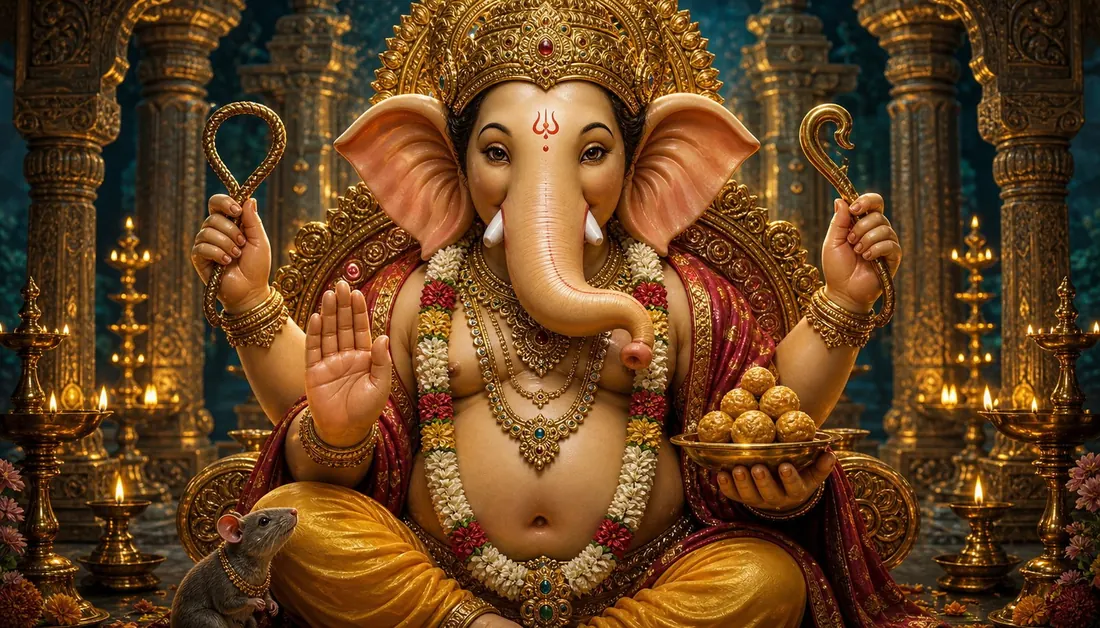
No god in Hinduism is a more complete teaching in a single image than Ganesha. Every strange and wonderful feature of his form is meant to be read, and together they are a whole philosophy of how to live wisely.
His great ears, wide as winnowing fans, are for listening: the wise person hears everything, patiently, before speaking. His small eyes are for concentration and for seeing the fine truth others miss. His large head holds great wisdom, and his small mouth means to speak little. His long trunk is famously able to uproot a tree and to pick up a needle: the sign of a mind equally capable of vast strength and delicate subtlety. His big belly is the ability to digest all of life, the good and the bad alike, and carry on in peace.
In his hands he holds a noose, to catch and pull the devotee toward the truth, and a goad, to prod them forward on the path; one hand offers a modak, the sweet reward of realization, and one is always raised in the gesture that means do not be afraid. And beneath this vast form sits a tiny mouse. The great god rides the small rodent because the mouse is desire itself, restless and gnawing, able to get into everything; and Ganesha, seated calmly upon it, is desire mastered, made a servant and a vehicle rather than a master.
Read him head to foot and he becomes an instruction: listen much, see clearly, think deeply, speak little, take in all of life without being poisoned by it, and keep your desires beneath you, carrying you where you choose to go.
Why this story matters
Ganesha answers a question newcomers rarely think to ask about Hindu images: why do the gods look the way they do? He is proof that the strange forms are not arbitrary but legible, a language of the body meant to be read. And what he spells out is not grand mysticism but the most practical wisdom there is, the kind you could teach a child: listen before you speak, focus on what matters, digest your troubles, ride your desires instead of being ridden by them. The elephant head that began as a tragedy becomes, in the end, the most eloquent teaching in the tradition.
Chapter 6 · The God Who Comes Home
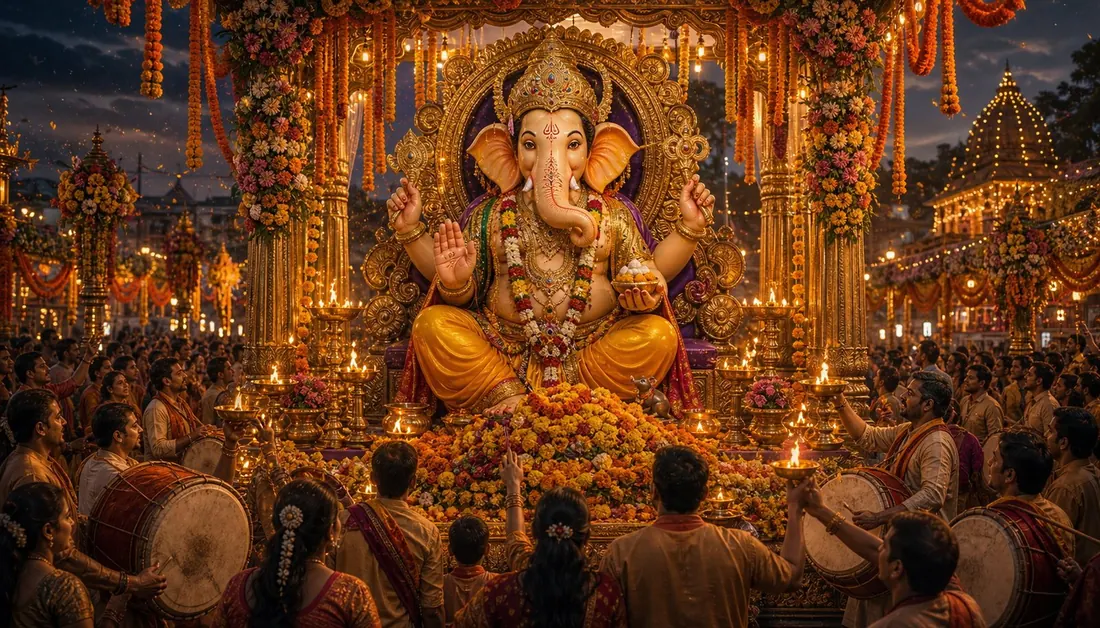
Once a year, for ten days at the end of the monsoon, Ganesha comes to stay. Ganesh Chaturthi is among the most joyful festivals in India, greatest of all in Maharashtra, when clay images of the elephant-headed god, from small ones on home altars to giants towering over whole neighborhoods, are installed with music and welcomed as an honored guest into the house and the street.
For ten days he is treated as family. He is bathed, dressed, garlanded, and fed mountains of modaks; there is singing and drumming and the great cry of Ganpati Bappa Morya ringing through the cities day and night; obstacles are laid at his feet and beginnings are blessed. Whole communities that spend the year apart gather before him.
And then, on the last day, the same thing happens that happens to Durga in Bengal: the beloved guest is carried in a joyous, tearful procession to the sea or the river and given to the water. Visarjan, the immersion, dissolves the clay back into the element it came from, as the crowds call out Ganpati Bappa Morya, pudhchya varshi lavkar ya: come again soon, next year. The god who was welcomed with such love is released with such trust, and the promise of return hangs in the air over the water.
It is the perfect festival for the lord of beginnings, because it teaches the hardest lesson about beginnings: that they are married to endings, and that both, held rightly, are joy. The clay came from the earth and returns to it. The god who removes the obstacle of our fear of loss shows us, in his own going, that there is nothing to fear.
Why this story matters
Ganesh Chaturthi turns doctrine into a thing you can carry to the water in your arms. Welcoming a god made of clay and then dissolving him on purpose is one of the boldest acts of devotion in the world, and it teaches exactly what the Gita teaches: love the form completely, and release it without fear, because the form was always clay and the love was never lost. For the god of beginnings to be sent back to the river each year is the tradition’s way of saying that even endings are auspicious, even goodbyes can be sung, and the remover of obstacles removes, last of all, the obstacle of clinging.
वक्रतुण्ड महाकाय सूर्यकोटि समप्रभ ।
निर्विघ्नं कुरु मे देव सर्वकार्येषु सर्वदा ॥
vakratuṇḍa mahā-kāya sūrya-koṭi samaprabha
nirvighnaṃ kuru me deva sarva-kāryeṣu sarvadā
“O curved-trunked, mighty-bodied one, radiant as ten million suns: make all my undertakings free of obstacles, always, O Lord.”
Traditional Ganesha shloka
Small Glossary
- Vighnaharta
- The remover of obstacles: Ganesha’s central role and dearest title.
- Vinayaka
- The supreme leader or guide; a common name for Ganesha.
- Ganapati
- Lord of the ganas, Shiva’s hosts; hence Ganesha, “lord of the ganas.”
- Prathama Pujya
- The first to be worshipped: Ganesha is honored before every rite and undertaking.
- Ekadanta
- The one-tusked: Ganesha broke a tusk to write the Mahabharata.
- Modak
- The sweet dumpling Ganesha loves; the symbol of the reward of wisdom.
- Mushika
- The mouse that Ganesha rides: desire, mastered and made a vehicle.
- Ganesh Chaturthi
- The ten-day festival of Ganesha’s birth (August/September).
- Ganpati Bappa Morya
- The great festival cry of love and farewell to Ganesha.
- Riddhi-Siddhi
- Prosperity and attainment, worshipped as Ganesha’s consorts.
- Vyasa
- The sage who composed the Mahabharata with Ganesha as his scribe.
- Visarjan
- The immersion of the clay image in water at the festival’s close.
Retold in original words from the Shiva Purana, the Ganesha Purana, the Skanda Purana and the Mahabharata.
Test yourself
Think you know Ganesha? Ten questions, no sign in.
Carry this darshan with you.
The Bhakti Angan app brings a new darshan each morning, simple mantras, a japa counter and the daily Panchang. Using Android? Join the waitlist.