
The Complete Story · For First-Time Readers
RamaFrom the bow of Shiva to the lamps of Ayodhya: the whole story of the perfect man and the first Diwali, told gently.
Who is Rama?
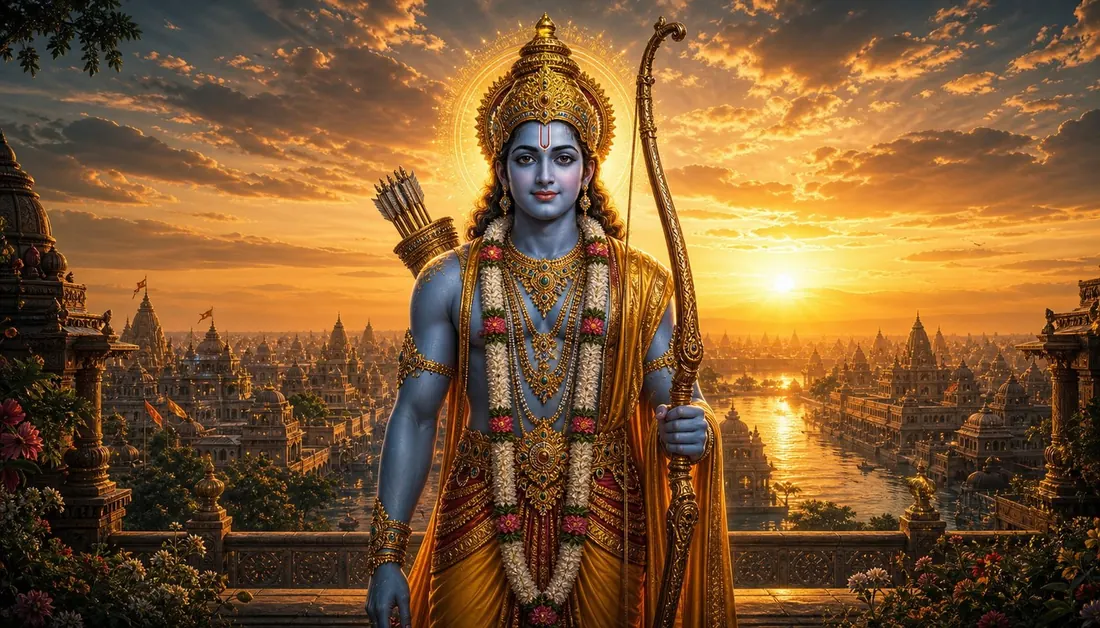
He is the prince who gave up a kingdom without a moment’s protest to keep his father’s word. He is the husband who crossed an ocean and fought a war to win back his wife. He is the king under whose rule, tradition says, no one wept. He is Rama: the seventh avatar of Vishnu, the hero of the Ramayana, and the figure Hindus hold up, above all others, as the answer to a single question: how should a good person live?
Where Krishna enchants and Shiva transcends, Rama does something quieter and harder. He shows us a divine being who chooses, again and again, to live perfectly by the rules of dharma, of right conduct, even when it costs him everything he loves. He is called Maryada Purushottam: the perfect man who lives within the bounds, the ideal of righteousness in human form. He does not bend the world to his will. He submits himself to what is right, and becomes divine by doing so.
For that reason he is loved not with awe but with a kind of trust. His very name became a greeting and a farewell and a prayer; Ram Ram is said in villages as hello, and Ram Naam, the name of Rama, is chanted at births and whispered at deaths across India. To say his name is to reach for goodness itself.
His story is the story of an ideal tested to its limit: a man who had every reason to do wrong, and did right instead, and lost, and endured, and won. It begins in the golden city of Ayodhya, with a promise.
Chapter 1 · The Prince and the Bow
Rama was born the eldest son of Dasharatha, the righteous king of Ayodhya, answer to his father’s long prayer for an heir; his birth is celebrated every year as Ram Navami. He grew up beloved, with three brothers, and closest of all to Lakshmana, who would follow him through everything to come. Even as a youth he went with the sage Vishwamitra to defend the forest hermitages from demons, and the world began to learn what this prince was.
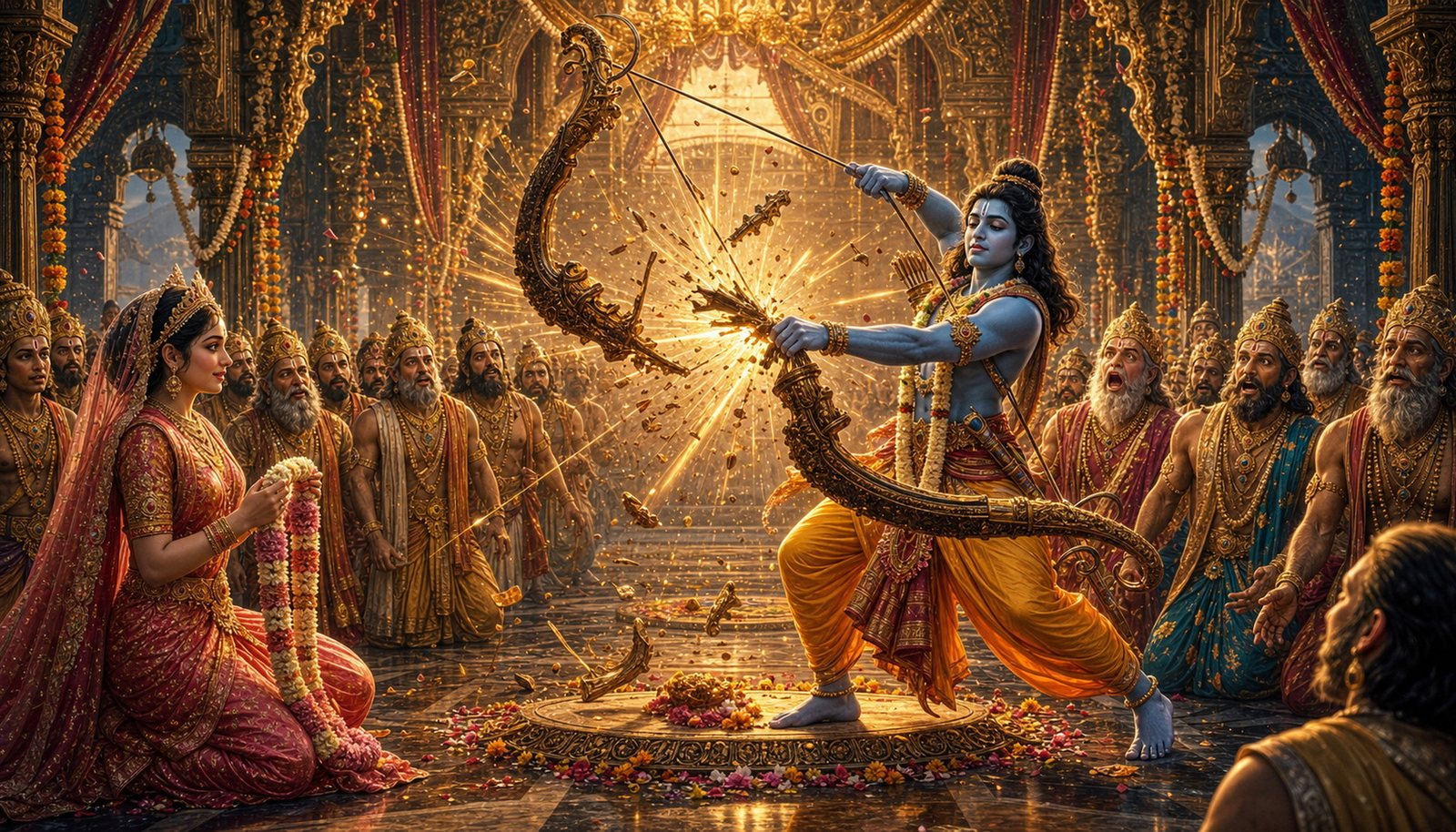
His marriage came in the kingdom of Mithila, whose king Janaka had set an impossible test for the hand of his daughter Sita: whoever could lift and string the great bow of Shiva, a weapon so heavy that armies could not shift it, would win her. Kings and princes strained at it and failed. Then Rama walked forward, lifted the mighty bow as easily as a flower, and in the drawing of it, snapped it in two.
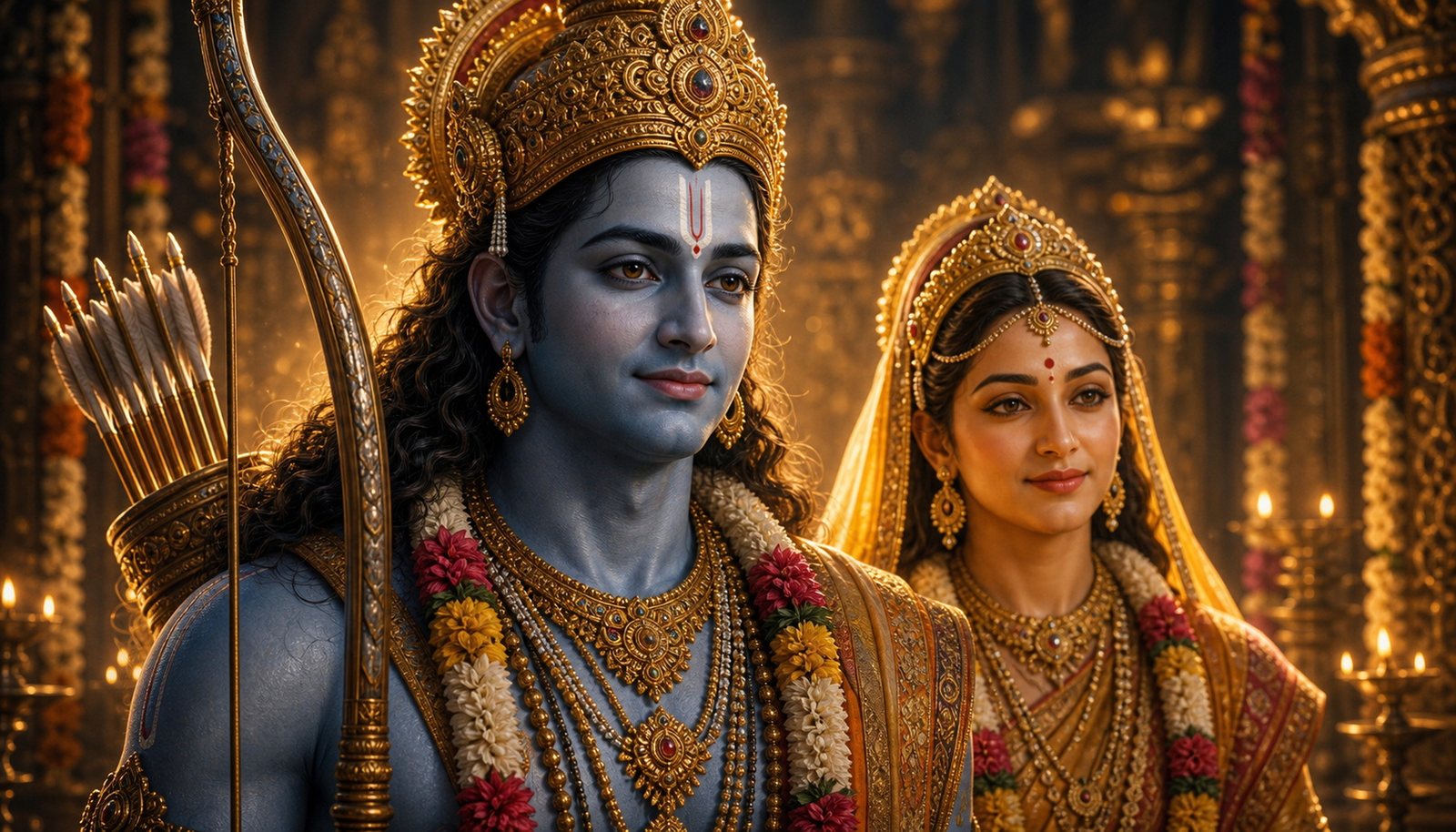
Sita, who had already loved him at first sight, garlanded him, and the tradition treats their union as the meeting of the divine couple themselves, for Sita is an avatar of Lakshmi, Vishnu’s eternal consort, come to earth beside her Lord. Ayodhya rejoiced. Dasharatha, aging, resolved to crown Rama king while he still lived, and the whole kingdom prepared to celebrate the coronation of the prince everyone adored.
Everything was set for joy. And that is exactly when the story turns, because a story about doing right is not tested by good fortune.
Why this story matters
The bow of Shiva is the first sign of who Rama is: not that he is strong, many are strong, but that he lifts the unliftable with ease and grace, without strain or show. And Sita at his side matters as much as the bow. The Ramayana is, at its heart, a love story and a marriage story, and it insists from the start that Rama’s greatness is not solitary. He is one half of a divine pair, and everything he suffers and achieves afterward is bound up with her. The perfect man is not perfect alone.
Chapter 2 · The Kingdom Given Away
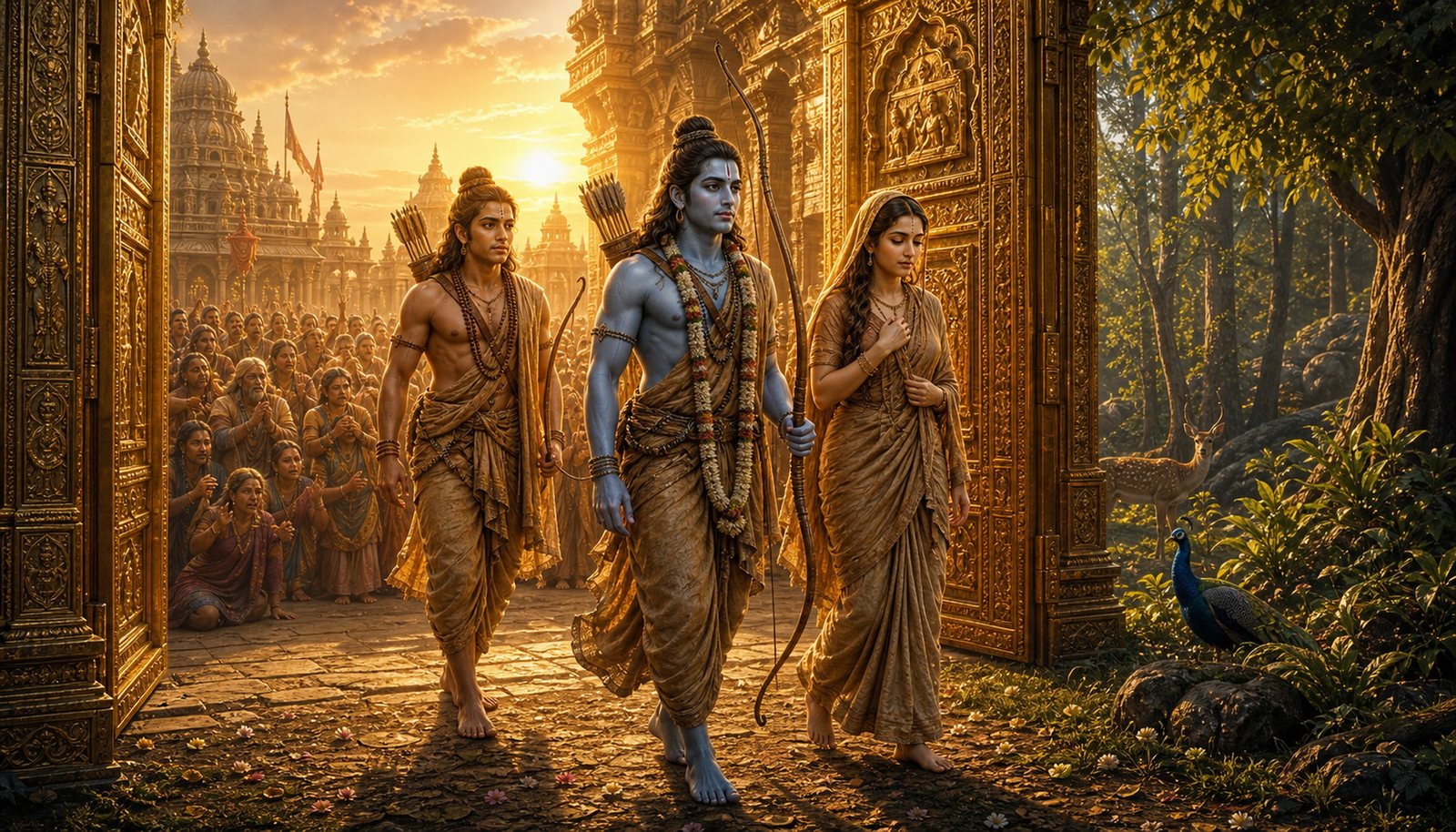
On the eve of the coronation, an old promise surfaced like a knife. Years before, Dasharatha had granted his queen Kaikeyi two boons, unspecified, to be claimed whenever she wished. Now, poisoned by the whispers of a servant, she claimed them: that her own son Bharata be crowned instead, and that Rama be exiled to the forest for fourteen years.
Dasharatha was shattered; he would rather have died than send Rama away, but a king’s word, once given, is the ground the whole kingdom stands on, and he could not take it back. And here the story reaches its first great height, because Rama, told that his coronation had become a fourteen-year banishment, did not argue, did not rage, did not for one instant consider seizing by force the throne that was rightfully his and that the whole city wanted him to have. He touched his father’s feet, comforted him, and prepared calmly to leave, because his father had given his word, and a son upholds his father’s dharma. Whether it is the kingdom or the forest, he said, is all the same to me.
He could not stop those who loved him from following. Sita refused to stay behind in comfort while her husband suffered, insisting that a wife’s place is beside her Lord; Lakshmana refused to be parted from his brother. And so the three of them, a prince, a princess, and his brother, took off their silks, put on the bark garments of forest ascetics, and walked out of the golden city into fourteen years of exile, while Ayodhya wept behind them and Bharata, horrified by what his mother had done, refused the throne and ruled only as caretaker, placing Rama’s sandals on it in his brother’s name.
They lived those years in the forest simply and even happily, until the exile brought them within reach of the one who would test Rama’s dharma past all bearing.
Why this story matters
This is the chapter that made Rama the ideal of a civilization. He is handed the perfect excuse, an unjust demand, a heartbroken father who does not even want him to go, a whole kingdom that would rise to keep him, and he refuses it, because his father gave his word and a promise is sacred. The tradition is making an almost unbearable claim: that dharma, right conduct, is worth more than a throne, more than comfort, more than justice to oneself. Rama does not do what is fair to Rama. He does what is right, and trusts that rightness, not advantage, is what holds the world together.
Chapter 3 · The Golden Deer
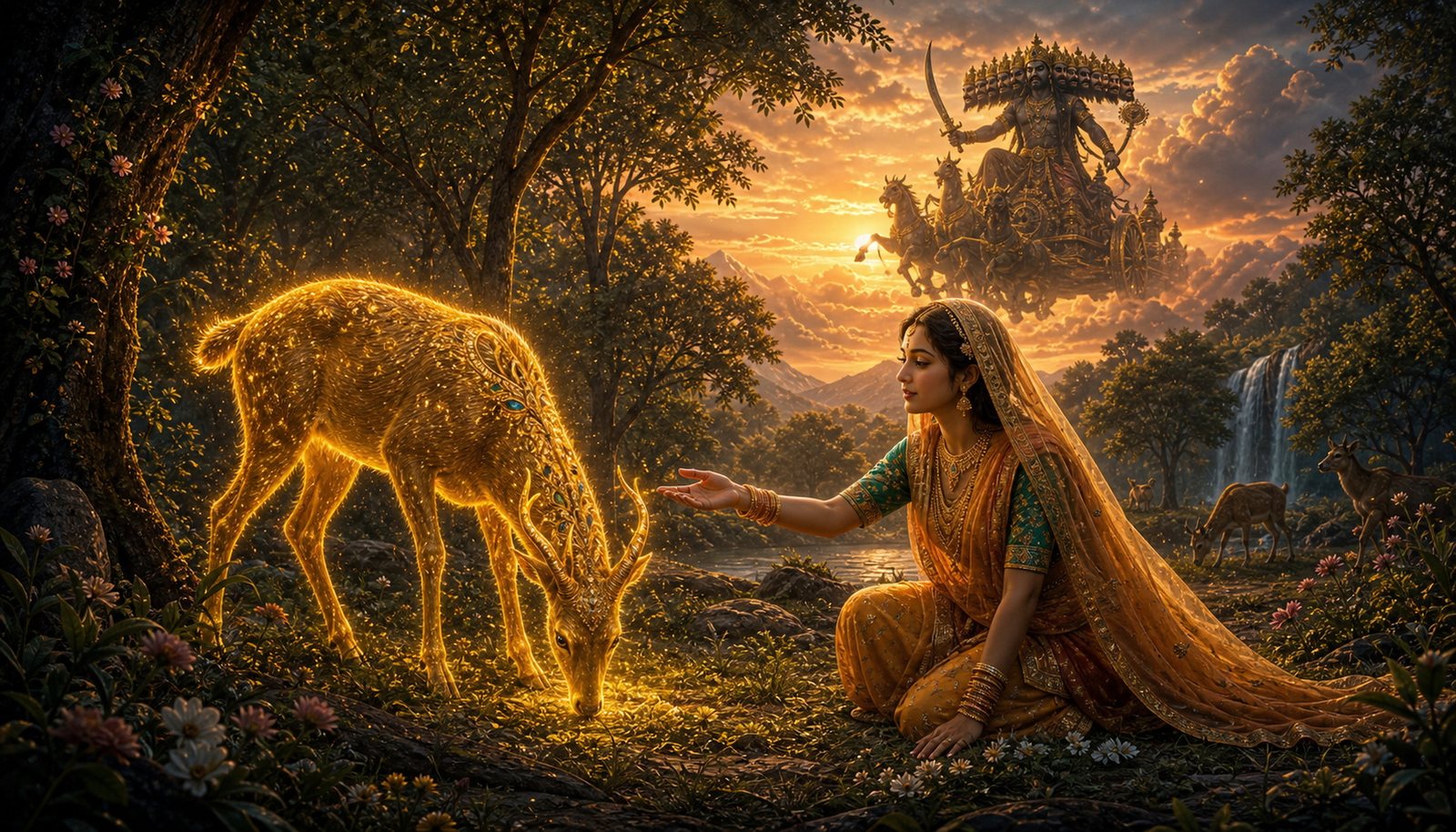
Deep in the forest lived the demon king Ravana, lord of Lanka: brilliant, learned, a great devotee of Shiva, and consumed by pride. His sister, humiliated by Rama and Lakshmana, inflamed him with descriptions of Sita’s beauty, and Ravana resolved to take her, not by strength, for he feared Rama’s bow, but by trickery.
He sent a demon in the form of a golden deer, dazzling and impossible, to graze near their hermitage. Sita, enchanted, begged Rama to catch it for her. Against his better judgment, Rama went, asking Lakshmana to guard her. Deep in the woods the deer led him a long chase, and when at last Rama shot it, the dying demon cried out in Rama’s own voice: Lakshmana! Sita! Help me!
Sita, hearing what she believed was her husband in mortal danger, forced a reluctant Lakshmana to go to him, leaving her alone, exactly as Ravana had planned. In that undefended moment Ravana came, seized Sita, and carried her through the sky toward Lanka. Only the ancient vulture-king Jatayu tried to stop him, fighting Ravana in the air until the demon cut him down; the dying bird lived just long enough to tell Rama which way his wife had been taken.
Rama returned to an empty hermitage, and the perfect prince, the calm and dutiful one, broke. He wandered the forest calling Sita’s name, questioning the trees and the animals, wild with a grief the tradition does not hide or soften. The avatar of Vishnu wept like any husband who has lost his wife, and then he did what grief must become if it is to mean anything: he set out to get her back.
Why this story matters
The golden deer is one of the oldest warnings in the tradition: the beautiful, dazzling thing that draws you away from what you are meant to protect is very often a trap. But the deeper note is Rama’s grief. The Ramayana insists that its divine hero feels loss the way we do, completely, that he weeps and wanders and nearly comes undone. This is not weakness in the ideal; it is the ideal made trustworthy. A Rama who felt nothing would teach us nothing. A Rama who suffers as we suffer, and still does not abandon dharma or hope, shows us that goodness is not the absence of pain but what we do with it.
Chapter 4 · The Allies in the Search
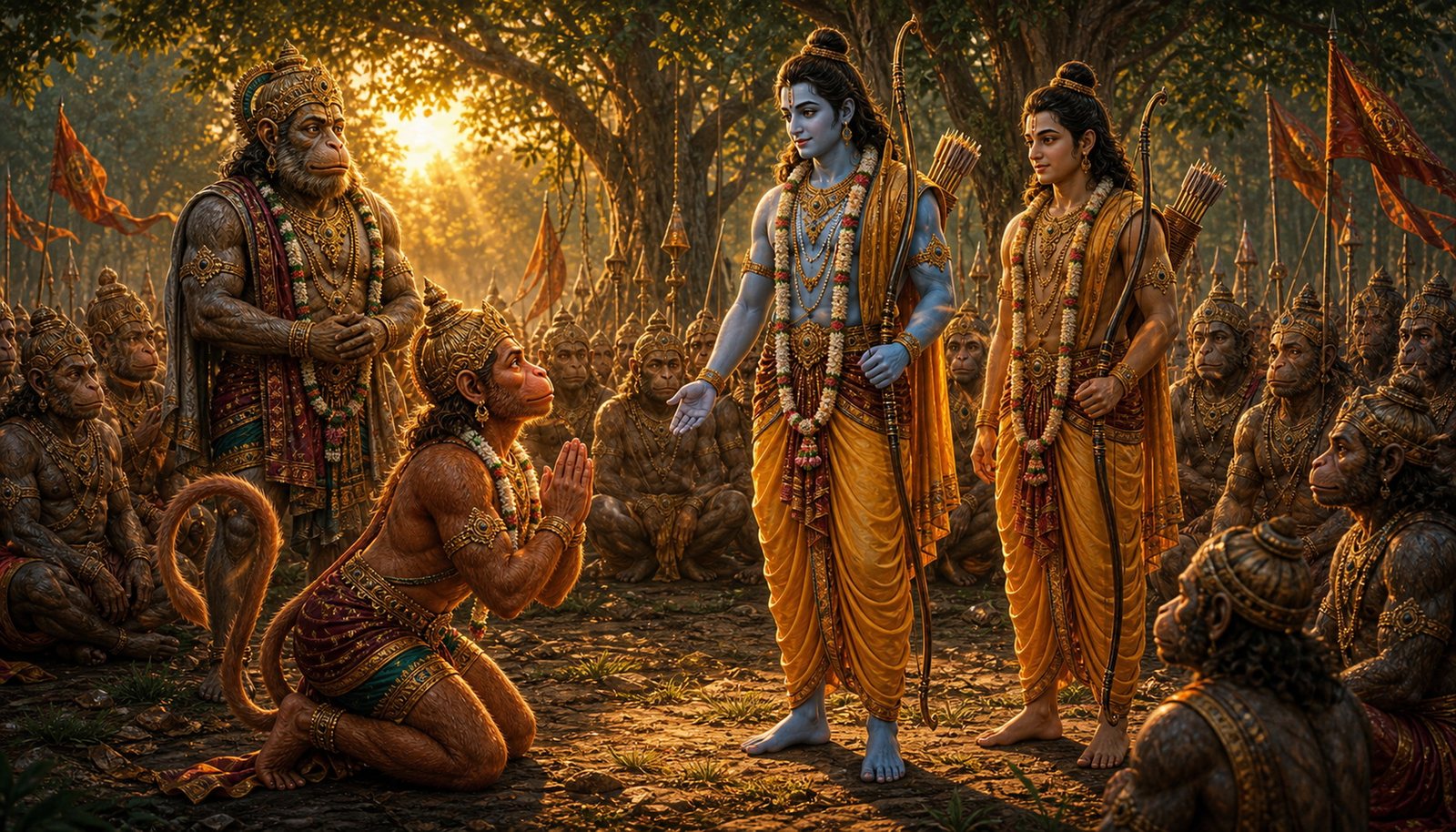
Rama and Lakshmana, searching south, came to the kingdom of the vanaras, the forest people, and there Rama gained the ally who would change everything: Hanuman, the mighty son of the wind, whose whole story we tell in the complete story of Hanuman. Hanuman recognized Rama as his Lord at once, and brought him into friendship with the exiled vanara prince Sugriva. Rama helped Sugriva regain his throne, and Sugriva gave Rama his army: a vast host of vanaras sent to search the whole earth for Sita.
It was Hanuman who found her. Sent south with a band of searchers, he alone could cross the hundred yojanas of ocean that separated the mainland from Lanka. He leapt the sea, searched Ravana’s golden city, and found Sita held captive in a grove, grieving but utterly faithful, refusing Ravana’s every threat and blandishment. Hanuman gave her Rama’s ring as a token, and carried back to Rama the words that turned his grief into a campaign: she lives, she is faithful, and I have seen where she is held.
Now Rama knew where Sita was, and knew the impossible thing that stood between them: the ocean, and beyond it the greatest fortress in the world, held by the greatest of the demon kings. The exile who had given away a kingdom without a fight was about to fight the hardest war in the scriptures, not for a throne, but for his wife.
Why this story matters
Rama, the avatar of Vishnu, does not simply reach out and rescue Sita by divine power. He builds an alliance, earns loyalty, keeps his word to Sugriva, and depends utterly on the devotion of Hanuman and the courage of an army of forest people. The tradition is teaching that even the divine works through relationship, through friendship kept and trust honored, and that the humblest ally, a monkey no one would have counted, can be the one who does what no one else can. Rama’s greatness includes his gift for drawing out the greatness of others.
Chapter 5 · The Bridge and the War
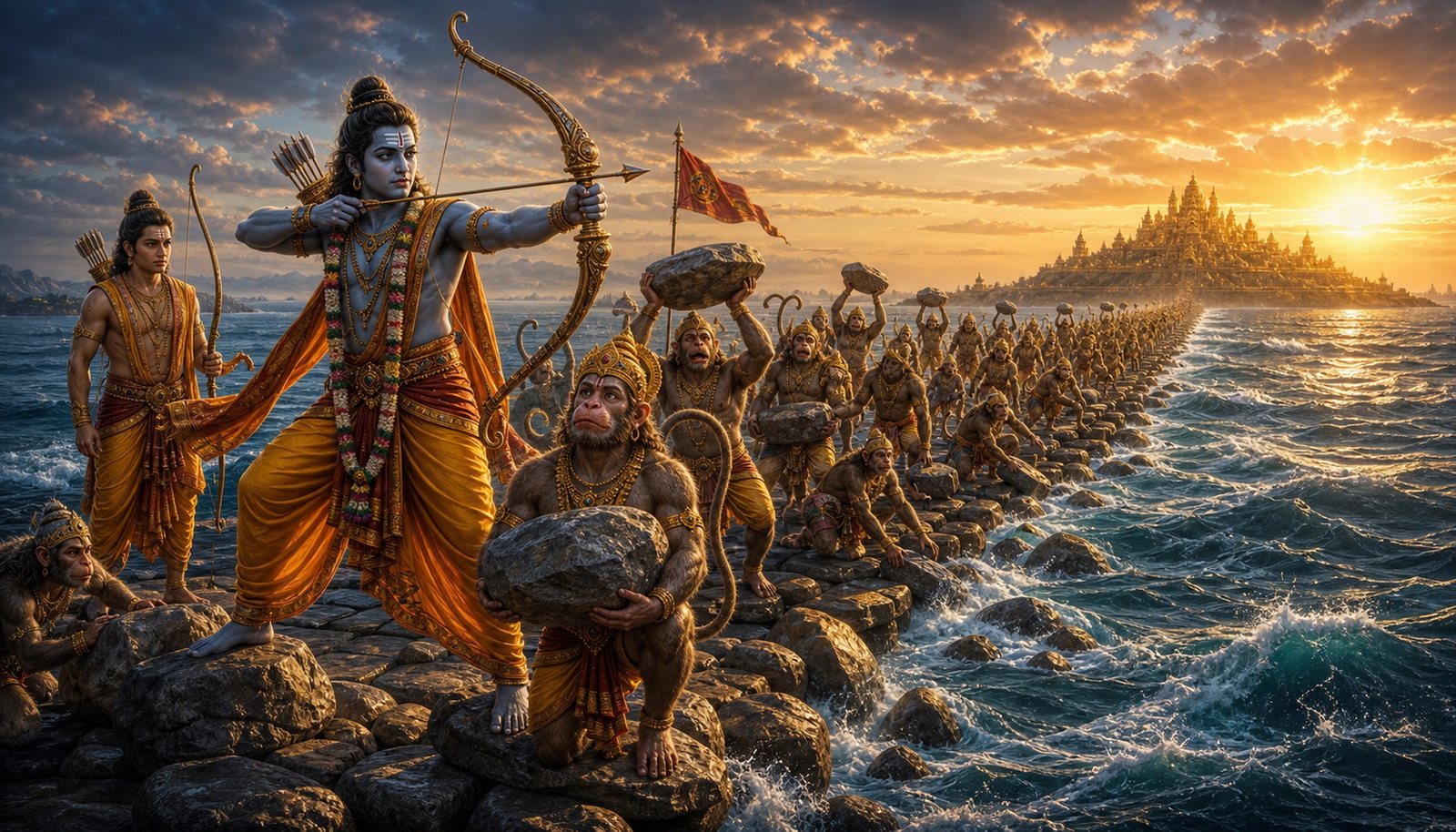
To reach Lanka, Rama’s army had to cross the sea, and so the vanaras built the impossible: a bridge of stones across the ocean, the Rama Setu, stones that floated, the tradition says, when the name of Rama was written upon them. Over that bridge the host crossed to the demon island, and the great war began.
The battle for Lanka is the climax of the Ramayana: the vanara army against Ravana’s legions, Lakshmana falling and being saved by the Sanjeevani herb that Hanuman carried on a mountaintop, the demon-giant Kumbhakarna waking to fight, Ravana’s heroic son Indrajit unleashing celestial weapons. And through it all, Rama, patient and terrible, the perfect archer, cutting toward the one confrontation the whole story had been moving toward.
At last Rama faced Ravana himself. It was no easy victory over a cartoon villain; Ravana was mighty, learned, a devotee of Shiva, in some tellings almost tragic, a great being undone by a single flaw of pride. Rama struck his heads from his shoulders and they grew back; the demon king seemed unkillable, until Rama loosed the divine arrow given him by the gods, blessed by Brahma, and it found the pot of nectar hidden in Ravana’s navel, and the great demon fell. The tyrant who had taken another man’s wife by trickery was ended by the man who had given away a kingdom to keep his father’s word.
And then, in a scene the tradition has debated for centuries, Sita was restored to Rama, but only after passing through fire, the agni pariksha, to prove before the world the purity that had never been in doubt to those who knew her. The fire god himself returned her unharmed and untouched, and testified to her spotlessness. Ravana was defeated; Sita was free; the fourteen years were nearly done.
Why this story matters
The war of the Ramayana is not a celebration of violence but a study of it: even the righteous war is terrible, even the enemy is a great being with virtues, even victory comes at a cost that the story refuses to hide. Rama fights not for conquest or revenge but to recover what was wrongfully taken and to end a tyranny, and he fights within limits, with allies, by the rules. And Ravana is drawn large enough to be a warning to everyone: brilliance, learning, even devotion cannot save a soul ruled by pride and unchecked desire. The demon and the ideal are two answers to the same question of how to use one’s power.
Chapter 6 · The Return, and the Lamps
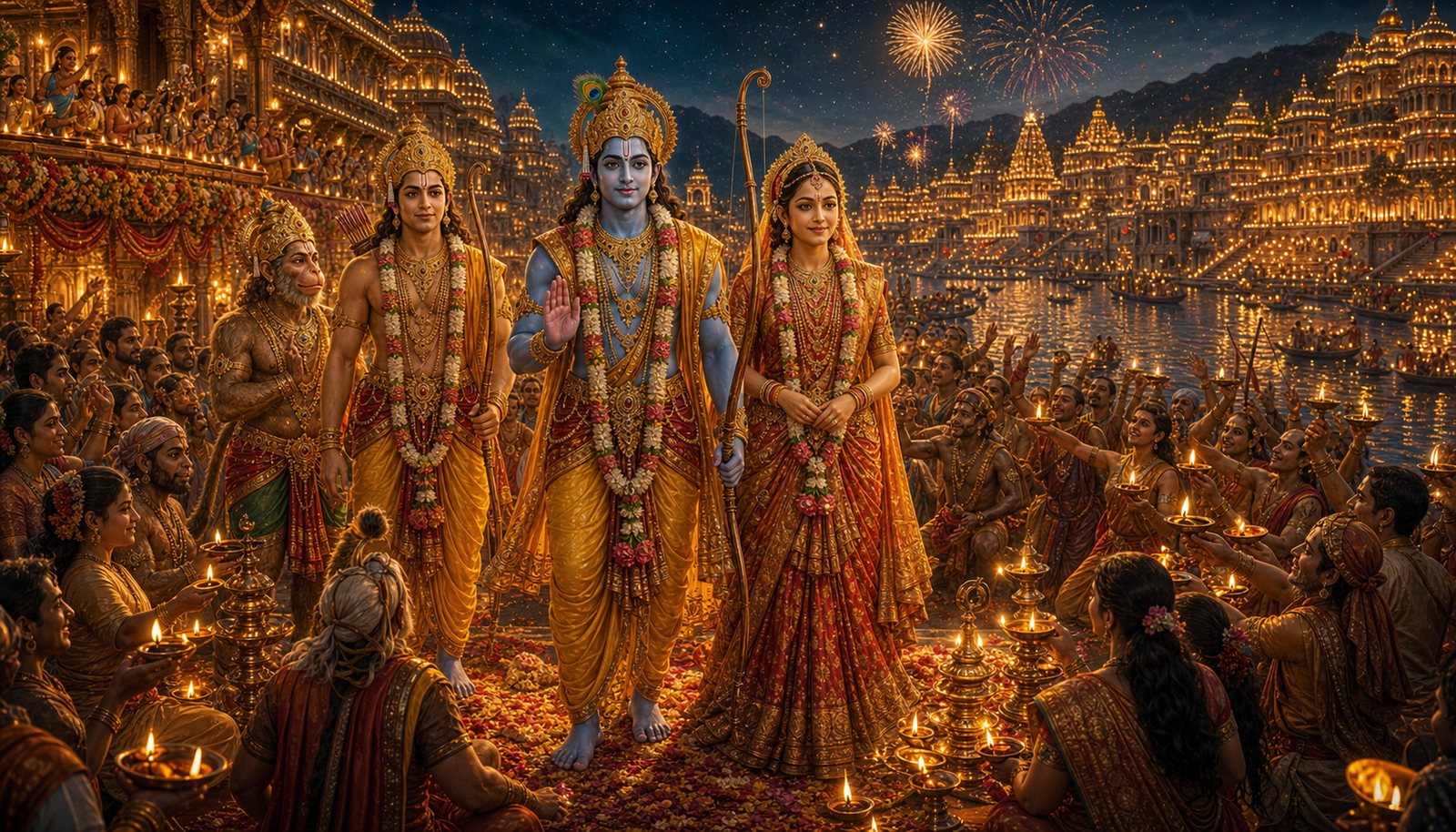
The fourteen years ended, and Rama, Sita and Lakshmana turned home. And Ayodhya, which had wept for fourteen years, lit itself for their return. As word spread that Rama was coming back, the people of the city lined every street and rooftop with rows of small oil lamps, diyas, to guide their beloved prince home through the dark and to celebrate the return of light to the world. That homecoming is Diwali, the festival of lights, kept by a billion people every autumn: the night the good king came home, and darkness was answered with a million flames.
Rama was crowned at last, and his reign became the tradition’s name for a perfect society: Ram Rajya, the rule of Rama, an age of such justice and abundance that, it is said, no one was hungry, no one was afraid, no one wept without cause, and dharma held the whole world steady. For three thousand years, whenever Indians have imagined an ideal government, they have called it Ram Rajya. It remains the measure.
The later story holds one more sorrow, one that the tradition tells with an ache: that Rama, as king, hearing his people’s doubts about Sita’s long captivity, and bound by the terrible logic of a king who must be beyond reproach in the eyes of all, sent his blameless queen away to the forest, where she raised their twin sons, and where at last, her purity affirmed one final time, the earth itself opened to receive her home. Even the perfect man, the story dares to say, is caught in the tragedy of impossible duties; even Maryada Purushottam pays a price for living wholly within the bounds.
And yet what the tradition remembers first, and celebrates with lamps in every window each year, is the homecoming: the good prince who kept every promise, walked home out of the forest, and was met by a city on fire with love.
Why this story matters
Rama’s return is why his story never ends in despair, whatever sorrows come later: the tradition chose to make its brightest festival out of his homecoming. Diwali says that goodness, however long exiled, comes home, and that a community can light a million lamps to meet it. And Ram Rajya keeps a promise alive in the imagination of a civilization, that a society can be just, that the powerful can serve, that the world can be well governed, and gives it a name to aspire to. Even the final sorrow of Sita’s parting serves the ideal’s honesty: it refuses to pretend that living perfectly by duty is painless, and loves Rama not less for his suffering, but more.
रामाय रामभद्राय रामचन्द्राय वेधसे ।
रघुनाथाय नाथाय सीतायाः पतये नमः ॥
rāmāya rāma-bhadrāya rāma-candrāya vedhase
raghu-nāthāya nāthāya sītāyāḥ pataye namaḥ
“To Rama, to the gracious Rama, to Rama the moon-bright, the creator; to the lord of the Raghus, to the protector, to the husband of Sita: I bow.”
Traditional Rama namaskara shloka
Small Glossary
- Maryada Purushottam
- The perfect man who lives within the bounds of dharma: Rama’s defining title.
- Ayodhya
- Rama’s capital and birthplace; its name means “the unconquerable.”
- Ram Rajya
- The reign of Rama: the tradition’s ideal of perfect, just government.
- Ram Navami
- The festival of Rama’s birth (March/April).
- Diwali
- The festival of lights, celebrating Rama’s return to Ayodhya after fourteen years.
- Sita
- Rama’s wife, an avatar of Lakshmi; the ideal of devotion, courage and faithfulness.
- Lakshmana
- Rama’s devoted brother, who shared his entire exile.
- Ravana
- The ten-headed demon king of Lanka who abducted Sita; brilliant, learned, undone by pride.
- Rama Setu
- The bridge of floating stones the vanaras built across the sea to Lanka.
- Ramayana
- The great epic of Rama, composed by the sage Valmiki.
- Ram Naam
- The name of Rama, chanted as the simplest and dearest prayer across India.
- Vanaras
- The forest people, led by Hanuman and Sugriva, who fought for Rama.
Retold in original words from the Valmiki Ramayana and the Ramcharitmanas of Tulsidas.
Test yourself
Think you know Rama? Ten questions, no sign in.
Carry this darshan with you.
The Bhakti Angan app brings a new darshan each morning, simple mantras, a japa counter and the daily Panchang. Using Android? Join the waitlist.