The Complete Story · For First-Time Readers
DurgaFrom the demon no god could kill to the daughter who comes home each autumn: the whole story of the Mother, told gently.
Who is Durga?
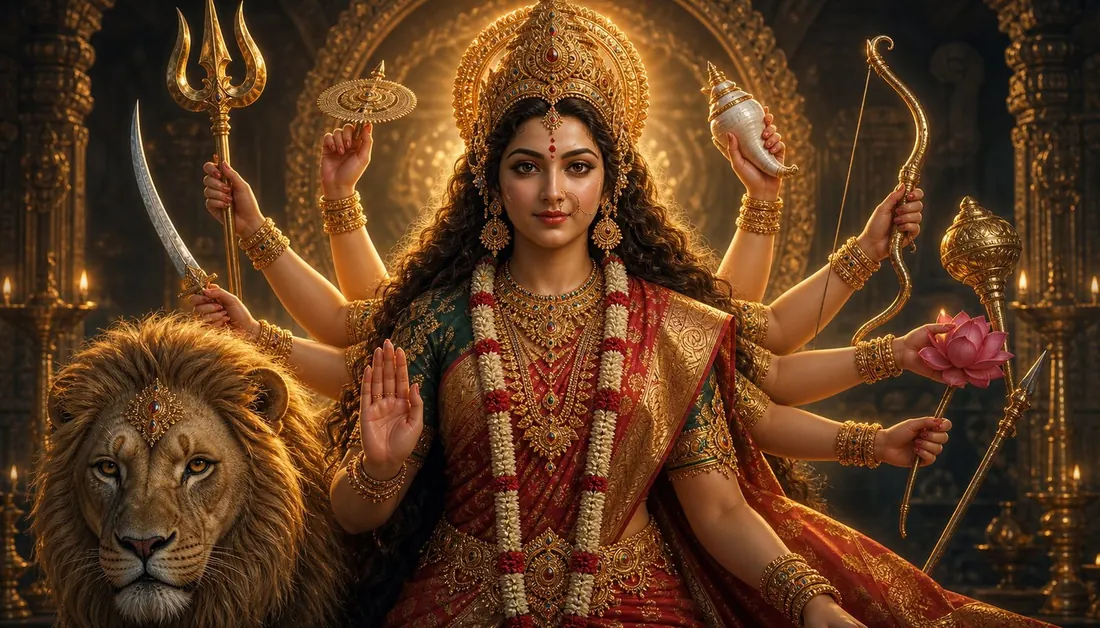
She rides a lion into battle, and her face is as calm as a lamp in a windless room. She carries a weapon in each of her ten hands, and half the hands are raised in blessing. She is Durga: the Goddess as protector, the fortress no evil can enter (that is what her name means), the one India calls, before any of her grand titles, simply Ma. Mother.
To understand Durga, a newcomer needs one idea that makes Hinduism unlike most traditions: here, the ultimate power of the universe is also worshipped as a woman. The tradition calls that power Shakti: the energy behind creation itself. Wisdom has a goddess, Saraswati. Abundance has a goddess, Lakshmi. And when existence itself is threatened, when a danger arises that no god can defeat, power itself takes form and picks up weapons: that form is Durga.
She is not a warrior who happens to be worshipped. She is worship’s answer to a specific and very honest question: what happens when the ordinary order of things fails? When the strong have been defeated, the rulers have surrendered, the fathers cannot protect? Then, says this tradition, the Mother comes. Fierce toward what threatens her children, tender past all telling toward the children themselves.
Her great story is told in the Devi Mahatmya, the “Glory of the Goddess,” seven hundred verses that Hindus have chanted for fifteen centuries, especially in the autumn, during her nine nights. It begins, as her stories always begin, with the gods losing.
Chapter 1 · The Demon No Man Could Kill
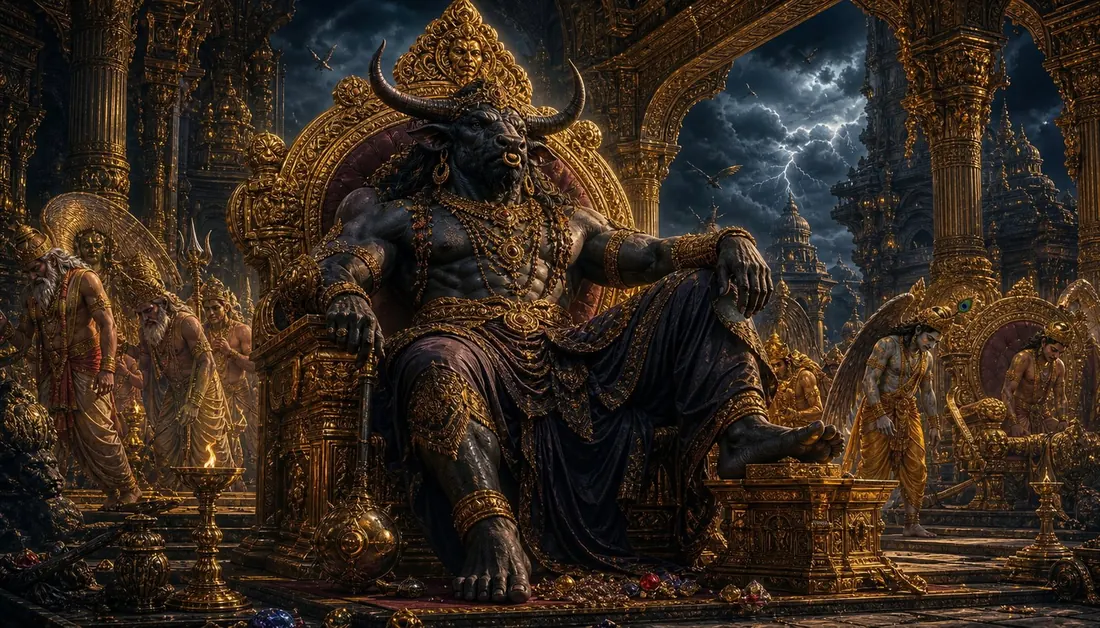
His name was Mahishasura, the buffalo demon: a being of immense strength and one brilliant, poisonous idea. Through years of terrible penance he won a boon from Brahma, and he crafted it with a lawyer’s cunning: he could not be killed by any god, demon or man. Reading the fine print of eternity, he had noticed what he thought was nothing at all: he had not bothered to mention women.
The tradition savors this detail: it is the whole story in one sentence. Mahishasura did not think to armor himself against the feminine, because he could not imagine it dangerous.
What followed was what always follows unbeatable power joined to unlimited appetite. He rose from the underworld, shattered the armies of the gods, drove Indra from his throne, and seated himself in the heavens as their master. The gods, homeless, wandered the worlds. Every refuge refused them, every strategy failed, because the boon stood: nothing male, mortal or divine, could touch him.
They went at last, as the defeated always do in these stories, to the great ones: to Brahma, to Vishnu, to Shiva. And as the gods recounted their humiliation, something began to happen that had never happened before. Anger rose in Vishnu’s face, and from that anger came light. Light rose from Shiva, from Brahma, from Indra, from every god present: each poured out the fire of his own essential power, and the fires flowed together into one blaze too bright for the assembly to look upon.
Why this story matters
The boon is the tradition’s sharpest satire: evil’s great oversight is its contempt. What Mahishasura dismissed as harmless became the only door his death could walk through. The story invites every listener to check the same blind spot: whatever you believe is beneath your notice, too gentle, too quiet, too “merely” nurturing to matter, is precisely where you are unguarded. Power that respects only its own kind of power has already written its own ending.
Chapter 2 · Born of All Their Light
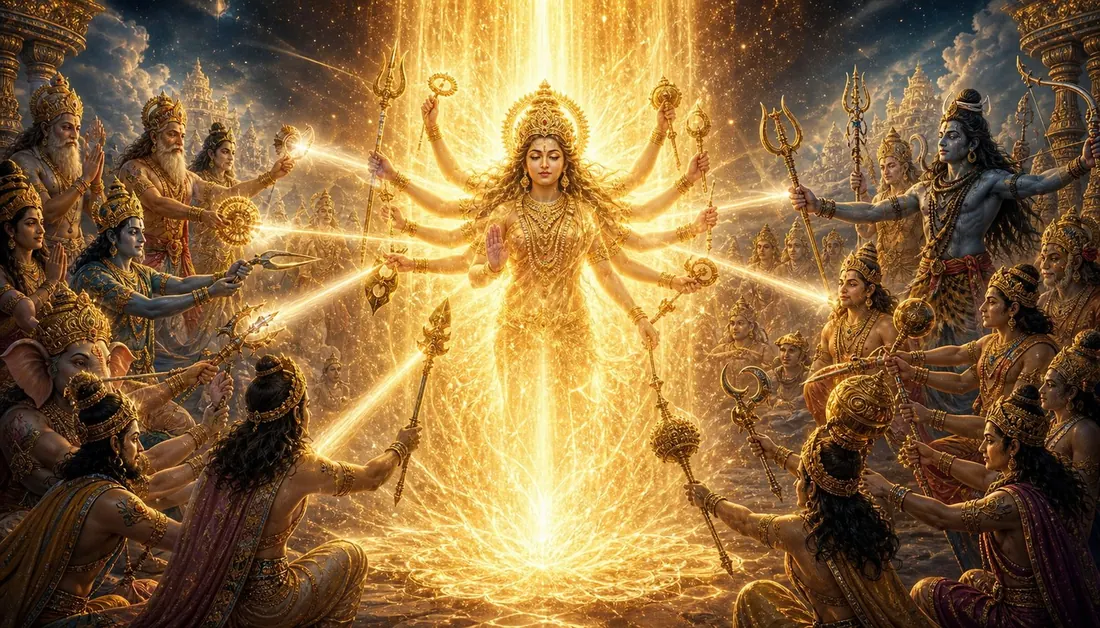
Out of that mountain of light, a form emerged. Her face was shaped from the light of Shiva, her ten arms from Vishnu, her feet from Brahma, her waist from Indra, her hair from Yama, her breasts from the moon-god, and so on through the whole pantheon: every god’s essence became a limb of her body. Note carefully what the scripture is saying: the gods did not create Durga, the way a sculptor makes a statue. They released her: the power that had always been within all of them, now standing free, in her own right, in her own form.
Then, one by one, the gods gave her their weapons. Shiva his trident, Vishnu his discus, Varuna his conch, Agni his spear, Vayu his bow, Indra his thunderbolt; the mountain god Himavan gave her a lion to ride, and the divine craftsman gave her ornaments for every limb. She accepted them all, and the tradition is clear that she needed none of them.
When she was complete, she laughed. The scripture says her laugh filled the sky, shook the seas, and made the mountains stagger; the demons in the conquered heavens heard it and reached for their weapons in the dark. It was not the laugh of anger. It was the laugh of something vast finally uncoiled, the Mother announcing herself to a universe that had forgotten she existed.
The gods bowed and spoke a single prayer, the one still spoken today: Ya Devi. O Goddess, conquer. Protect. Be victorious.
Why this story matters
This is one of the most quietly radical scenes in world scripture. At the moment of ultimate crisis, all the male power of the universe pools together, and what stands up out of it is the Goddess. Each god surrenders his signature weapon: the very things that define them are handed over, because power hoarded had failed and power surrendered became salvation. And her laugh teaches its own lesson: the divine feminine does not enter the battle grim and burdened. She arrives in joy, because the outcome was never in doubt.
Chapter 3 · The Nine Nights
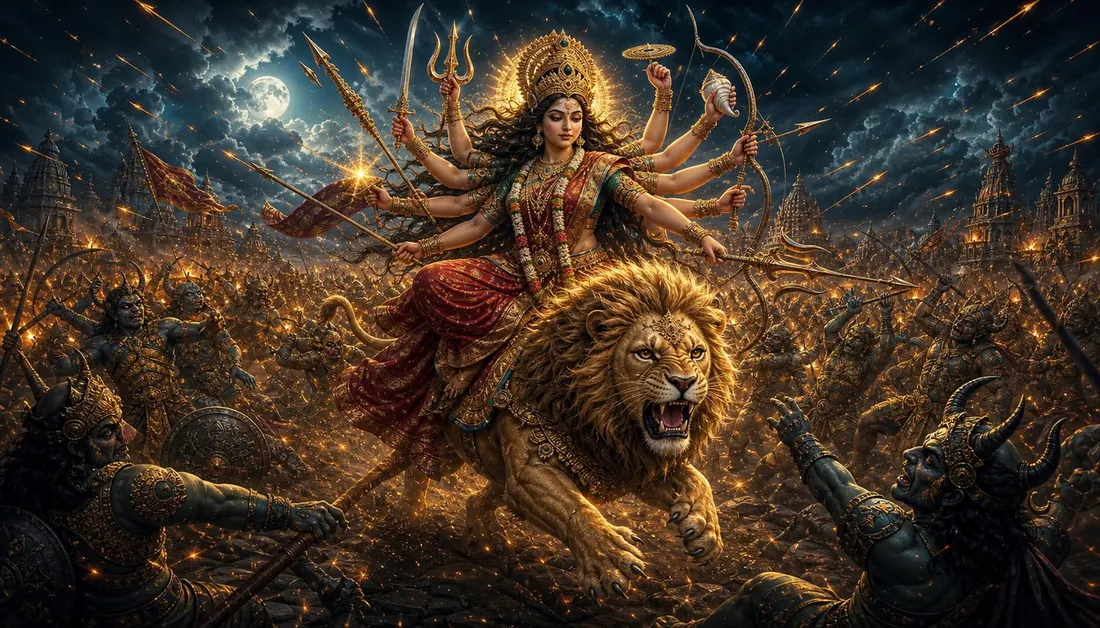
The war that followed lasted, tradition says, nine nights, and India has never stopped keeping them. They are Navratri, the nine-night festival celebrated across the country every autumn with fasting, dance and worship, one of the largest religious festivals on earth. On each of those nights, the battle turned.
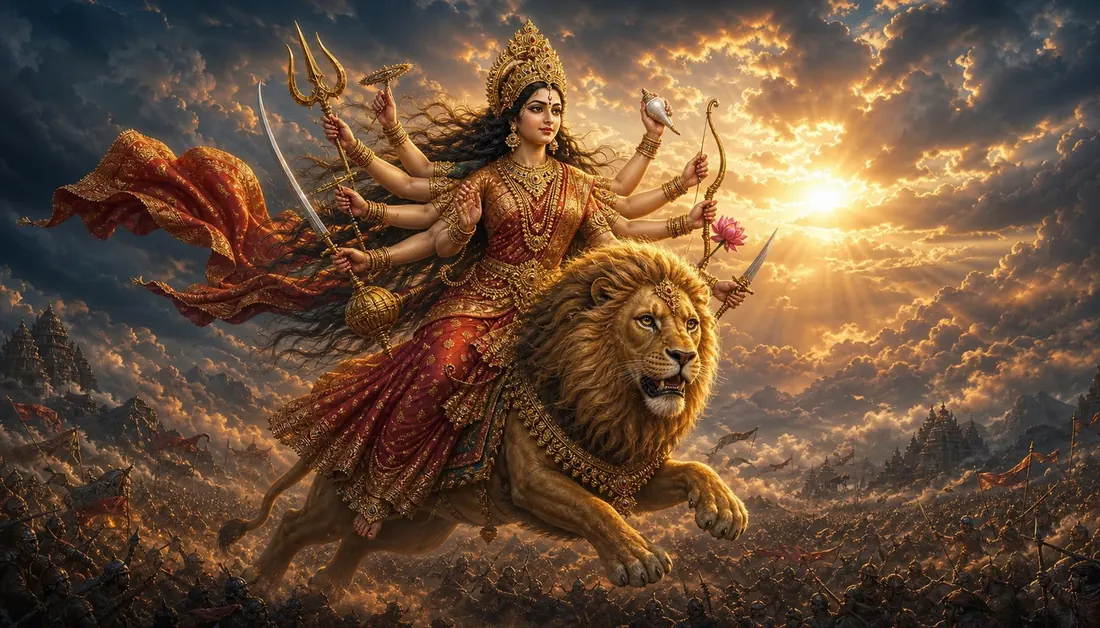
Mahishasura did not come himself at first. He sent his generals: armies described in numbers meant to numb the mind, sixty thousand chariots, hordes darkening the horizon. The Goddess met them from the back of her lion, and the scripture describes her fighting the way one describes weather: arrows in unbroken streams, the lion loose among the ranks like fire in dry grass, her weapons striking down commanders whose names had terrified the heavens for centuries.
And here the text adds its strangest, most wonderful detail: throughout the carnage, her face never lost its calm. She fought, the seers say, like one at play; her breath knocked whole battalions from their feet. The demons could not comprehend what they were fighting: rage they understood, but this serene, smiling, unstoppable force was outside everything their power had prepared them for.
One by one the great generals fell: Chikshura, Chamara, the vast Raktabija (whose story belongs to the next chapter), until at last the buffalo demon understood that no one was coming back from the field, and rose from his stolen throne himself.
Why this story matters
Navratri turns this chapter into lived experience: nine nights, in many traditions honoring nine forms of the Goddess, in which devotees fast, dance the garba in her honor, and remember that the war against what is wrong takes time. Not one night: nine. The battle’s deepest teaching is her calm. Fury is not the source of her strength; it is what her strength makes unnecessary. The tradition asks its children to fight what must be fought the way she does: completely, and without letting the fight poison the fighter.
Chapter 4 · Kali of the Battlefield
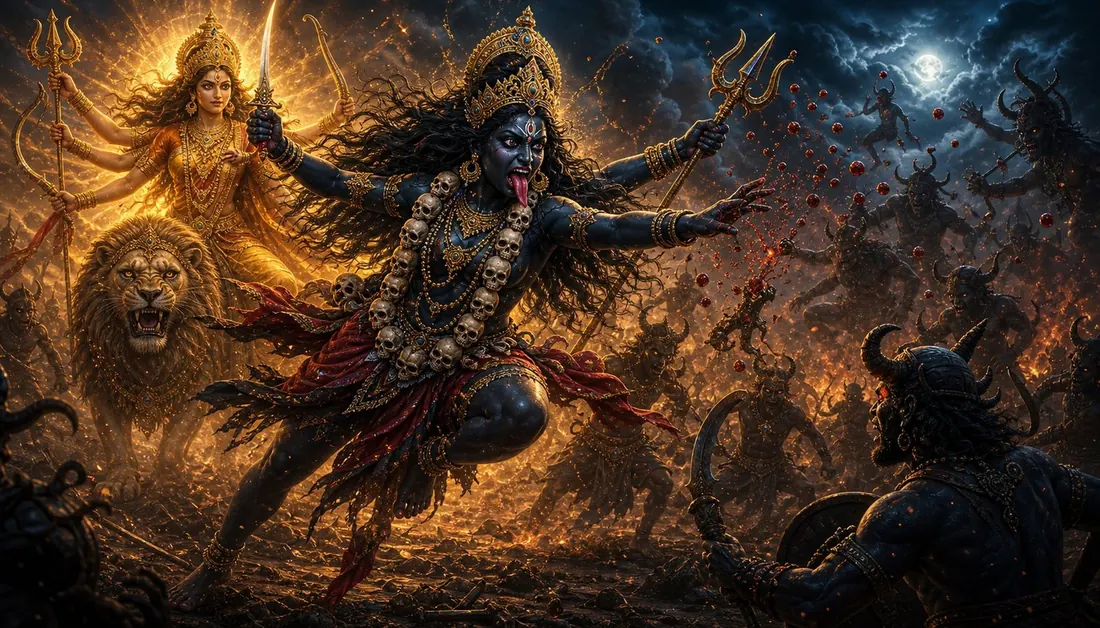
Among Mahishasura’s allies was a demon who could not lose. His name was Raktabija, “blood-seed,” and his boon was nightmare arithmetic: every drop of his blood that touched the earth became another Raktabija, whole, armed, and full-grown. Wound him and you multiplied him. The gods’ weapons made the battlefield worse with every strike: a hundred demons, a thousand, wherever his blood rained down.
Then the brow of the Goddess darkened, and from her furrowed forehead sprang a form the world has never stopped painting: Kali, night-black, gaunt and vast, eyes red, tongue lolling, garlanded in skulls, the Goddess’s own fury given separate body. What happened next is one of the tradition’s most unforgettable images: as Durga’s weapons cut Raktabija down, Kali spread her tongue across the battlefield and drank every drop of his blood before it could touch the ground. The demon’s infinite multiplication ended in a single terrible subtraction. He fell, finally, empty.
But fury, once released, does not file itself neatly away. Kali began to dance the battlefield’s victory, and her dance shook the cosmos until the worlds themselves began to crack. No god could approach her. It was Shiva, her eternal counterpart, who did what only love can do: he lay down silently among the fallen, directly in the path of the dance. When Kali’s foot came down on her Lord’s chest, she stopped. The scripture gives her a moment the whole tradition holds tenderly: her tongue out between her teeth, the universal gesture of Indian abashment, wildness recognizing love and coming to rest.
Kali is worshipped to this day, in Bengal above all, not as a monster but as the fiercest form of the Mother: the one you call when the enemy multiplies with every blow.
Why this story matters
Raktabija is the most psychologically precise demon in the scriptures. Everyone has fought him: the anger that grows each time you strike at it, the craving fed by every indulgence, the argument that spawns ten new arguments. Ordinary weapons multiply him. The teaching of Kali is that some evils cannot be fought piecemeal; they must be consumed at the source, denied the very ground they breed on. And her stilling under Shiva’s stillness completes the lesson: ferocity is holy when it serves love, and love is the only thing with the authority to end it.
Chapter 5 · The Buffalo Falls
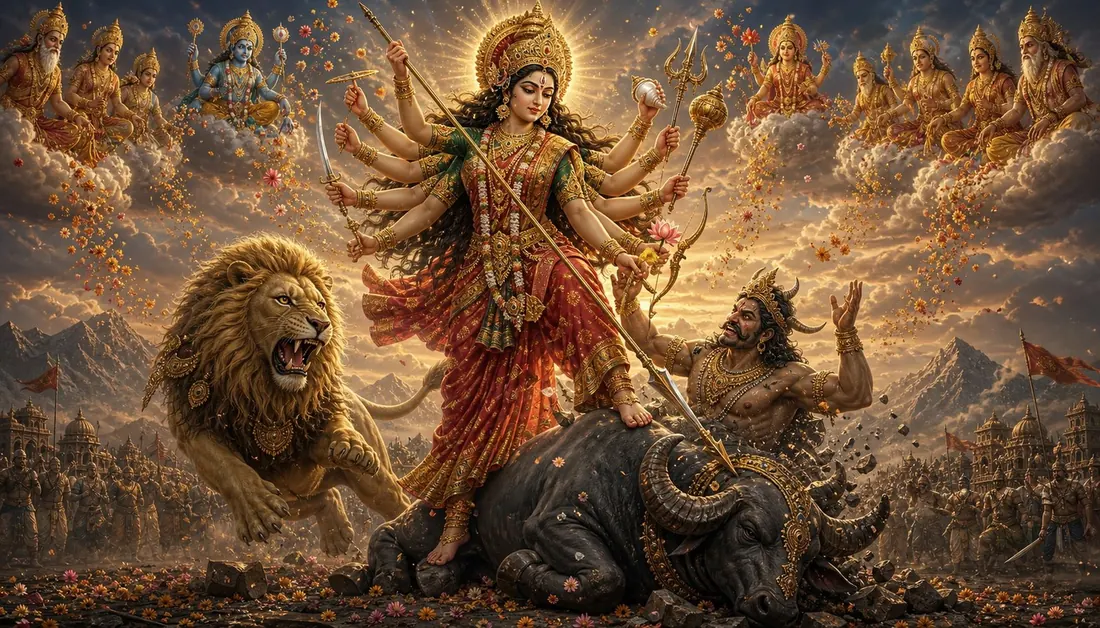
Mahishasura came to the field at last in his own form: the great buffalo, mountain-huge, hooves cracking the earth. And now the Goddess faced the boon itself, the shape-shifter’s power that had beaten every army in existence. He charged as a buffalo; when she bound him, he became a lion; struck, he became a man with a sword; cornered, an elephant; seized, the buffalo again, each transformation slipping death by a heartbeat.
The Devi Mahatmya says the Goddess, in the middle of this whirlwind, paused… and drank from a cup of wine, and her eyes reddened, and she laughed at him. Roar while you can, she told him, in the scripture’s own words. Roar until I finish this drink. The gods will roar after.
Then she leapt. Her foot came down on the buffalo’s neck, pinning the vast body to the earth, and her spear struck. Half-transformed, the demon’s true form emerging from the buffalo’s broken shape, Mahishasura died between his own disguises, by the hand of the one being his boon had never barred.
The heavens erupted. The gods returned to their thrones, the sages sang the hymns that devotees still chant, and the day of that victory became a festival that a billion people keep to this hour: Vijayadashami, the “tenth day of victory,” Dussehra, when effigies of evil burn across India and the Goddess’s triumph is proclaimed for another year. Her most beloved image holds this exact moment: Mahishasura-mardini, the slayer of the buffalo demon, serene amid the storm, the lion at her side.
Why this story matters
The shape-shifting is the honest part of the story: evil rarely stands still long enough to be struck. It becomes something else the moment you name it; the excuse changes, the target moves. Her patience with the transformations, and the almost leisurely confidence of the wine-cup, teach that the Goddess is never in a race. And Vijayadashami plants the flag the tradition lives by: good does not merely survive evil, it wins, decisively, on a day you can mark on a calendar and celebrate with your children.
Chapter 6 · The Nine Forms
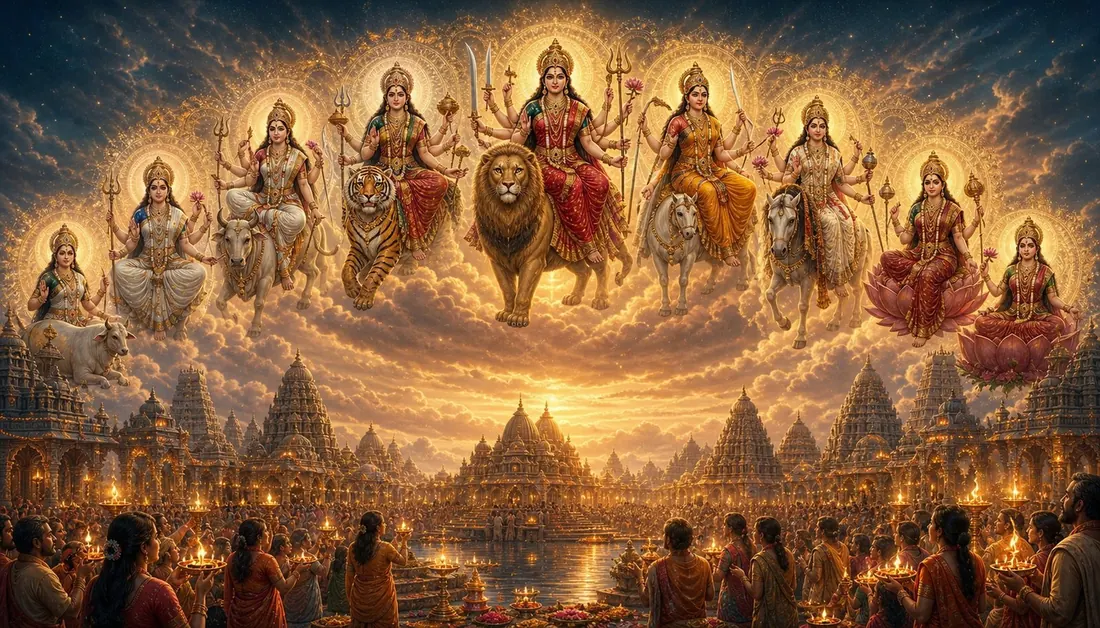
The tradition worships Durga not as one frozen image but as nine unfolding ones: the Navadurga, one honored on each night of Navratri, together telling the Goddess’s own life as a journey.
She is Shailaputri, the mountain’s daughter, on the first night, and Brahmacharini, the austere seeker, on the second. She is Chandraghanta, bearing the moon-bell of courage; Kushmanda, whose smile is said to have kindled the cosmos; Skandamata, mother of the war-god Kartikeya, holding her son as her weapon-arms hold the world at bay. She is Katyayani, the warrior born of a sage’s longing; Kalaratri, the dark night that destroys all fear; Mahagauri, radiant purity after the battle’s dust; and at last Siddhidatri, the granter of fulfillment, every power at rest in an open hand.
Read in order, the nine names trace an arc every seeker recognizes: birth into the world, discipline, courage, creative joy, motherhood, battle, the dark night, purification, and completion. The Goddess does not skip stages, and does not let her devotees skip them either.
Each form has her own story, worship and mantra; we tell them one by one in our Avatars library, alongside her other great faces: Kali, the ten Mahavidyas, and the gentle and terrible forms between.
Why this story matters
The Navadurga answer a question newcomers rarely think to ask: why does one Goddess need nine forms? Because a mother is not one thing. The same power that nurses an infant defends it; the same love that teaches discipline grants freedom at the end. The nine nights let the devotee meet each face in turn and discover that the fierce ones and the tender ones are not different goddesses, but one Mother, meeting nine different needs.
Chapter 7 · The Daughter Comes Home
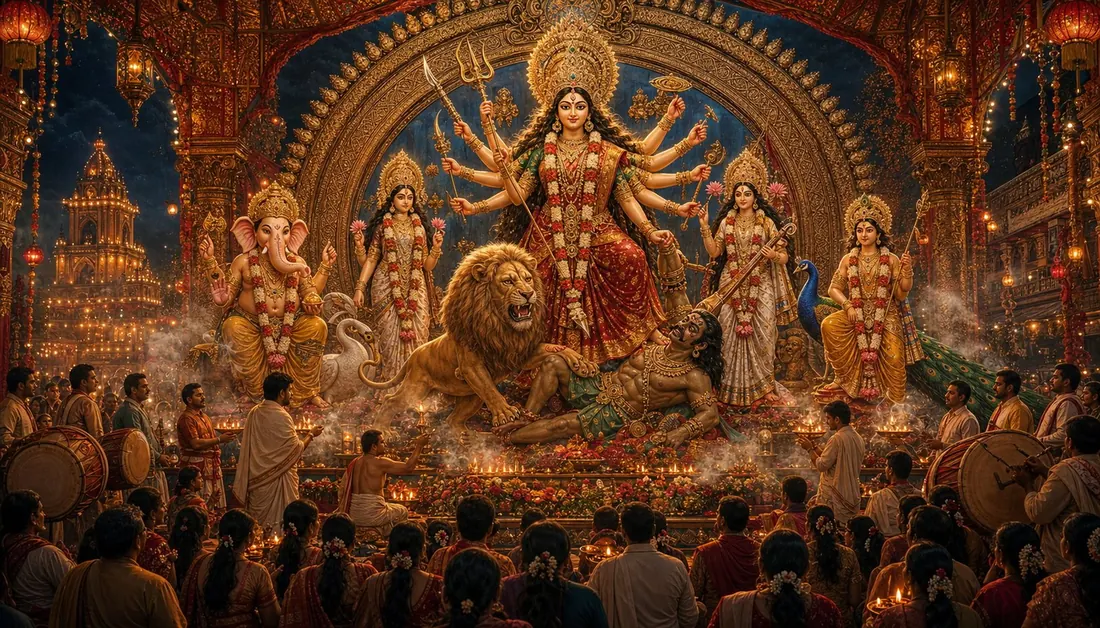
There is one more way the tradition holds Durga, and for millions it is the dearest of all. In Bengal, and wherever Bengalis have carried her, the goddess of the nine nights is awaited each autumn not as a queen visiting her subjects, but as a daughter coming home to her parents’ house. For the days of Durga Puja, the greatest festival of eastern India, Durga is Uma, the girl who married the ascetic of Kailash and lives far away, returned at last for her yearly visit with her children at her side.
Whole cities transform. Neighborhoods spend months building pandals, temporary palaces of bamboo and cloth and astonishing artistry, each housing her image: the Mother, ten-armed and golden-faced, Mahishasura falling beneath her, and around her the divine children, Lakshmi, Saraswati, Ganesha, Kartikeya. For five days there is drumming and incense, new clothes and feasting, art and homecoming; the streets flow all night with people walking from goddess to goddess.
And then comes the day the tradition performs its bravest act. On Vijayadashami, the image that was welcomed like a daughter is carried in procession to the river and, with drums and tears and cries of next year, come again, Ma, given to the water: visarjan, the immersion. The clay returns to the riverbed it came from. The Mother returns to Kailash. The house of the world stands swept and quiet, and already waiting for next autumn.
No image better completes her story. The same Goddess whose spear ended Mahishasura is embraced as family, wept over at parting, and trusted to return. Har season, her people say goodbye to God the way one says goodbye to a beloved child, in absolute confidence of reunion.
Why this story matters
Durga Puja teaches what doctrine alone cannot: that the divine can be loved with complete intimacy and released with complete trust. The immersion looks like loss and is actually the festival’s deepest teaching, the one the Gita states and Bengal enacts: forms come and go, love does not. A tradition that can build God a palace, adore her for five days, and then give her back to the river with singing has learned something about impermanence that no philosophy lecture can teach.
या देवी सर्वभूतेषु शक्तिरूपेण संस्थिता ।
नमस्तस्यै नमस्तस्यै नमस्तस्यै नमो नमः ॥
yā devī sarva-bhūteṣu śakti-rūpeṇa saṃsthitā
namas tasyai namas tasyai namas tasyai namo namaḥ
“To the Goddess who abides in all beings in the form of power: salutations to her, salutations to her, salutations to her, again and again.”
Devi Mahatmya 5
Small Glossary
- Shakti
- The primal energy of the universe, worshipped as the Goddess; the power within all the gods.
- Devi
- The Goddess; the supreme divine in feminine form.
- Ma / Mata
- Mother: the most common and most intimate way Durga is addressed.
- Mahishasura
- The shape-shifting buffalo demon whose boon excluded only women.
- Devi Mahatmya
- The 700-verse scripture of the Goddess’s glory, also called Durga Saptashati or Chandi.
- Navratri
- The nine-night autumn festival of the Goddess, celebrated across India.
- Navadurga
- The nine forms of Durga honored on the nine nights, from Shailaputri to Siddhidatri.
- Vijayadashami / Dussehra
- The “tenth day of victory” after Navratri, celebrating good’s triumph.
- Kali
- The Goddess’s fiercest form, born of Durga’s brow to defeat Raktabija.
- Mahishasura-mardini
- “Slayer of the buffalo demon”: Durga’s most iconic image.
- Durga Puja
- Eastern India’s great five-day festival welcoming the Goddess home as a daughter.
- Visarjan
- The immersion of the goddess’s image in the river at the festival’s end.
Retold in original words from the Devi Mahatmya (Markandeya Purana), the Devi Bhagavata Purana and living festival tradition.
Test yourself
Think you know Durga? Ten questions, no sign in.
Carry this darshan with you.
The Bhakti Angan app brings a new darshan each morning, simple mantras, a japa counter and the daily Panchang. Using Android? Join the waitlist.