
The Complete Story · For First-Time Readers
VishnuHe rests on the endless serpent upon the ocean of milk, and whenever the world loses its way, he is born among us to set it right. The whole story of Vishnu and his ten avatars, told gently.
Who is Vishnu?
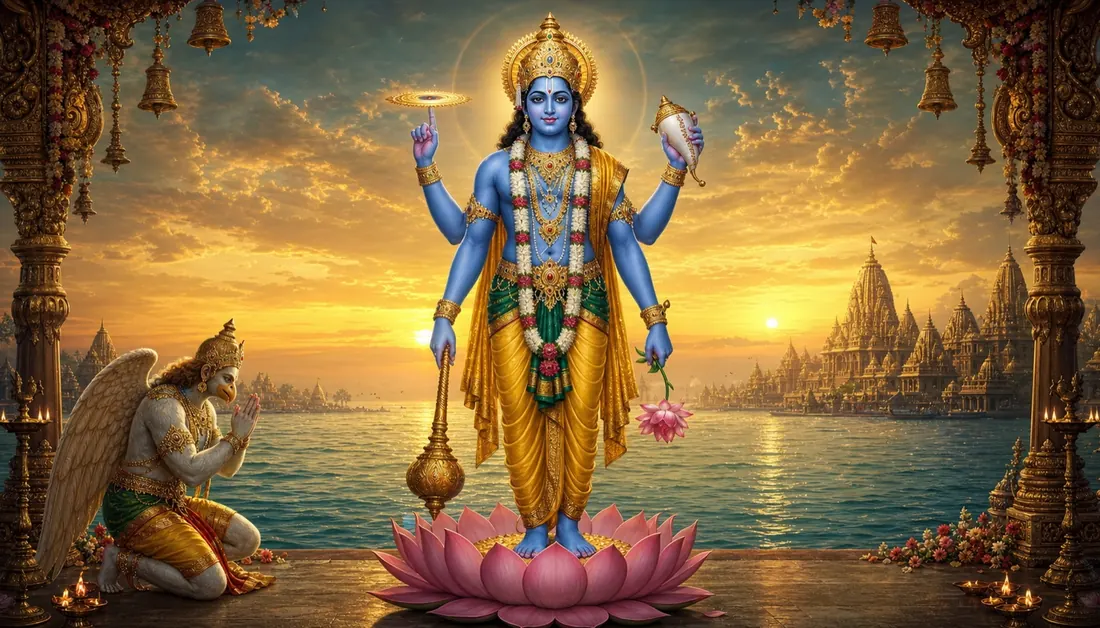
Hindus speak of three great movements in the life of the universe: creation, preservation, and dissolution. Brahma brings the worlds into being, Shiva draws them back into the stillness, and between the two stands Vishnu, the preserver, whose work is to keep creation in balance and turning. Of the three, he is the one closest to daily life, because preservation is a slow, patient, everyday kind of love.
You will know him by four things held in four hands: the conch (shankha), whose sound is the first vibration of creation; the discus (Sudarshana chakra), ever spinning, that cuts through what is false; the mace (gada), the weight of strength held in reserve; and the lotus (padma), beauty that rises unstained from the mud. He is blue like the boundless sky and sea, wears a garland of forest flowers, rests on the thousand-headed serpent Ananta, rides the eagle Garuda, and his home is Vaikuntha. Beside him always is Lakshmi.
In the Bhagavad Gita he makes a promise that is the key to his whole story: whenever dharma declines and adharma rises, he takes birth, age after age, to protect the good and restore the balance. Each of those descents is an avatar, and the avatars are how a formless, cosmic Lord becomes someone you can love by name.
Chapter 1 · The Cosmic Sleep
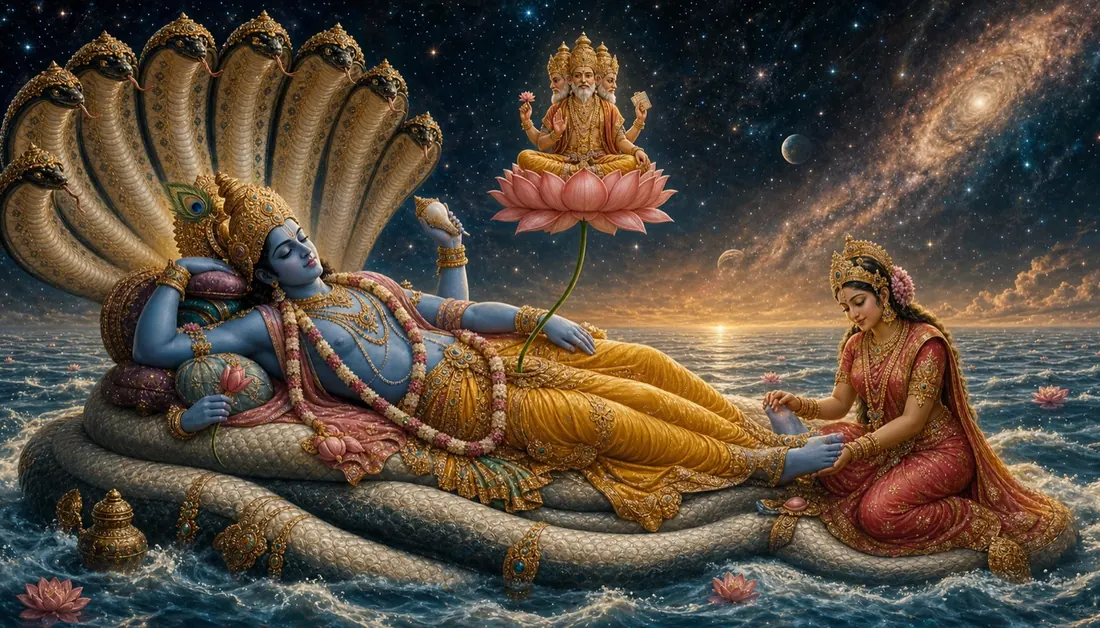
Between the ages, when one creation has ended and the next has not yet begun, Vishnu reclines upon Ananta, the serpent whose name means “endless,” floating on the Kshira Sagara, the ocean of milk. This is not ordinary sleep but yoga-nidra, a wakeful stillness that holds everything in potential.
From his navel a lotus opens, and seated upon it is Brahma, who looks around at the quiet waters and begins to sing the worlds into being once more. Lakshmi presses his feet. Picture it: the whole of creation unfolding from a single point of rest. That is the heart of Vishnu. He does not rush. He abides, and because he abides, everything else can move.
Chapter 2 · The Churning of the Ocean
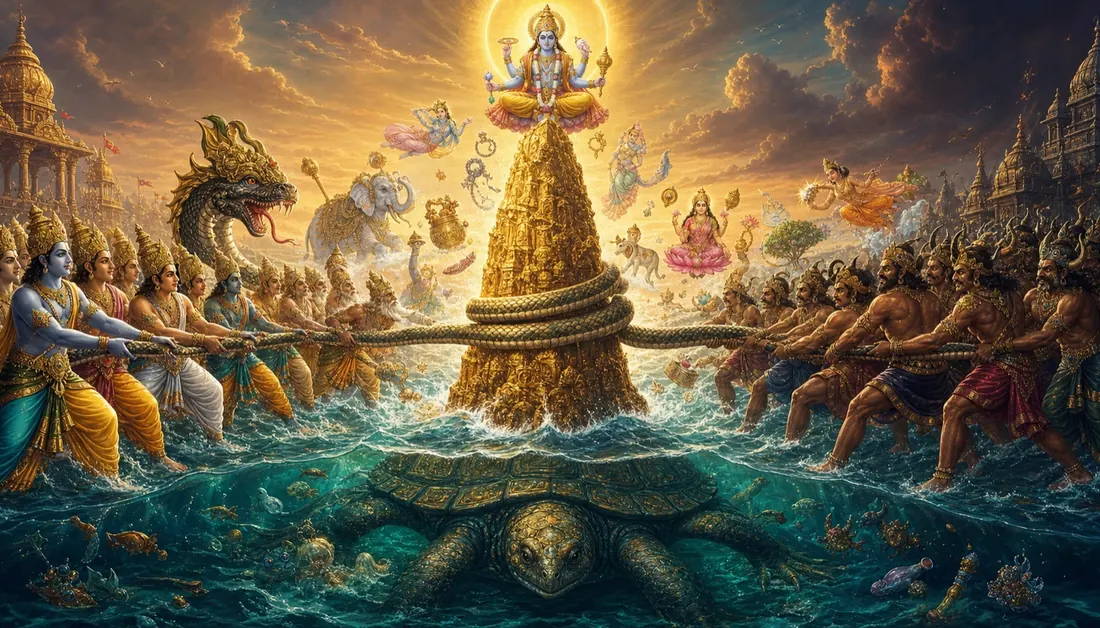
Long ago the gods had grown weak, and the only cure was amrita, the nectar of immortality, hidden in the ocean of milk. Gods and demons made an uneasy truce to churn the ocean for it. They used Mount Mandara as the churning-rod and the great serpent Vasuki as the rope, and they pulled, one side against the other.
The mountain began to sink into the soft seabed. Vishnu slipped beneath the waters as Kurma, the tortoise, and took the whole mountain on his back so the churning could go on. Up from the depths rose wonder after wonder, and at last Dhanvantari with the pot of amrita, and Lakshmi herself, radiant, who looked upon all the gods and demons and chose Vishnu. When the demons snatched the nectar, Vishnu became Mohini, an enchantress so lovely that they handed it back to be shared, and she gave it quietly to the gods. (The one poison the churning also raised was drunk by Shiva, whose throat turned blue.)
Chapter 3 · Varaha, Who Lifted the Earth
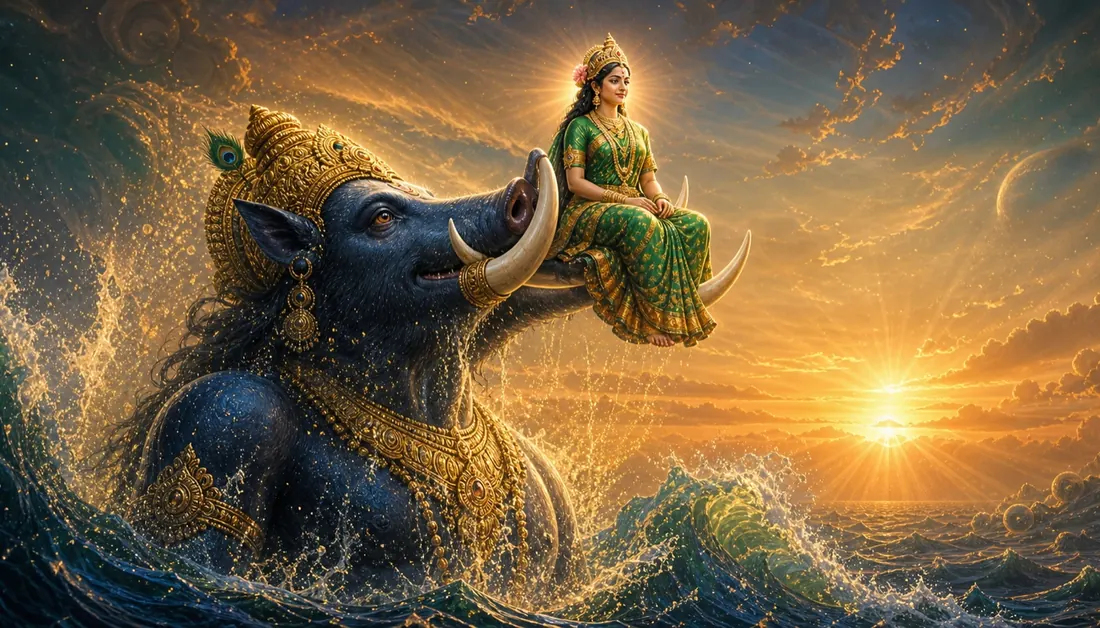
A demon named Hiranyaksha, drunk on his own power, seized the earth herself, Bhudevi, and dragged her down to the bottom of the cosmic ocean, where she lay lost in the dark. The preserver could not leave the ground beneath our feet to drown.
Vishnu took the form of Varaha, a mighty boar, and plunged into the deep. He found the earth, set her upon his curved tusks, and rose with her through the waters, slaying the demon on the way, until he lifted her gently back into her place among the stars. When the world itself is sinking, this is the God who dives after it.
Chapter 4 · Narasimha, Neither Man nor Beast
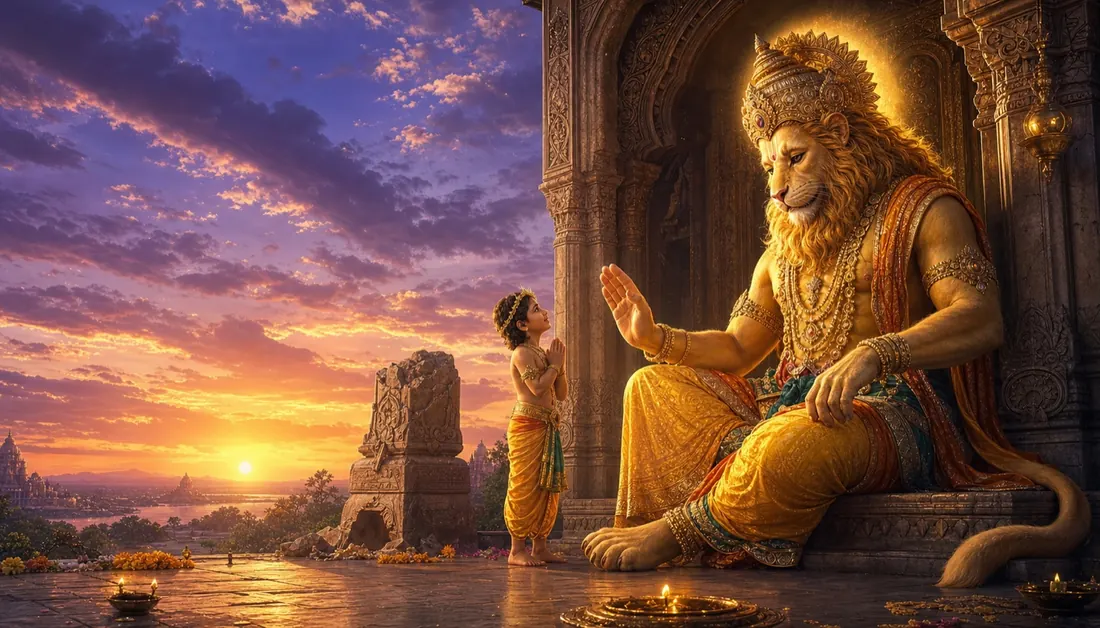
Hiranyakashipu, brother of the boar-slain demon, won a boon he thought made him deathless: he could not be killed by man or beast, by day or by night, indoors or outdoors, on the earth or in the sky, by any weapon. He declared himself God and forbade the worship of Vishnu. Yet his own small son, Prahlada, would not stop loving the Lord.
Enraged, the demon struck a stone pillar and roared, “If your Vishnu is everywhere, is he in this?” The pillar split, and out came Narasimha, half-man and half-lion, who was neither man nor beast. He caught the demon at dusk, which is neither day nor night, on the threshold of the hall, which is neither in nor out, laid him across his lap, which is neither earth nor sky, and used no weapon but his claws. Every letter of the boon was kept, and devotion was protected. It is one of the oldest promises in these stories: the heart that will not let go of God is never let go of.
Chapter 5 · Vamana, the Three Steps
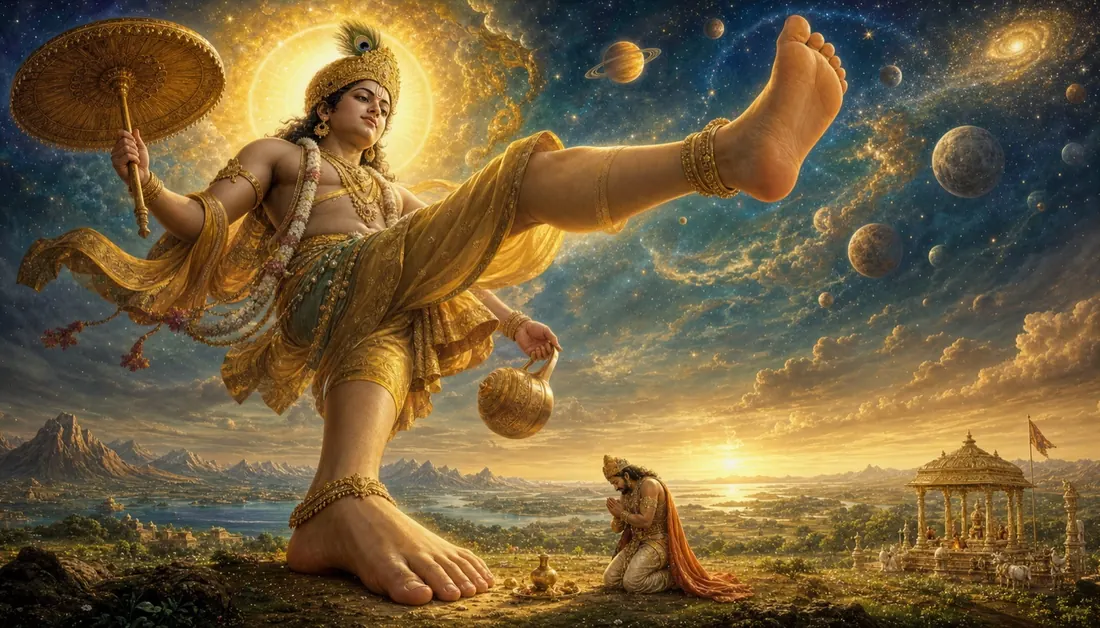
Not every demon is cruel. Bali was a generous and noble king, so mighty in virtue that he came to rule the three worlds, and even the gods grew uneasy at his rise. Vishnu came to him not as a warrior but as Vamana, a small brahmin boy, and asked for the humblest of gifts: three paces of land, measured by his own short steps.
Bali laughed and agreed. Then the boy began to grow. With one step he covered all the earth; with the second, all the heavens; and for the third there was nowhere left to stand. Bali, true to his word, bowed his head and offered it for the final step. Vishnu pressed him gently down to rule the netherworld with honor, and blessed him for keeping his promise. Even the proud are met with tenderness when they are true.
Chapter 6 · Rama and Krishna
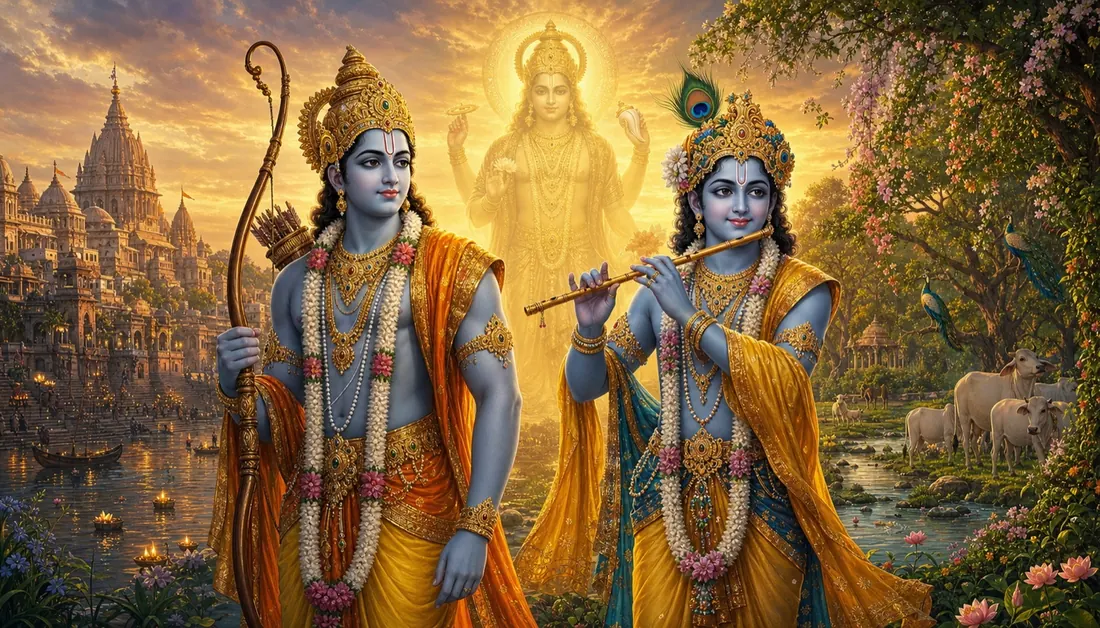
Two of Vishnu’s descents are so beloved that they have become whole worlds of their own. The seventh is Rama, the perfect king, who held to dharma even when it cost him his throne, his forest years, and his heart, and who is remembered every Diwali as the light that returned home. The eighth is Krishna, the cowherd boy who lifted a mountain, the friend who became a charioteer, and the teacher who spoke the Bhagavad Gita on the field of battle.
Between them they hold almost everything a person could need: Rama shows how to live rightly, and Krishna shows how to love completely. That both are Vishnu is the quiet secret of the pantheon: the God you meet in a hundred temples under a hundred names is, again and again, the same preserver, arriving in the shape each age can receive.
Chapter 7 · The Ten and the One
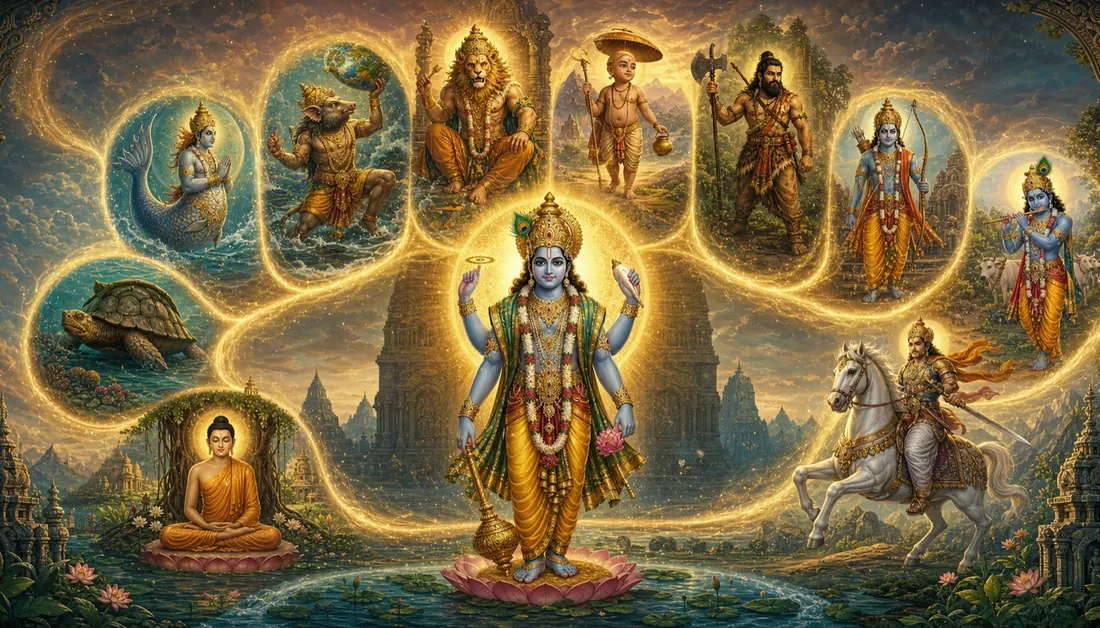
Tradition gathers his descents into the Dashavatar, the ten principal avatars, and read in order they tell the story of life itself unfolding: Matsya, the fish who saved the seeds of creation from the flood; Kurma, the tortoise beneath the churning; Varaha, the boar who raised the earth; Narasimha, the man-lion; Vamana, the dwarf of three steps; Parashurama, the axe-bearing sage; Rama, the perfect king; Krishna, the divine cowherd; the Buddha, teacher of compassion, whom many count among them; and Kalki, still to come at the end of this age, riding a white horse to close one turning of the world and open the next.
Fish, tortoise, boar, man-lion, dwarf, then fully human: some see in the sequence a picture of life climbing toward awareness. However you read it, the lesson is one. The forms are many; the Lord is one. Vishnu meets every age in the shape it needs, and he is not finished yet.
शान्ताकारं भुजगशयनं पद्मनाभं सुरेशं
विश्वाधारं गगनसदृशं मेघवर्णं शुभाङ्गम् ।
लक्ष्मीकान्तं कमलनयनं योगिभिर्ध्यानगम्यं
वन्दे विष्णुं भवभयहरं सर्वलोकैकनाथम् ॥
shāntākāraṃ bhujaga-śayanaṃ padma-nābhaṃ sureśaṃ, viśvādhāraṃ gagana-sadṛśaṃ megha-varṇaṃ śubhāṅgam, lakṣmīkāntaṃ kamala-nayanaṃ yogibhir dhyāna-gamyaṃ, vande viṣṇuṃ bhava-bhaya-haraṃ sarva-lok̲aika-nātham
“I bow to Vishnu: of peaceful form, resting on the serpent, the lotus-naveled, lord of the gods; who upholds the universe, vast as the sky, dark as a raincloud, of auspicious form; beloved of Lakshmi, lotus-eyed, whom the yogis reach in meditation; remover of the fear of worldly life, the one Lord of all the worlds.”
The traditional Vishnu dhyana shloka
Small Glossary
- Trimurti
- The three great functions of the divine: Brahma the creator, Vishnu the preserver, Shiva the dissolver.
- Avatar
- A descent: God taking form in the world to restore dharma. Literally, a “crossing down”.
- Dashavatar
- The ten principal avatars of Vishnu, from Matsya the fish to Kalki yet to come.
- Ananta Shesha
- The endless thousand-headed serpent on whom Vishnu reclines between the ages.
- Kshira Sagara
- The cosmic ocean of milk, the still sea on which Vishnu rests.
- Sudarshana Chakra
- Vishnu’s spinning discus, the weapon that cuts through illusion and protects dharma.
- Vaikuntha
- The eternal abode of Vishnu, a heaven beyond sorrow.
- Narayana
- A name of Vishnu: “the one who rests upon the waters,” the refuge of all beings.
- Garuda
- The great eagle who is Vishnu’s mount and the enemy of serpents.
- Samudra Manthan
- The churning of the ocean of milk by gods and demons to win the nectar of immortality.
- Lakshmi
- Goddess of fortune and abundance, the consort of Vishnu, ever at his side.
Retold in original words from the Vishnu Purana, the Bhagavata Purana, the Ramayana and the Mahabharata.
Test yourself
Think you know Vishnu? Ten questions, no sign in.
Carry this darshan with you.
The Bhakti Angan app brings a new darshan each morning, simple mantras, a japa counter and the daily Panchang.