

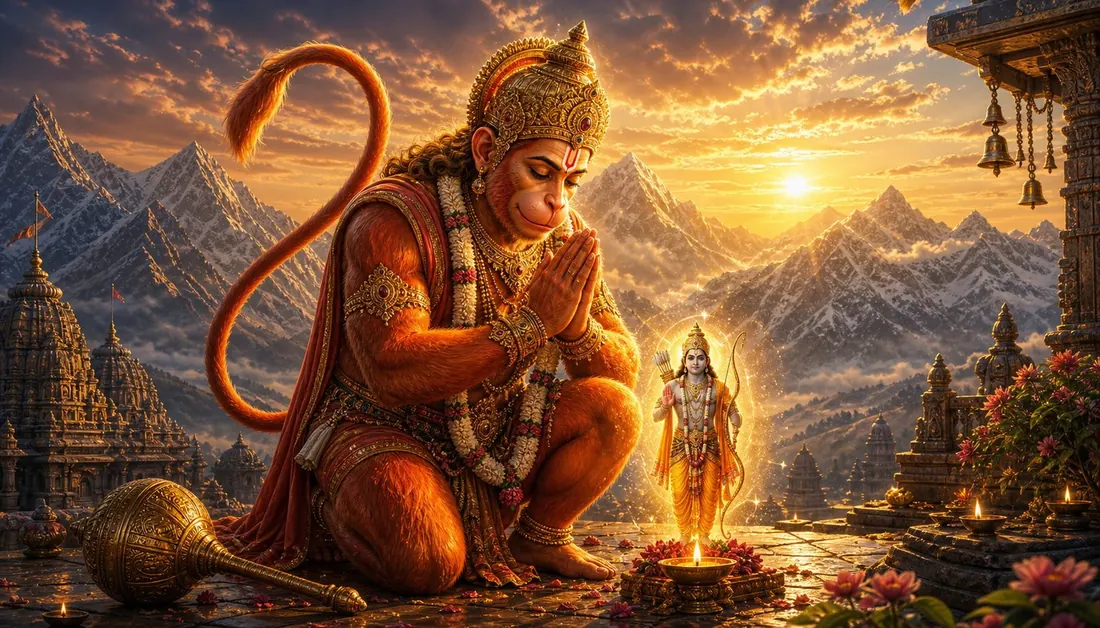
The Complete Story · For First-Time Readers
HanumanFrom the child who leapt at the sun to the devotee with Rama in his heart: the whole story of the mighty servant of God, told gently.
Who is Hanuman?
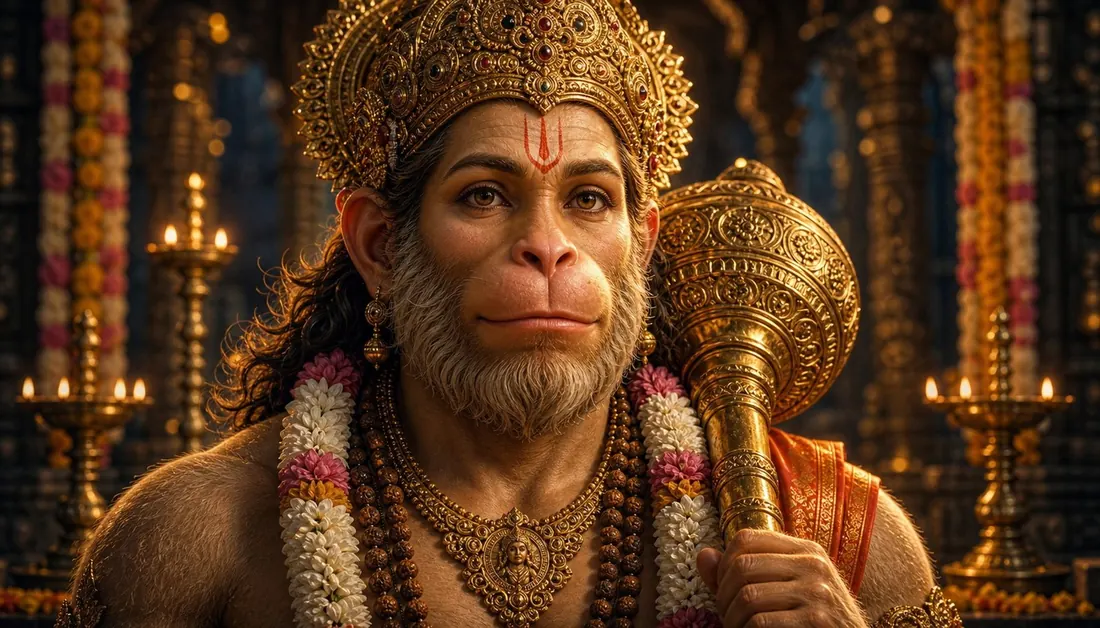
He has the face of a monkey and the strength of a hundred elephants, he can grow larger than a mountain or shrink smaller than a thumb, he leapt across an ocean in a single bound, and he is, without rival, the most beloved servant in all of Hinduism. He is Hanuman: the mighty son of the wind, and the perfect devotee, whose entire boundless power exists for one purpose only, to serve his Lord Rama.
To understand Hanuman is to understand something the tradition holds very dear: that the highest thing a soul can be is not a king, or a sage, or even a god, but a true devotee. Hanuman could have ruled worlds. He chose instead to carry Rama’s sandals, to run Rama’s errands, to sing Rama’s name, and in that choice he became greater than the kings and stronger than the gods. His devotion is his power, and his power is entirely his devotion.
He is called by many loving names. Bajrangbali, the one whose body is hard as a thunderbolt; Sankat Mochan, the remover of troubles, prayed to by millions in every kind of distress; Anjaneya, the son of Anjana; Maruti, the son of the wind-god. He is worshipped for courage, for strength, for protection, and above all for the one thing he embodies more purely than any other figure: a heart that has made itself completely the servant of what it loves.
His story runs alongside the great epic of the Ramayana, but it begins long before, with a child, a hunger, and a leap toward the sun.
Chapter 1 · The Child Who Leapt at the Sun
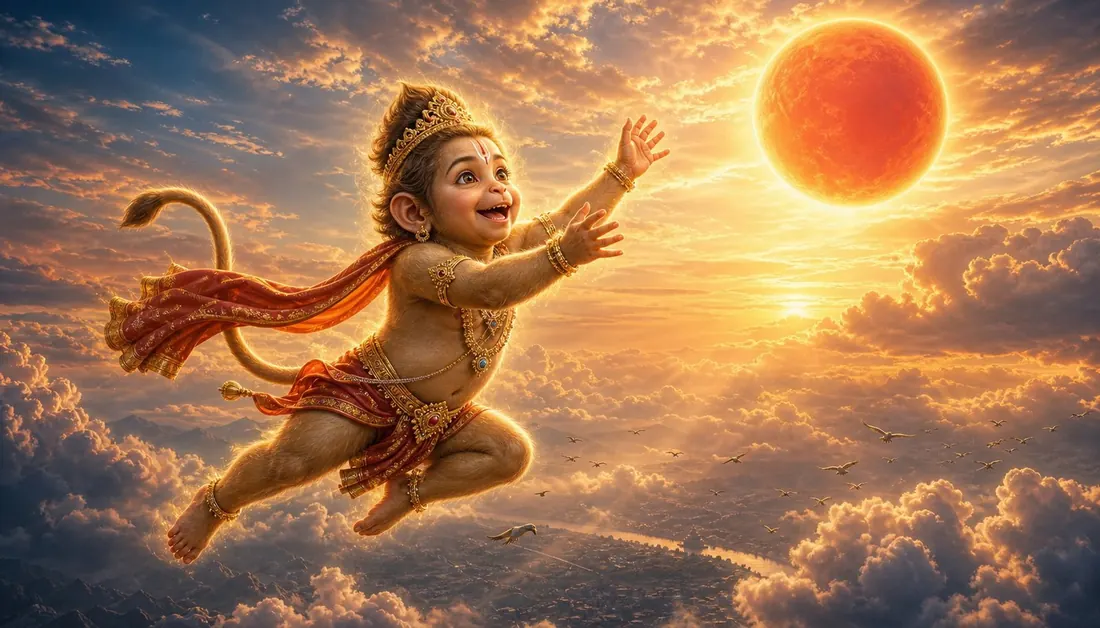
Hanuman was the son of Anjana, a celestial being, and Vayu, the god of the wind, and from his father he inherited the power to fly and a strength beyond measure. But as a baby he did not know it, and like all babies he was hungry.
One morning the infant Hanuman saw the sun rising red and round on the horizon and mistook it for a ripe fruit. So he did what came naturally to the son of the wind: he leapt into the sky to eat it. Up and up he flew, past the clouds, past the birds, straight toward the blazing sun, a baby reaching for a snack the size of a star.
This alarmed the heavens. Indra, king of the gods, seeing a child about to seize the sun itself, hurled his thunderbolt, the vajra, to stop him. It struck the baby on the jaw and sent him tumbling back to earth. The blow did him no lasting harm, but it left his jaw slightly marked, and from the Sanskrit word for jaw, hanu, the child took the name the world would know him by: Hanuman, the one with the marked jaw.
Vayu, the wind, was enraged that his son had been struck, and in his grief he withdrew, and the breath of the world stopped; nothing could breathe until the gods came in apology. To make amends, every god gave the child a boon: Indra made his body invincible, Brahma made him free to go anywhere unstopped, Surya gave him wisdom, and so on, until the little one was armored in the gifts of the whole pantheon. But the gods added one crucial condition, which is the hinge of his whole life: the child, mischievous and impossibly strong, would forget his own powers, and remember them only when someone reminded him of them.
Why this story matters
The forgetting is the most important detail in Hanuman’s story, and one of the most beautiful ideas in the tradition. The mightiest being alive walks the world unaware of his own strength, until a moment of need and a word of reminder call it forth. It is a picture of every soul: we carry powers we have forgotten, gifts we do not know we hold, and often it takes another person, at the right moment, to say you can do this, you always could, before we leap. Hanuman is strongest precisely when he is reminded who he is, and the tradition suggests we are too.
Chapter 2 · The Meeting That Made Him
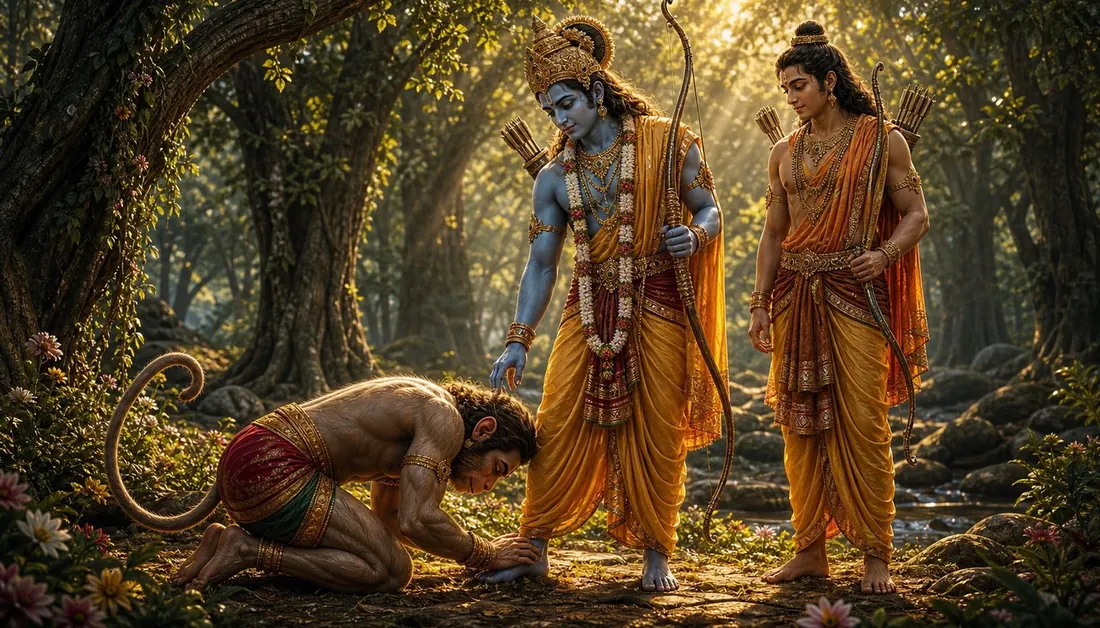
Hanuman grew up among the vanaras, the forest people, in the kingdom of Kishkindha, and served their exiled prince Sugriva. And there, one day, two brothers walked into the forest who would give his life its meaning: Rama, the exiled prince of Ayodhya, seventh avatar of Vishnu, and his brother Lakshmana, searching for Rama’s wife Sita, who had been carried off by the demon king Ravana.
Sugriva, hiding and afraid, sent Hanuman to find out whether these two mighty strangers were friends or enemies. Hanuman went in the disguise of a humble brahmin, and spoke to Rama, and the moment he heard Rama speak, something in him recognized his Lord. The disguise fell away; Hanuman placed his head at Rama’s feet; and from that instant, the strongest being in the world had a master, and wanted no other.
It was a perfect meeting of need. Rama needed an ally who could cross oceans and move mountains; Hanuman needed someone worth giving his whole self to. He brought Rama and Sugriva together in friendship, and when the vanara army was gathered to search the earth for Sita, it was Hanuman, of course, who would be sent south, toward the sea, toward the impossible.
From this meeting flows everything Hanuman becomes. He is never again simply strong; he is strong for Rama. His story and Rama’s become one story, which we tell in full in the complete story of Rama.
Why this story matters
Hanuman’s life teaches that devotion is not weakness but the channel that gives strength its meaning. Before Rama, Hanuman was merely powerful, a strong monkey among monkeys who had forgotten most of what he could do. After Rama, that same power had a direction, and became world-changing. The tradition is making a quiet claim against the modern instinct that to serve is to be diminished: Hanuman is the freest, mightiest, most joyful being in the epic precisely because he has given himself completely to something greater than himself. Love did not shrink him. It unlocked him.
Chapter 3 · The Leap Across the Ocean
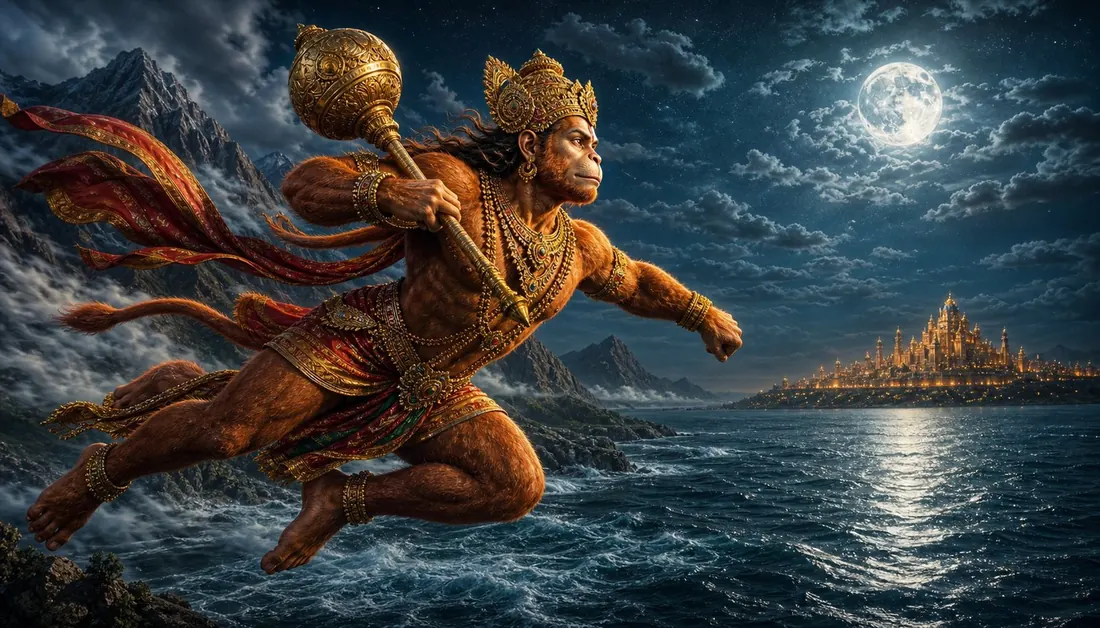
The search led to the southern shore, and there the vanaras stopped, defeated. Sita was held in Lanka, the golden island-fortress of the demon king Ravana, a hundred yojanas across the sea, and no one could cross that much ocean. The army sat on the beach in despair.
And then an old bear named Jambavan did the one thing that could change everything: he reminded Hanuman who he was. You are the son of the wind, he said. You crossed the sky as an infant to seize the sun. This ocean is nothing to you. Rise, and remember. And as the words landed, Hanuman felt his forgotten powers wake in him, and he began to grow. He grew until he towered over the mountains, climbed the peak of Mahendra, gathered himself, and leapt.
The leap of Hanuman across the ocean is one of the great images of the Ramayana. He flew like a mountain hurled from a bow, the wind roaring behind his father’s son, the sea heaving beneath him. Demons rose to stop him and he passed them; a mountain offered him rest and he touched it in thanks and flew on; nothing between the shores could hold him. He crossed the impossible sea for love of Rama, and came down in secret in the enemy’s golden city.
There, shrinking to the size of a cat, he searched Lanka through the night until he found Sita in a grove of ashoka trees, guarded, grieving, faithful. He gave her Rama’s ring; he gave her the one thing she had lost, hope; and he carried back to Rama the news that she lived. But before he left, he let the demons capture him, so that he might see Ravana’s court and deliver a warning, and when they set his tail on fire to humiliate him, he leapt across the rooftops and burned the golden city to the ground, and sailed home on the wind with his tail ablaze.
Why this story matters
The leap only happens after the reminder, and that is the teaching. Hanuman sat on the same beach as everyone else, equally stuck, until Jambavan spoke and he remembered his own nature. How often is the ocean in front of us not too wide, but simply un-leapt because no one has reminded us what we are? Hanuman’s crossing is the tradition’s great image of the power that devotion unlocks: love for Rama made him remember, and remembering made him limitless. Faith, this story says, is not believing in the far shore. It is discovering you were always able to reach it.
Chapter 4 · The Mountain of Healing
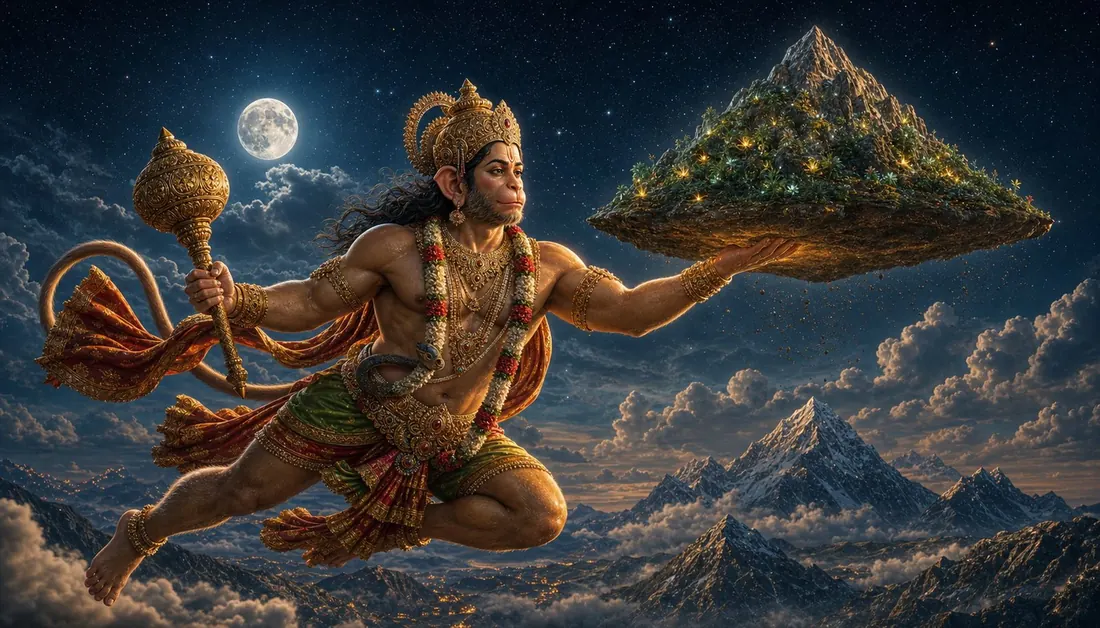

The war for Lanka came, Rama’s vanara army against Ravana’s demon hordes, and on a terrible night of it, Rama’s brother Lakshmana fell, struck down by a weapon that would kill him by dawn unless a single healing herb, the Sanjeevani, could be found on a mountain in the far Himalayas and brought back before sunrise. It was hundreds of leagues away. There was one night. There was one being who could try.
Hanuman flew north faster than the wind, found the mountain, and searched its slopes for the glowing herb, but the herbs of that mountain hid themselves from him, and time was running out. So Hanuman did the thing that only Hanuman would think to do: he set his hands beneath the entire mountain, tore it whole from the earth, lifted it onto his palm, and flew back to Lanka carrying a Himalayan peak through the night sky, so that the physicians could simply find the herb themselves.
He arrived before dawn. Lakshmana was healed. The image of Hanuman soaring through the darkness with a glowing mountain held aloft in one hand is among the most beloved in all of India, painted on ten thousand temple walls: devotion that will not be stopped by not knowing which herb, that will carry the whole mountain rather than come back empty-handed. The fuller telling is in our katha, Hanuman and the Sanjeevani.
Why this story matters
Hanuman could not tell one herb from another, and it did not stop him; he brought the whole mountain. This is the tradition’s picture of wholehearted service, the kind that does not wait until it has understood everything or found the perfect single answer, but gives everything it has, immediately, and trusts that within all it has brought, the healing will be found. When someone you love is dying and you do not know exactly what will save them, Hanuman shows the way: bring the mountain. Bring all of it. Let the rest be sorted out once you have arrived in time.
Chapter 5 · Rama in His Heart
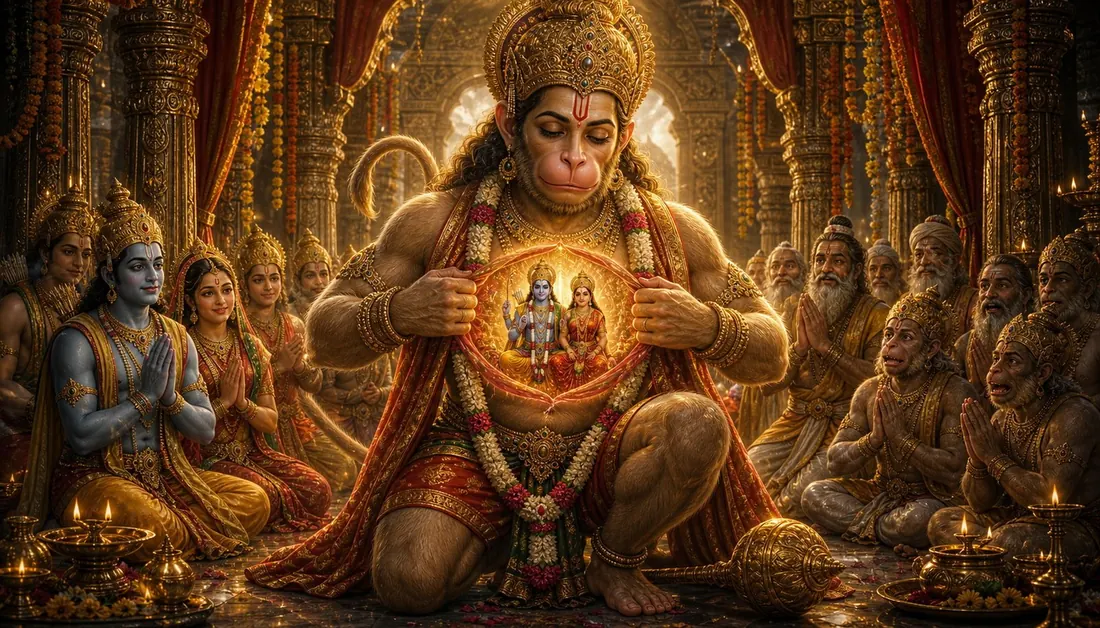
After the war was won and Rama enthroned at last in Ayodhya, the court showered Hanuman with gifts, and Sita gave him a necklace of magnificent pearls. And then the whole court watched, puzzled, as Hanuman took each pearl between his teeth, bit it open, peered inside, and cast it aside.
Someone asked him, half offended, why he was destroying such a priceless gift. Hanuman answered simply: I am looking inside each pearl to see whether Rama is in it. Anything that does not hold Rama is worthless to me. The court laughed, and one courtier taunted him: then is Rama in you, monkey? You who wear no jewels and keep nothing?
Hanuman did not answer with words. He set his fingers to his own chest and tore it open, and there, within his heart, for the whole court to see, were Rama and Sita, enthroned and radiant, dwelling in the body of their servant. There was nothing left to say. The court fell silent and then to its knees.
This is the image the tradition holds dearest of all: Hanuman with his chest open, revealing the divine couple living in his heart. It is why he is the supreme icon of bhakti, of devotion so total that the beloved is not somewhere far away to be reached, but already, permanently, at home inside the one who loves.
Why this story matters
The open chest of Hanuman answers the deepest question of the devotional path: where is God? Hanuman’s reply is that for the true devotee, God is not in the pearl, not in the temple far away, not on some distant shore that must be leapt to. God is in the heart, closer than one’s own breath, carried everywhere, never absent. It is the reward at the end of the road of devotion: you spend a life leaping oceans and lifting mountains for a Lord you serve, and discover at last that he was living in your chest the whole time. That is why Hanuman, of all the gods, is the one who shows us how to love.
Chapter 6 · The Deathless Devotee
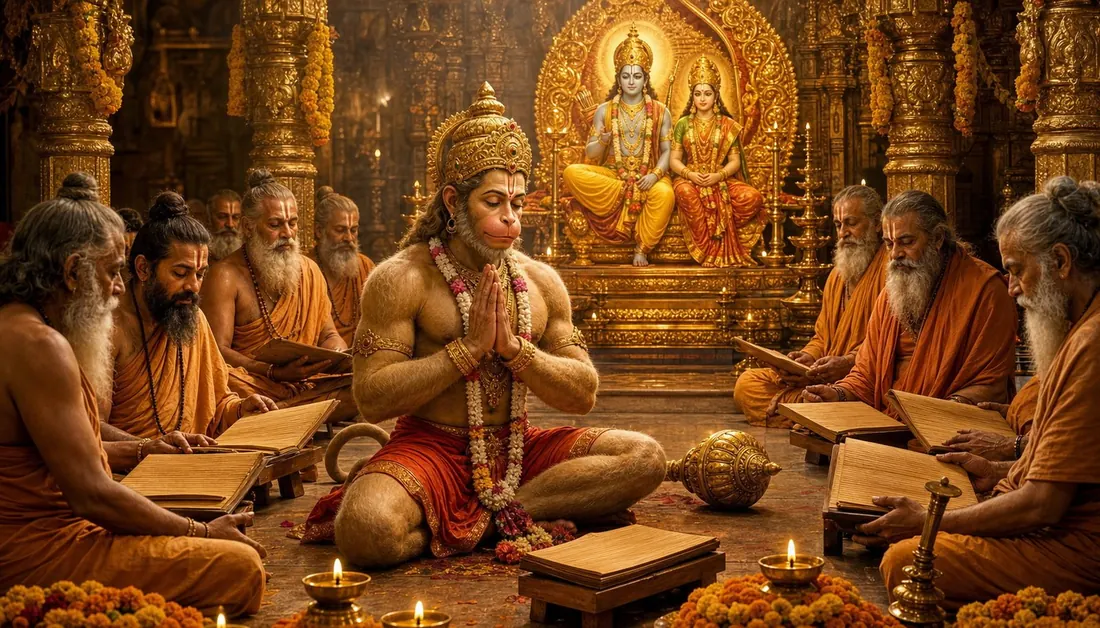
When Rama’s time on earth was ending and he prepared to leave the world, Hanuman asked for one boon, the only thing he ever wanted for himself: to remain on earth, alive, for as long as Rama’s name was remembered among human beings. Rama granted it. And so Hanuman is one of the Chiranjivis, the deathless ones, and the tradition holds that he is present, unseen, wherever the story of Rama is told and wherever Rama’s name is sung.
This is why, in temples across India, an image of Hanuman with folded hands is placed to listen at every recitation of the Ramayana, for he is believed to attend them all. It is why he is prayed to as Sankat Mochan, the remover of troubles, on Tuesdays and Saturdays, by anyone in fear or difficulty. And it is why the Hanuman Chalisa, the forty verses in his praise composed by the poet Tulsidas, is perhaps the most recited prayer in all of Hinduism, whispered on trains and in hospital corridors and dark nights by hundreds of millions who trust the deathless devotee to stand between them and their fear.
Of all the mighty figures in this library, Hanuman is the one closest to the ordinary person, because he is not worshipped for being God. He is worshipped for showing us how to love God: with a whole heart, a strong back, a fearless spirit, and no thought at all for oneself. He is the friend who will cross any ocean for you, and the proof that such friends can exist.
Why this story matters
Hanuman remains, and that is the gift. In a tradition full of gods who come and go across the ages, Hanuman is the one who stayed, choosing an endless life of service over any reward, so that no one who calls on him in trouble would ever find him gone. That is what makes him the people’s god: not distant majesty but present help, a strength you can actually call on, a devotee so complete that his devotion became a permanent shelter for everyone else’s fear. To recite his Chalisa is to borrow, for a moment, the courage of the one who forgot he was afraid because he remembered whom he served.
मनोजवं मारुततुल्यवेगं जितेन्द्रियं बुद्धिमतां वरिष्ठम् ।
वातात्मजं वानरयूथमुख्यं श्रीरामदूतं शरणं प्रपद्ये ॥
manojavaṃ māruta-tulya-vegaṃ jitendriyaṃ buddhimatāṃ variṣṭham
vātātmajaṃ vānara-yūtha-mukhyaṃ śrī-rāma-dūtaṃ śaraṇaṃ prapadye
“Swift as thought, fast as the wind, master of his senses, foremost among the wise; son of the wind, chief of the vanaras, messenger of Rama: in him I take refuge.”
Traditional Hanuman dhyana shloka
Small Glossary
- Bajrangbali
- The one whose limbs are strong as a thunderbolt (vajra-anga); a beloved name for Hanuman.
- Sankat Mochan
- The remover of troubles: Hanuman prayed to in every distress.
- Anjaneya
- The son of Anjana: another common name for Hanuman.
- Maruti / Vayuputra
- The son of Vayu, the wind-god; hence Hanuman’s power of flight.
- Vanara
- The forest people of the Ramayana, of whom Hanuman is the greatest.
- Sanjeevani
- The life-restoring herb Hanuman brought, mountain and all, to heal Lakshmana.
- Chiranjivi
- One of the deathless ones; Hanuman remains on earth as long as Rama is remembered.
- Hanuman Chalisa
- The 40-verse hymn to Hanuman by Tulsidas; among the most recited prayers in Hinduism.
- Bhakti
- The path of loving devotion, of which Hanuman is the supreme example.
- Gada
- The mace Hanuman carries: the sign of his strength and his readiness to serve.
- Ramayana
- The great epic of Rama, in which Hanuman plays the decisive part.
- Ram Bhakt
- “Devotee of Rama”: the identity Hanuman chose above all others.
Retold in original words from the Valmiki Ramayana, the Ramcharitmanas of Tulsidas and the Hanuman Chalisa.
Test yourself
Think you know Hanuman? Ten questions, no sign in.
Carry this darshan with you.
The Bhakti Angan app brings a new darshan each morning, simple mantras, a japa counter and the daily Panchang. Using Android? Join the waitlist.