Aarti Lyrics with Meaningआरती संग्रह
The seven aartis sung in most Hindu homes, with transliteration, meaning and when each is sung.
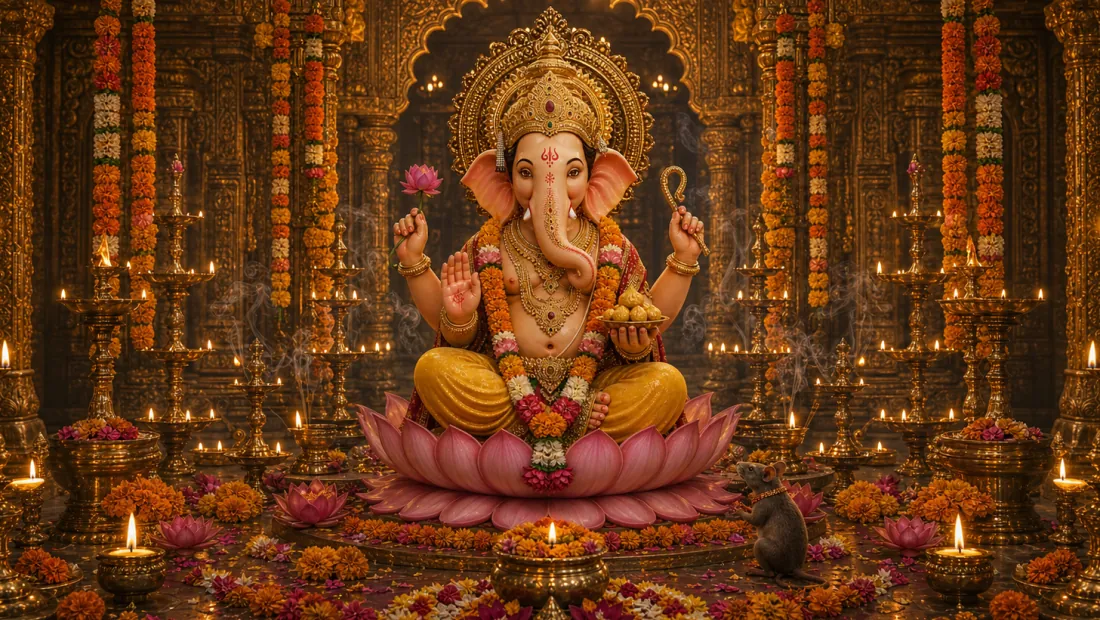
Aarti is the closing of a puja in light: a lamp of ghee or camphor waved before the deity while the family sings. The word comes from the Sanskrit aratrika, the lamp waved before the Lord. These are the seven aartis most homes know by heart, each given in Devanagari with a transliteration, a short meaning and the days it is sung. The refrain at the top of each aarti is repeated after every verse.
How to do the aarti
- Light the diya with ghee, or camphor, on the aarti plate with flowers, kumkum and rice.
- Ring the bell with the left hand while you wave the lamp with the right, always clockwise.
- A common tradition: four circles at the deity’s feet, two at the navel, one at the face, then seven around the whole form.
- Sing the aarti of the deity you are worshipping. In many homes Ganesha’s comes first and Om Jai Jagdish Hare closes the puja.
- End with Karpur Gauram and the jaykaras, then offer the flame to everyone: each person passes their hands over it and touches them to the eyes and head.
- Then share the prasad.
The words of Karpur Gauram, sung as the aarti ends, are on the Daily Shlokas page.
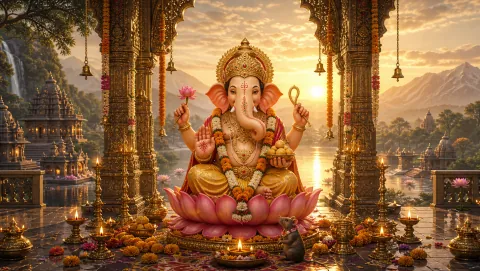
Aarti 1 of 7 · Ganesha
Jai Ganesh Deva
जय गणेश देवा
First, at any puja: every worship begins with Ganesha. Also on Wednesdays and through Ganesh Chaturthi.
Refrain, repeated after each verse
जय गणेश जय गणेश जय गणेश देवा।
माता जाकी पार्वती पिता महादेवा॥
Jai Ganesh jai Ganesh jai Ganesh deva,
mata jaki Parvati pita Mahadeva.
एकदन्त दयावन्त चार भुजा धारी।
माथे पर तिलक सोहे मूसे की सवारी॥
Ekadant dayavant char bhuja dhari,
mathe par tilak sohe moose ki savari.
पान चढ़े फल चढ़े और चढ़े मेवा।
लड्डुअन का भोग लगे सन्त करें सेवा॥
Paan chadhe phal chadhe aur chadhe meva,
ladduan ka bhog lage sant karen seva.
अंधे को आँख देत कोढ़िन को काया।
बाँझन को पुत्र देत निर्धन को माया॥
Andhe ko aankh det kodhin ko kaya,
baanjhan ko putra det nirdhan ko maya.
सूर श्याम शरण आए सफल कीजे सेवा।
जय गणेश जय गणेश जय गणेश देवा॥
Soor Shyam sharan aaye saphal keeje seva,
jai Ganesh jai Ganesh jai Ganesh deva.
Meaning: Victory to Ganesha, son of Parvati and Mahadeva: the one-tusked, compassionate, four-armed lord with the tilak on his brow who rides a mouse. Betel, fruit and dry fruit are offered to him, laddoos are his bhog, and saints serve him. He gives sight to the blind, health to the sick, children to the childless and wealth to the poor. The poet, Surdas by the name in the last line, takes his refuge and asks that his service bear fruit.
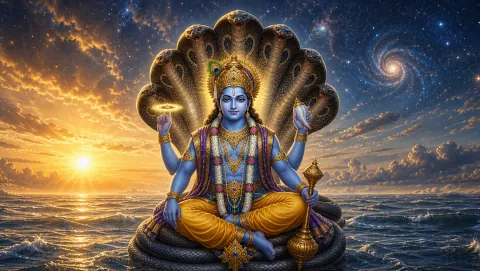
Aarti 2 of 7 · Vishnu
Om Jai Jagdish Hare
ॐ जय जगदीश हरे
At the close of most pujas and at the Satyanarayan katha, and as an evening aarti in many homes.
Refrain, repeated after each verse
ॐ जय जगदीश हरे, स्वामी जय जगदीश हरे।
भक्त जनों के संकट, क्षण में दूर करे॥
Om jai Jagdish hare, swami jai Jagdish hare,
bhakt janon ke sankat, kshan mein door kare.
जो ध्यावे फल पावे, दुख बिनसे मन का।
सुख सम्पति घर आवे, कष्ट मिटे तन का॥
Jo dhyave phal pave, dukh binse man ka,
sukh sampati ghar aave, kasht mite tan ka.
मात पिता तुम मेरे, शरण गहूँ मैं किसकी।
तुम बिन और न दूजा, आस करूँ मैं जिसकी॥
Mat pita tum mere, sharan gahun main kiski,
tum bin aur na dooja, aas karun main jiski.
तुम पूरण परमात्मा, तुम अंतरयामी।
पारब्रह्म परमेश्वर, तुम सब के स्वामी॥
Tum pooran Paramatma, tum antaryami,
Parabrahm Parameshwar, tum sab ke swami.
तुम करुणा के सागर, तुम पालनकर्ता।
मैं सेवक तुम स्वामी, कृपा करो भर्ता॥
Tum karuna ke sagar, tum palankarta,
main sevak tum swami, kripa karo bharta.
तुम हो एक अगोचर, सबके प्राणपति।
किस विधि मिलूँ दयामय, तुमको मैं कुमति॥
Tum ho ek agochar, sabke pranpati,
kis vidhi miloon dayamay, tumko main kumati.
दीनबंधु दुखहर्ता, तुम रक्षक मेरे।
करुणा हस्त बढ़ाओ, द्वार पड़ा तेरे॥
Deenbandhu dukhharta, tum rakshak mere,
karuna hast badhao, dwar pada tere.
विषय विकार मिटाओ, पाप हरो देवा।
श्रद्धा भक्ति बढ़ाओ, संतन की सेवा॥
Vishay vikar mitao, paap haro deva,
shraddha bhakti badhao, santan ki seva.
तन मन धन सब कुछ है तेरा।
तेरा तुझको अर्पण, क्या लागे मेरा॥
Tan man dhan sab kuchh hai tera,
tera tujhko arpan, kya lage mera.
Many homes close with this added verse: body, mind and wealth are all yours; what is yours I offer back to you.
Meaning: Victory to the Lord of the world, who removes his devotees’ troubles in an instant. Whoever meditates on him finds the mind’s sorrow gone, and joy and plenty come home. You are my mother and father, the complete Supreme, the knower of every heart, the ocean of compassion and the sustainer of all; I am your servant. You are beyond the senses, the life of every being: how is someone of small understanding to reach you? Friend of the humble, remover of sorrow, extend your hand of mercy; I lie at your door. Take away the pull of the senses and my faults, and increase my faith, devotion and service to the good.
Aarti 3 of 7 · Shiva
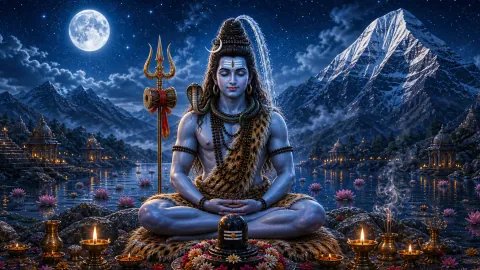
Om Jai Shiv Omkara
ॐ जय शिव ओंकारा
Mondays, Pradosh evenings, through Sawan and on Maha Shivratri.
Refrain, repeated after each verse
ॐ जय शिव ओंकारा, स्वामी जय शिव ओंकारा।
ब्रह्मा विष्णु सदाशिव, अर्द्धांगी धारा॥
Om jai Shiv Omkara, swami jai Shiv Omkara,
Brahma Vishnu Sadashiv, ardhangi dhara.
एकानन चतुरानन पंचानन राजे।
हंसासन गरुड़ासन वृषवाहन साजे॥
Ekanan chaturanan panchanan raje,
hansasan garudasan vrishvahan saje.
दो भुज चारु चतुर्भुज दसभुज से सोहे।
तीनों रूप निरखते त्रिभुवन जन मोहे॥
Do bhuj charu chaturbhuj dasbhuj se sohe,
teenon roop nirakhte tribhuvan jan mohe.
अक्षमाला वनमाला मुण्डमाला धारी।
चंदन मृगमद सोहे भाले शशिधारी॥
Akshamala vanamala mundamala dhari,
chandan mrigmad sohe bhale shashidhari.
श्वेताम्बर पीताम्बर बाघम्बर अंगे।
सनकादिक ब्रह्मादिक भूतादिक संगे॥
Shvetambar pitambar baghambar ange,
Sanakadik Brahmadik bhootadik sange.
कर में श्रेष्ठ कमण्डलु चक्र त्रिशूल धरता।
जगकर्ता जगहर्ता जग पालन कर्ता॥
Kar mein shreshth kamandalu chakra trishul dharta,
jagkarta jagharta jag palan karta.
ब्रह्मा विष्णु सदाशिव जानत अविवेका।
प्रणवाक्षर में शोभित ये तीनों एका॥
Brahma Vishnu Sadashiv janat aviveka,
pranavakshar mein shobhit ye teenon eka.
निर्गुण शिव की आरती जो कोई नर गावे।
कहत शिवानंद स्वामी मनवांछित फल पावे॥
Nirgun Shiv ki aarti jo koi nar gave,
kahat Shivanand Swami manvanchhit phal pave.
Meaning: Victory to Shiva, the Omkara, in whom Brahma, Vishnu and Sadashiva are held, with Parvati as half his body. He shines with one face, four faces and five, riding the swan, Garuda and the bull; with two, four and ten arms, the three forms enchant the three worlds. He wears the rudraksha, forest and skull garlands, sandal and musk, the moon on his brow; white, yellow and tiger-skin garments; Sanaka, Brahma and the spirits around him. Holding kamandalu, chakra and trishul, he creates, sustains and dissolves the world. Only the unwise see Brahma, Vishnu and Shiva as separate: in the syllable Om the three are one. Whoever sings this aarti, says Shivanand Swami, receives what the heart longs for.
Aarti 4 of 7 · Krishna
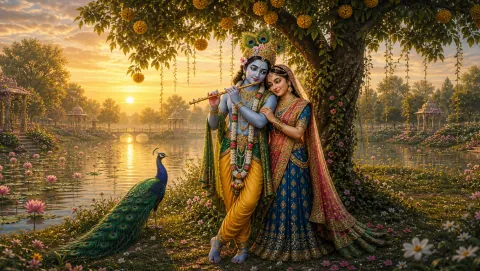
Aarti Kunj Bihari Ki
आरती कुंजबिहारी की
Every evening in Krishna temples, and above all at midnight on Janmashtami.
Refrain, repeated after each verse
आरती कुंजबिहारी की,
श्री गिरिधर कृष्णमुरारी की॥
Aarti Kunj Bihari ki,
Shri Girdhar Krishna Murari ki.
गले में बैजंती माला, बजावै मुरली मधुर बाला।
श्रवण में कुण्डल झलकाला, नंद के आनंद नंदलाला।
गगन सम अंग कांति काली, राधिका चमक रही आली।
लतन में ठाढ़े बनमाली, भ्रमर सी अलक, कस्तूरी तिलक, चंद्र सी झलक,
ललित छवि श्यामा प्यारी की॥
Gale mein Baijanti mala, bajavai murali madhur bala,
shravan mein kundal jhalkala, Nand ke anand Nandlala,
gagan sam ang kanti kali, Radhika chamak rahi aali,
latan mein thadhe Banmali, bhramar si alak, kasturi tilak, chandra si jhalak,
lalit chhavi Shyama pyari ki.
कनकमय मोर मुकुट बिलसै, देवता दरसन को तरसैं।
गगन सों सुमन रासि बरसै, बजे मुरचंग, मधुर मिरदंग, ग्वालिन संग,
अतुल रति गोप कुमारी की॥
Kanakmay mor mukut bilsai, devta darsan ko tarsain,
gagan son suman rasi barsai, baje murchang, madhur mirdang, gwalin sang,
atul rati gop kumari ki.
जहाँ ते प्रकट भई गंगा, कलुष कलि हारिणि श्री गंगा।
स्मरन ते होत मोह भंगा, बसी शिव सीस, जटा के बीच, हरै अघ कीच,
चरन छवि श्रीबनवारी की॥
Jahan te pragat bhai Ganga, kalush kali harini Shri Ganga,
smaran te hot moh bhanga, basi Shiv sees, jata ke beech, harai agh keech,
charan chhavi Shri Banwari ki.
चमकती उज्ज्वल तट रेनू, बज रही वृंदावन बेनू।
चहुँ दिसि गोपि ग्वाल धेनू, हँसत मृदु मंद, चाँदनी चंद, कटत भव फंद,
टेर सुन दीन दुखारी की॥
Chamakti ujjwal tat renu, baj rahi Vrindavan benu,
chahun disi gopi gwal dhenu, hansat mridu mand, chandni chand, katat bhav phand,
ter sun deen dukhari ki.
Meaning: The aarti of Krishna who plays in the groves, Shri Girdhar, Krishna Murari. The vaijayanti garland at his throat, he plays sweet music on the flute; earrings gleam in his ears, the joy of Nanda, Nanda’s darling. His body is dark as the sky and Radha shines beside him; the forest-garlanded one stands among the vines, with curls like bees, a musk tilak and the glow of the moon. His golden peacock crown shines and the gods long for his darshan; flowers rain from the sky as the murchang and mridang play among the gopis. From his feet the Ganga flows, the remover of the Kali age’s sins, who ends delusion at a thought and lives in Shiva’s matted locks. The sand of the Yamuna bank gleams, the Vrindavan flute plays, gopis, cowherds and cows all around; he smiles softly in the moonlight and cuts the bonds of the world. Hear the call of the humble and sorrowful, Lord.
Aarti 5 of 7 · Hanuman
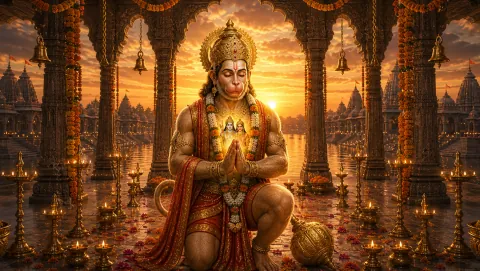
Aarti Kije Hanuman Lala Ki
आरती कीजै हनुमान लला की
Tuesdays and Saturdays, on Hanuman Jayanti, and after reciting the Hanuman Chalisa.
Refrain, repeated after each verse
आरती कीजै हनुमान लला की।
दुष्ट दलन रघुनाथ कला की॥
Aarti kije Hanuman lala ki,
dusht dalan Raghunath kala ki.
जाके बल से गिरिवर काँपे, रोग दोष जाके निकट न झाँके।
अंजनि पुत्र महा बलदाई, संतन के प्रभु सदा सहाई॥
Jake bal se girivar kanpe, rog dosh jake nikat na jhanke,
Anjani putra maha baldai, santan ke prabhu sada sahai.
दे बीरा रघुनाथ पठाए, लंका जाय सिया सुधि लाए।
लंका सो कोट समुद्र सी खाई, जात पवनसुत बार न लाई॥
De beera Raghunath pathaye, Lanka jaye Siya sudhi laye,
Lanka so kot samudra si khai, jat Pavansut bar na lai.
लंका जारि असुर संहारे, सियारामजी के काज सँवारे।
लक्ष्मण मूर्छित पड़े सकारे, आनि संजीवन प्रान उबारे॥
Lanka jari asur sanhare, Siyaramji ke kaj sanvare,
Lakshman moorchhit pade sakare, aani Sanjivan pran ubare.
पैठि पताल तोरि जम कारे, अहिरावण की भुजा उखारे।
बाएँ भुजा असुरदल मारे, दाहिने भुजा संतजन तारे॥
Paithi patal tori jam kare, Ahiravan ki bhuja ukhare,
baen bhuja asurdal mare, dahine bhuja santjan tare.
सुर नर मुनि जन आरती उतारें, जय जय जय हनुमान उचारें।
कंचन थार कपूर लौ छाई, आरती करत अंजना माई॥
Sur nar muni jan aarti utaren, jai jai jai Hanuman ucharen,
kanchan thar kapoor lau chhai, aarti karat Anjana mai.
जो हनुमानजी की आरती गावै,
बसि बैकुंठ परम पद पावै॥
Jo Hanumanji ki aarti gavai,
basi Baikunth param pad pavai.
Meaning: Offer the aarti to dear Hanuman, the power of Raghunath that crushes the wicked. Mountains tremble at his strength, and illness and fault cannot come near him; son of Anjani, giver of great strength, ever the helper of the saints. Honoured by Rama with the betel roll and sent forth, he went to Lanka and brought back news of Sita; Lanka was a fortress with the ocean for its moat, yet the son of the Wind crossed it without delay. He burned Lanka, destroyed the demons and set right the work of Sita and Rama; when Lakshmana lay senseless at dawn, he brought the Sanjeevani and saved his life. Entering the netherworld he broke Yama’s bonds and tore off Ahiravana’s arms; with his left arm he struck down the demon hosts, with his right he carried the saints across. Gods, men and sages wave the lamp and cry victory to Hanuman, and mother Anjana herself offers the aarti on a golden plate of camphor flame. Whoever sings this aarti dwells in Vaikuntha and attains the highest state.
Aarti 6 of 7 · Lakshmi
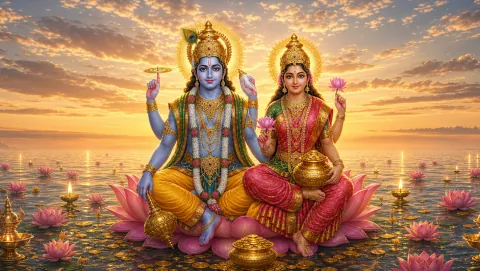
Om Jai Lakshmi Mata
ॐ जय लक्ष्मी माता
Fridays, Dhanteras and the Lakshmi puja on Diwali night.
Refrain, repeated after each verse
ॐ जय लक्ष्मी माता, मैया जय लक्ष्मी माता।
तुमको निशदिन सेवत, हर विष्णु विधाता॥
Om jai Lakshmi Mata, maiya jai Lakshmi Mata,
tumko nishdin sevat, Har Vishnu Vidhata.
उमा रमा ब्रह्माणी, तुम ही जग माता।
सूर्य चन्द्रमा ध्यावत, नारद ऋषि गाता॥
Uma Rama Brahmani, tum hi jag mata,
Surya Chandrama dhyavat, Narad rishi gata.
दुर्गा रूप निरंजनि, सुख सम्पति दाता।
जो कोई तुमको ध्यावत, ऋद्धि सिद्धि धन पाता॥
Durga roop niranjani, sukh sampati data,
jo koi tumko dhyavat, riddhi siddhi dhan pata.
तुम पाताल निवासिनि, तुम ही शुभ दाता।
कर्म प्रभाव प्रकाशिनि, भवनिधि की त्राता॥
Tum patal nivasini, tum hi shubh data,
karm prabhav prakashini, bhavnidhi ki trata.
जिस घर में तुम रहतीं, सब सद्गुण आता।
सब संभव हो जाता, मन नहीं घबराता॥
Jis ghar mein tum rahtin, sab sadgun aata,
sab sambhav ho jata, man nahin ghabrata.
तुम बिन यज्ञ न होते, वस्त्र न कोई पाता।
खान पान का वैभव, सब तुमसे आता॥
Tum bin yagya na hote, vastra na koi pata,
khan paan ka vaibhav, sab tumse aata.
शुभ गुण मंदिर सुंदर, क्षीरोदधि जाता।
रत्न चतुर्दश तुम बिन, कोई नहीं पाता॥
Shubh gun mandir sundar, kshirodadhi jata,
ratna chaturdash tum bin, koi nahin pata.
महालक्ष्मी जी की आरती, जो कोई जन गाता।
उर आनंद समाता, पाप उतर जाता॥
Mahalakshmi ji ki aarti, jo koi jan gata,
ur anand samata, paap utar jata.
Meaning: Victory to Mother Lakshmi, served day and night by Shiva, Vishnu and Brahma. You are Uma, Rama and Brahmani, the mother of the world; the sun and moon meditate on you and the sage Narada sings your praise. In the pure form of Durga you give happiness and wealth, and whoever meditates on you gains prosperity, success and riches. You dwell in the depths, you are the giver of all good, you bring the fruit of deeds to light and carry us across the ocean of the world. Every virtue comes to the home where you live; everything becomes possible and the mind is free of fear. Without you there would be no yajna, no clothing, no plenty of food. Lovely temple of every good quality, born of the ocean of milk, without you no one gains the fourteen treasures. Whoever sings the aarti of Mahalakshmi finds joy filling the heart and sin falling away.
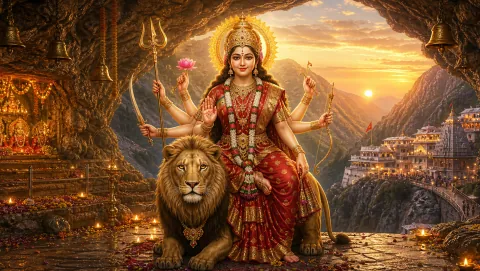
Aarti 7 of 7 · Durga
Jai Ambe Gauri
जय अम्बे गौरी
Through Navratri, on Fridays, on Durga Ashtami and in any Devi puja.
Refrain, repeated after each verse
जय अम्बे गौरी, मैया जय श्यामा गौरी।
तुमको निशदिन ध्यावत, हरि ब्रह्मा शिवरी॥
Jai Ambe Gauri, maiya jai Shyama Gauri,
tumko nishdin dhyavat, Hari Brahma Shivri.
माँग सिंदूर विराजत, टीको मृगमद को।
उज्ज्वल से दोउ नैना, चंद्रवदन नीको॥
Maang sindoor virajat, teeko mrigmad ko,
ujjwal se dou naina, chandravadan neeko.
कनक समान कलेवर, रक्ताम्बर राजै।
रक्तपुष्प गल माला, कंठन पर साजै॥
Kanak saman kalevar, raktambar rajai,
raktapushp gal mala, kanthan par sajai.
केहरि वाहन राजत, खड्ग खप्पर धारी।
सुर नर मुनि जन सेवत, तिनके दुखहारी॥
Kehari vahan rajat, khadag khappar dhari,
sur nar muni jan sevat, tinke dukhhari.
कानन कुण्डल शोभित, नासाग्रे मोती।
कोटिक चंद्र दिवाकर, सम राजत ज्योति॥
Kanan kundal shobhit, nasagre moti,
kotik chandra divakar, sam rajat jyoti.
शुंभ निशुंभ बिदारे, महिषासुर घाती।
धूम्र विलोचन नैना, निशदिन मदमाती॥
Shumbh Nishumbh bidare, Mahishasur ghati,
Dhumra Vilochan naina, nishdin madmati.
चण्ड मुण्ड संहारे, शोणित बीज हरे।
मधु कैटभ दोउ मारे, सुर भयहीन करे॥
Chand Mund sanhare, Shonit Beej hare,
Madhu Kaitabh dou mare, sur bhayheen kare.
ब्रह्माणी रुद्राणी, तुम कमला रानी।
आगम निगम बखानी, तुम शिव पटरानी॥
Brahmani Rudrani, tum Kamala rani,
agam nigam bakhani, tum Shiv patrani.
चौंसठ योगिनी मंगल गावत, नृत्य करत भैरों।
बाजत ताल मृदंगा, अरु बाजत डमरू॥
Chaunsath yogini mangal gavat, nritya karat Bhairon,
bajat taal mridanga, aru bajat damroo.
तुम ही जग की माता, तुम ही हो भरता।
भक्तन की दुख हरता, सुख संपति करता॥
Tum hi jag ki mata, tum hi ho bharta,
bhaktan ki dukh harta, sukh sampati karta.
भुजा चार अति शोभित, वर मुद्रा धारी।
मनवांछित फल पावत, सेवत नर नारी॥
Bhuja char ati shobhit, var mudra dhari,
manvanchhit phal pavat, sevat nar nari.
कंचन थाल विराजत, अगर कपूर बाती।
श्रीमालकेतु में राजत, कोटि रतन ज्योति॥
Kanchan thaal virajat, agar kapoor baati,
Shrimalketu mein rajat, koti ratan jyoti.
श्री अंबे जी की आरती, जो कोई नर गावै।
कहत शिवानंद स्वामी, सुख संपति पावै॥
Shri Ambe ji ki aarti, jo koi nar gavai,
kahat Shivanand Swami, sukh sampati pavai.
Meaning: Victory to Mother Ambe Gauri, Shyama Gauri, on whom Vishnu, Brahma and Shiva meditate day and night. Sindoor shines in her parting and musk on her brow; her eyes are bright and her face lovely as the moon. Her body glows like gold in red garments, with a garland of red flowers at her throat. She rides the lion, holding sword and skull-bowl, and takes away the sorrow of gods, men and sages who serve her. Earrings shine in her ears and a pearl at her nose, her radiance equal to millions of moons and suns. She tore apart Shumbha and Nishumbha and slew Mahishasura; she destroyed Dhumralochana, Chanda, Munda and Raktabija, and killed Madhu and Kaitabha, freeing the gods from fear. She is Brahmani, Rudrani and Kamala, praised by the scriptures, the queen of Shiva. The sixty-four yoginis sing, Bhairava dances, and the drums and damaru play. Mother of the world and its sustainer, she removes her devotees’ sorrow and gives joy and plenty. Four-armed, her hand raised in blessing, she fulfils the wishes of all who serve her. The golden plate holds incense and camphor wicks, shining like millions of jewels. Whoever sings this aarti of Ambe, says Shivanand Swami, gains happiness and plenty.
Frequently asked questions
Why is aarti done?
It closes the puja with light. The flame is offered to the deity and then shared with everyone present, so the whole family receives the blessing of the worship.
Which aarti should be sung first?
In many homes Ganesha’s aarti comes first, then the aarti of the day’s deity, with Om Jai Jagdish Hare at the close. Family custom decides; there is no single rule.
When should aarti be done at home?
Morning and evening, after the puja. The evening aarti at lamp-lighting time, sandhya, is the one most families keep every day.
Can aarti be done without a priest?
Yes. Aarti is the part of worship meant for everyone; children often lead it at home.
A darshan every morning. The Bhakti Angan app brings a new darshan each day, a japa counter, the Panchang and reminders before each festival.
Get the appPlaylists open in a privacy-friendly YouTube player only when you press play. Nothing loads or plays on its own.