
The Complete Story · For First-Time Readers
KrishnaFrom the midnight birth to the Bhagavad Gita: the whole story, told gently, for someone meeting him for the first time.
Who is Krishna?
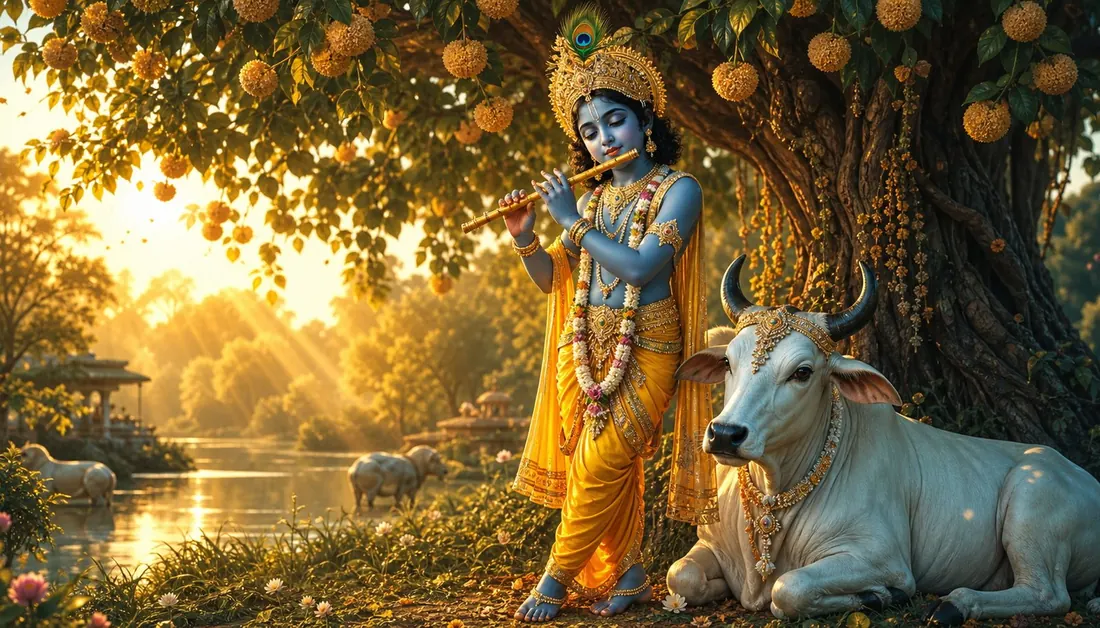
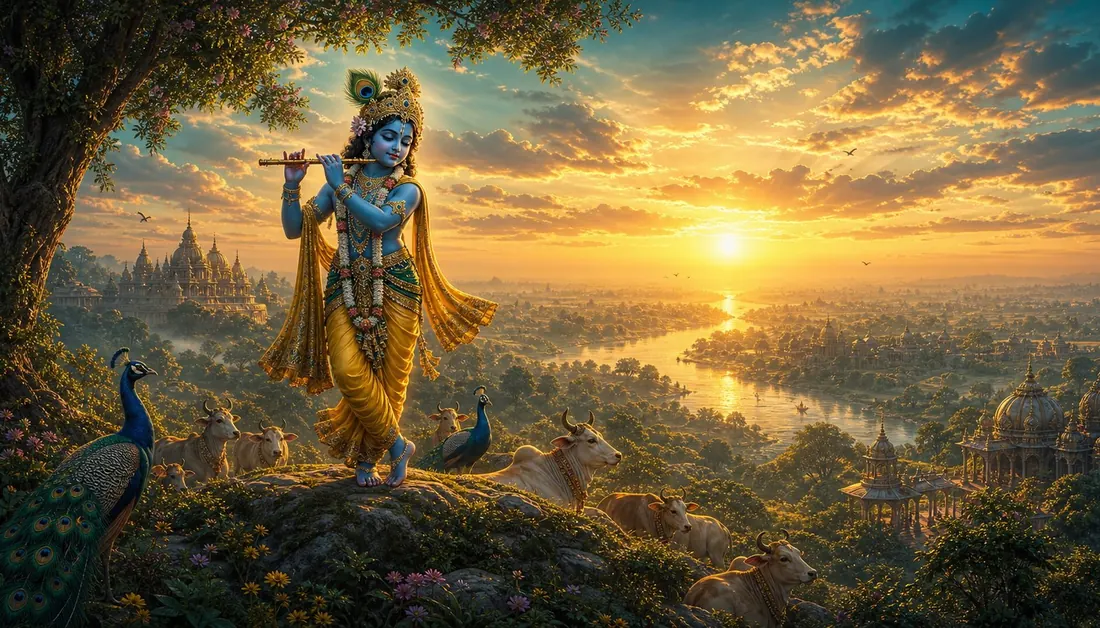
If you have ever seen a painting of a young man with deep blue skin, a peacock feather in his crown and a flute at his lips, then you have already had your first darshan of Krishna. He is one of the most beloved figures in all of Hinduism: God who chose to be born as a cowherd’s son, who stole butter as a child, danced in the moonlight as a youth, and, on the eve of history’s greatest battle, spoke the Bhagavad Gita: perhaps the most treasured spiritual teaching India has given the world.
In the Hindu understanding, whenever goodness is in danger of being extinguished, the divine descends into the world in a living form. Such a descent is called an avatar. Krishna is the eighth avatar of Vishnu, the preserver among the great gods, and, for millions, not merely an avatar but the fullest expression of God there has ever been: “Krishnas tu bhagavan svayam”. Krishna is the Lord himself.
But here is the secret of his hold on the human heart: nobody loves Krishna out of fear or duty. People love him the way they love a mischievous child, a dearest friend, a first love, a wise elder, because he offered himself in all of those forms. His life is a story you can enter at any age, and it will meet you where you are.
His name comes from the Sanskrit krishna: “the dark one, the all-attractive one.” The deep blue of his skin is the colour of the monsoon cloud that ends the drought, of the deep sky and the deep sea: that which is limitless.
Before He Was Born: A World That Needed Him
At the end of the Dvapara Yuga, the third great age of the world, the city of Mathura, on the banks of the river Yamuna, groaned under a tyrant. His name was Kamsa. He had thrown his own father into prison to seize the throne, and his cruelty spread over the land like smoke over a fire. The scriptures say the Earth herself, burdened beyond bearing, took the form of a cow and went weeping to the gods. And Vishnu, the protector, gave his word: I will be born.
Kamsa had one tender spot: his sister Devaki. On the day of her wedding to the nobleman Vasudeva, Kamsa himself drove the marriage chariot. Then a voice spoke from the sky: “Kamsa. The eighth child of this woman will be your death.”
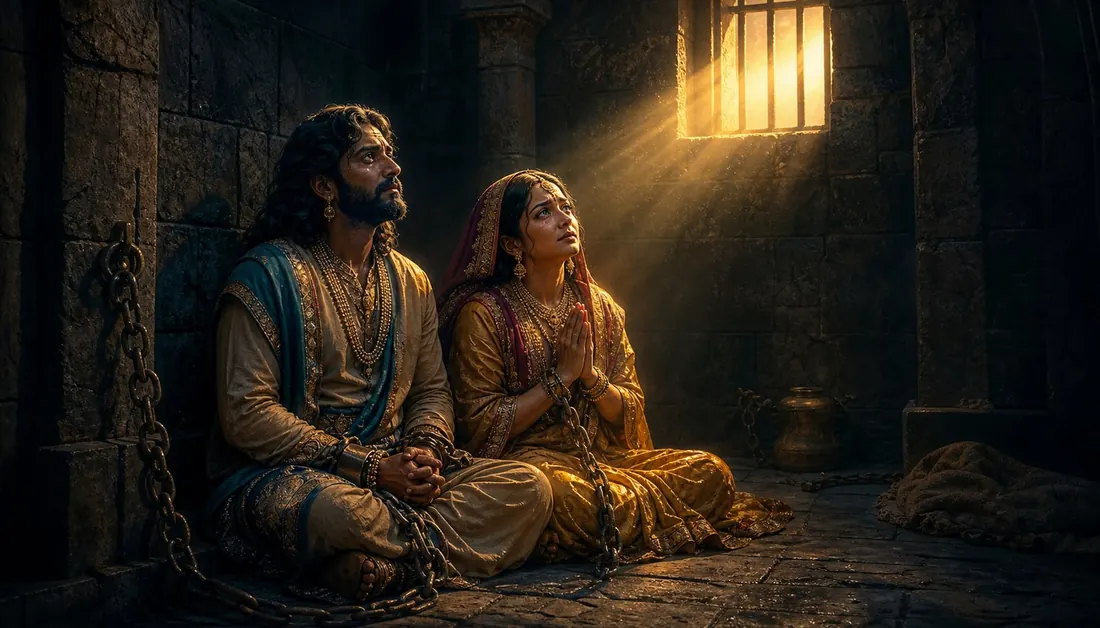
In one moment his love curdled into terror. He spared his sister’s life on her wedding day only when Vasudeva promised to hand over every child born to them. The tyrant locked the newlyweds in his darkest prison, and one by one, six newborn children were taken from Devaki’s arms and killed.
Remember this prison. In the Hindu imagination it is more than a place: it is the heart in despair, the world at its darkest hour, the exact place where God chooses to arrive.
Chapter 1 · The Birth at Midnight
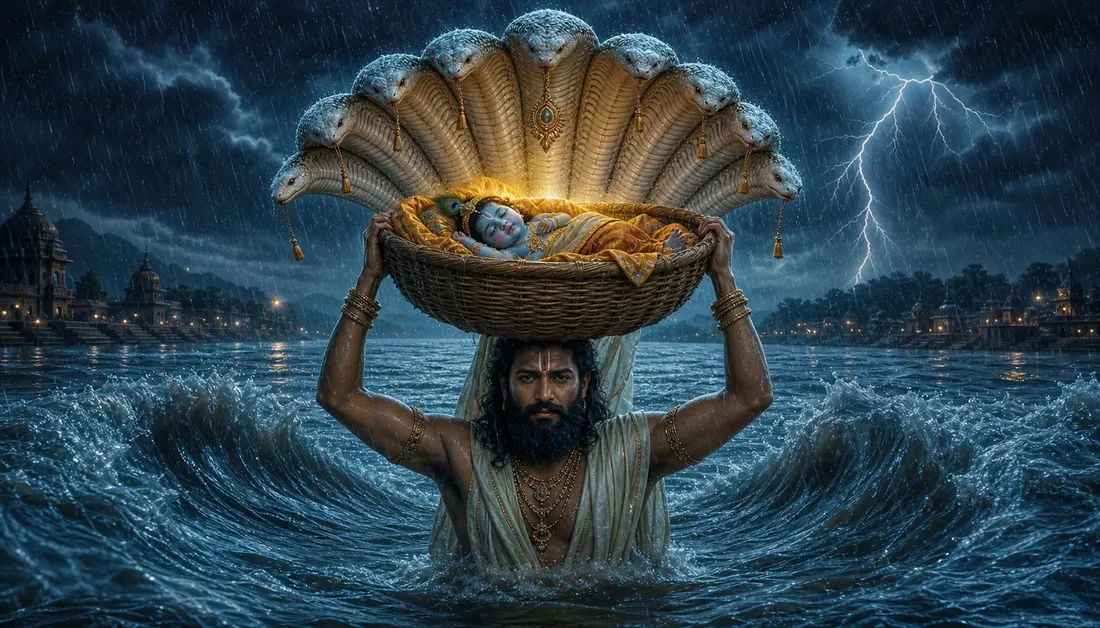
The seventh child was carried, by divine arrangement, to safety in another womb, to be born as Krishna’s elder brother Balarama. Then Devaki conceived an eighth time. This pregnancy was unlike the others: the prison seemed gentler, and a light rested on Devaki’s face that made even the guards uneasy. Kamsa doubled the locks and waited, sleepless.
He was born at midnight, the darkest hour of a storm-lashed night in the month of Shravana, when the rain fell as if the sky meant to wash the world clean. And in that instant, everything simply opened. The shackles fell from Vasudeva’s wrists. The barred doors swung silently wide. The guards slept as if enchanted.
For one moment the newborn showed his parents his true form, Vishnu himself, radiant. Then he became what every parent has ever held: a small, warm, crying baby. And a voice said: Take me across the river, to Gokul, to the house of Nanda and Yashoda. Their newborn daughter, bring her back in my place.
Vasudeva lifted his son in a basket onto his head and walked out of the open prison into the storm. The Yamuna was in flood: black, drowning-deep. He walked in anyway. The water rose to his knees, his chest, his chin, and then the great serpent Shesha spread his hoods above the basket like an umbrella, and the river, touching the feet of the child, grew calm and made a path.
By morning the baby lay asleep beside Yashoda in Gokul, and she, touched by the same divine sleep, knew only that she had given birth to a beautiful dark-skinned son. When Kamsa came at dawn and seized the exchanged baby girl, she rose out of his hands into the air, blazing, revealed as the Goddess herself: “Fool. The one who will end you is already safe, and growing.”
Why this story matters
Hindus celebrate this night every year as Janmashtami, the midnight celebrations, the tiny cradles, the children dressed as Krishna. Under the festival lies the story’s real promise: God is born precisely where the night is darkest, at the hour despair feels final. The locks that open, the river that parts, this is what the arrival of the divine does to a heart that has been a prison. Nothing about your circumstances has to change first. He arrives into them.
Chapter 2 · The Butter Thief of Gokul
In Gokul, and later in the cowherd village of Vrindavan, the child grew, and the stories from these years are the most beloved in all of Hindu literature, retold at bedtimes for a hundred generations. They are called his lila: his divine play.
Yashoda’s Krishna was, to put it honestly, a delightful menace. He toddled into neighbours’ houses and stole their fresh butter, hence the name every Indian child knows him by, Makhan Chor, the butter thief. When the pots were hung too high he stacked wooden mortars, climbed his friends’ shoulders, broke the pots and shared the loot with the monkeys. The village women came daily to Yashoda to complain, and somehow always stayed to watch him, unwilling to leave.
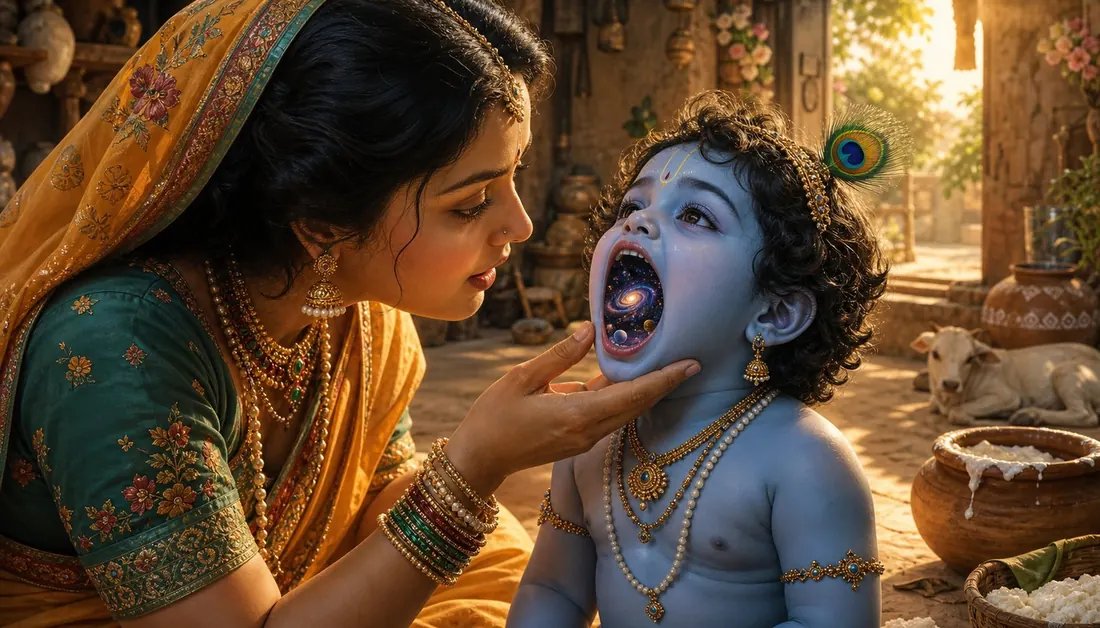
One day the children ran to Yashoda: Krishna is eating mud! She caught him, scolded him, and demanded he open his mouth. He resisted with the full theatrical outrage of a guilty toddler, and then opened it.
Inside his small mouth Yashoda saw the whirling of galaxies. Oceans, mountains, the sun and the moon, all the worlds turning, time itself, and in one corner of that universe, the village of Gokul, and in the village a mother, looking into the mouth of her son. For a heartbeat she stood at the edge of infinity.
Then Krishna blinked, and she forgot, because she asked to forget. She reached for him and held him as her boy, not as God, and carried him inside for his bath.
Why this story matters
This little episode holds the deepest idea in Krishna’s tradition. Yashoda was given the vision mystics spend lifetimes seeking, and chose, instead, a mother’s love for her child. Hinduism calls this bhakti: the path of loving devotion, where the humblest daily affection, feeding, scolding, worrying over someone, can be worship of the highest order. God, this story says, would rather be loved as your own than admired as the infinite. The butter he steals is the heart softened by love; he takes it only where it is kept.
Chapter 3 · The Protector of Vrindavan
Kamsa had not forgotten the prophecy. Demon after demon came quietly into the cowherd country to find the child. Putana came as a beautiful wet-nurse with poison on her breast; the infant Krishna drank the poison, and the life behind it, and she fell in her true monstrous form across the fields, yet because she had come as a nurse, the tradition says, he granted her the destiny of a mother. Trinavarta came as a whirlwind and carried the baby into the sky, and was astonished to find the small body grow heavier than a mountain until the storm itself collapsed.
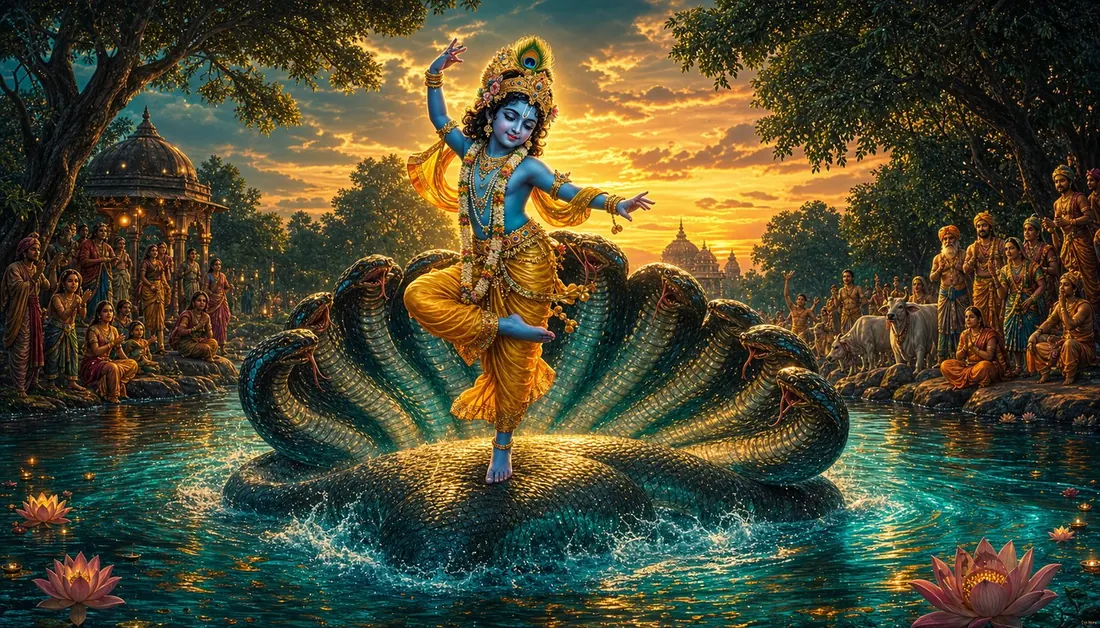
But the danger the village remembers most did not come from Kamsa at all. In a deep bend of the Yamuna lived Kaliya, a serpent king with a hundred and one hoods, whose venom blackened the water. Trees on the bank withered; birds fell from the air above the river; cows and cowherd boys who drank from it dropped where they stood, and were revived only by Krishna’s glance.
One afternoon, the boy Krishna climbed a kadamba tree overhanging the poisoned bend, and dived in. The river boiled. Kaliya rose and wrapped him in his coils, and for one long hour the village stood on the bank and wept, Yashoda held back by the elders. Then Krishna grew vast within the serpent’s grip, broke it, and rose out of the water dancing on Kaliya’s hoods, his feet striking each of the hundred and one heads in rhythm, as if the deadliest thing in the river were only a drum for his play.
When the serpent’s queens prayed for their husband’s life, Krishna spared him, and sent him away to the ocean with a promise of safety, the mark of the Lord’s feet on his hoods a lifelong protection. The Yamuna ran sweet again.
Why this story matters
Notice what the divine does with poison here. He does not curse the river or abandon the village; he enters the poisoned place himself and turns its danger into a dance floor. And even the serpent is not destroyed but sent home, marked with grace. For the devotee, Kaliya is the venom a mind can carry, old anger, old fear. The promise of this story is not that the serpent never existed, but that what once poisoned the water of your life can be danced upon, subdued, and released.
Chapter 4 · The Mountain on a Finger
Every year the cowherds of Vrindavan held a great sacrifice to Indra, king of the gods and lord of rain. One year the boy Krishna asked his father a question that stopped the whole village: “Why do we worship the far-away rain, and not the near-by hill? It is Govardhan that feeds our cows, gives us wood and water and shade. Should we not honour what actually sustains us?” The elders, half-amused and half-persuaded, agreed, and that year the offerings were made to the mountain.
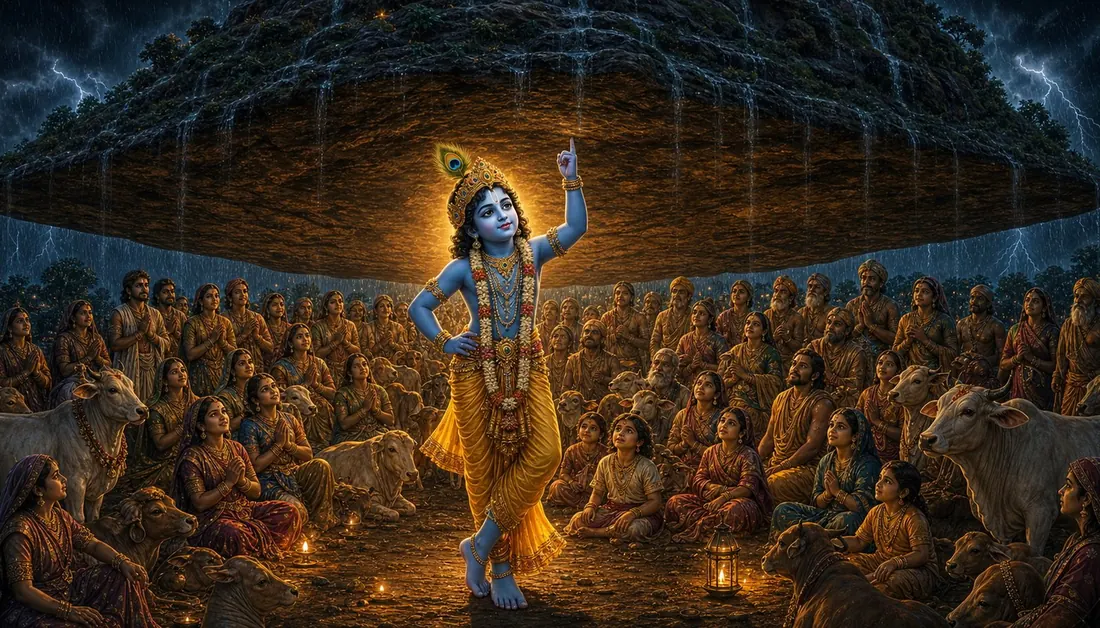
Indra’s pride broke like a dam. He sent the clouds of the world’s ending against one small village: rain like falling rivers, hail, lightning that walked the fields, for seven days. The lanes became torrents; the cows screamed; everything the cowherds had was going into the dark water.
And a boy of seven walked to the foot of Govardhan hill, set his palm beneath a ledge of rock, and lifted the mountain, the whole of it, holding it above the village on the little finger of his left hand, as lightly as a child holds a mushroom. Under that impossible stone umbrella the entire village sheltered: every family, every cow, every last sparrow, for seven days and seven nights, while the storm spent itself against the hill.
On the eighth morning Indra called back his clouds, descended, and bowed. The boy set the mountain down and asked, as if nothing had happened, whether the calves were frightened.
Why this story matters
This story asks a quietly radical question: where is your gratitude actually owed? Krishna turns worship from the distant and fearsome to the near and nourishing, the hill, the cows, the daily bread. And when the punished sky answers, note how grace carries weight: on a little finger, without strain, almost playfully. What crushes us is, to the divine, light. Devotees still walk the Govardhan parikrama today, and Diwali’s Govardhan Puja, the mountain of food offered in temples, is this story, alive on a plate.
Chapter 5 · The Flute in the Moonlight
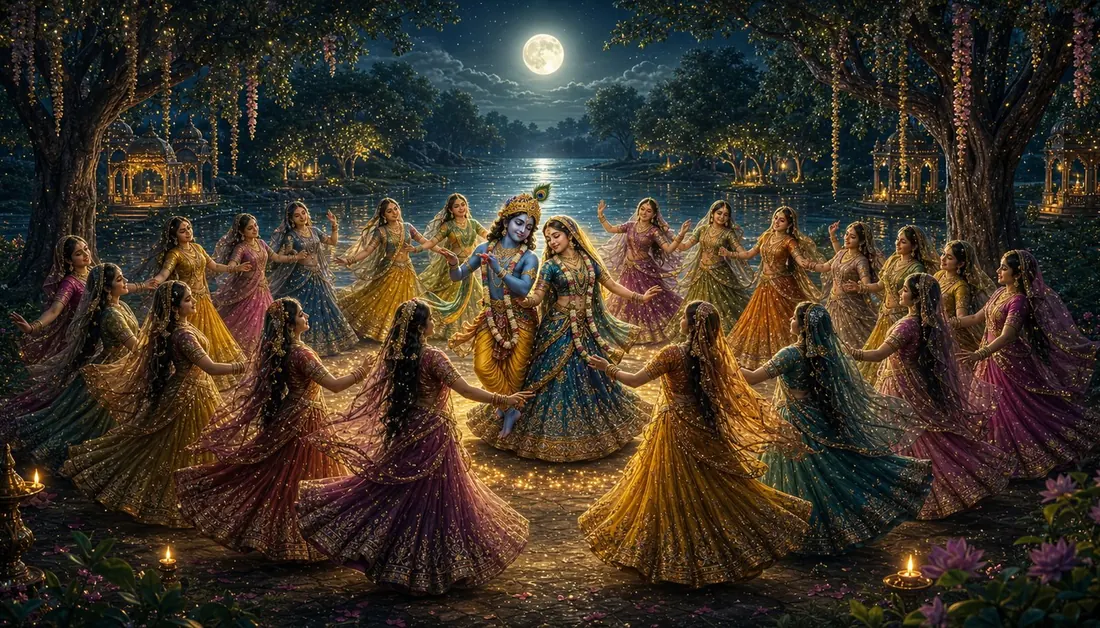
Of all the chapters of Krishna’s life, the tradition holds this one highest, and asks that it be entered with clean hands, for it is not what a casual reading assumes. On full-moon nights in Vrindavan, Krishna would stand beneath the trees by the Yamuna and play his flute. And the gopis, the cowherd women, hearing it, would leave whatever they were doing, leave name and duty and fear of opinion, and come to the forest.
There, in the clearing called the Raas Lila, the divine dance took place: a great circle of dancers in the moonlight. And, this is the heart of it, each gopi found Krishna dancing with her alone. He had multiplied himself so that no seeker in the circle ever lacked the beloved at her side. Whoever grew proud, thinking she alone possessed him, found her partner vanished; whoever simply loved, found him always there.
First among them all was Radha, her love so complete that the tradition stopped being able to tell where she ended and Krishna began. India worships them as one word: Radha-Krishna. Not a god and his consort, but Love and its Beloved, the soul and its Lord, inseparable.
The saints have always insisted: this is not a story about romance. The flute is the call of the divine, which reaches a soul in the middle of its housework; the leaving of everything is the heart’s answer; the dance in which each has the Beloved wholly to herself is the secret of how God is loved by millions and yet belongs, entirely, to each.
Why this story matters
Why does a devotional tradition place a moonlit dance above its philosophy? Because the Raas Lila answers the loneliest question a person can ask: is there enough of God for me? The dance says: you do not receive a share of the divine, a portion, a queue number. Every soul that turns toward him finds him wholly, privately, inexhaustibly present, as if there were no one else in the circle at all.
Chapter 6 · Return to Mathura
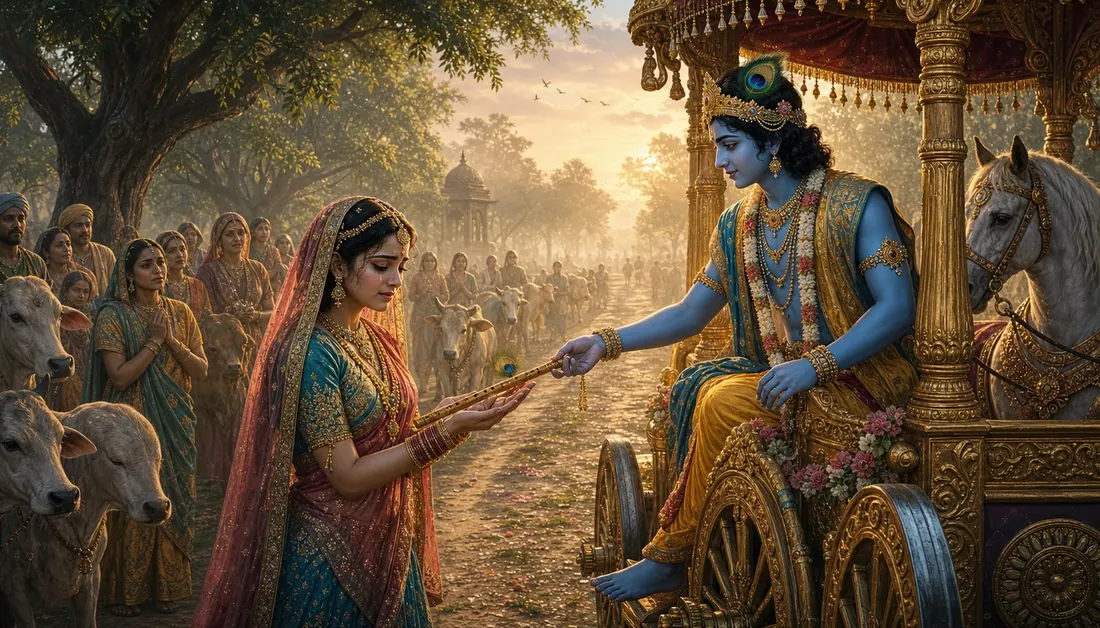
The boys grew toward sixteen, and Kamsa, his demons spent, chose treachery dressed as honour: a royal invitation: a festival of wrestling in Mathura, with his court wrestlers, killers both, waiting in the arena; a maddened elephant waiting at the gate.
The night before Krishna left Vrindavan is the tradition’s tenderest wound. The whole village walked with the chariot; the gopis stood in the road. He gave Radha his flute, and the texts say that Krishna, who would rule kingdoms and speak the Gita, never played the flute again. What belonged to Vrindavan he left in Vrindavan, whole.
In Mathura the elephant charged and fell; the wrestlers seized the boys and were broken by them; and the arena went silent as a sixteen-year-old walked, unhurried, up the royal steps. Kamsa, who had murdered six infants for fear of this moment and by that very fear had summoned it, was dragged from his throne, and the prophecy spoken on a wedding day was complete.
And then, the telling notes with quiet insistence, Krishna did not take the crown. He freed his grandfather Ugrasena and returned the throne to him; he opened the prison and touched, for the first time since the storm-lashed midnight, the feet of Devaki and Vasudeva, his first mother and father.
Why this story matters
A lesser story ends with the hero on the tyrant’s throne. Krishna’s refusal of the crown is the whole point: this was never revenge, and never ambition, it was dharma, the setting-right of the world, after which the hand that struck lets go completely. And the silenced flute teaches something grown hearts know: some chapters of grace are not carried forward; they are left, perfect and unrepeatable, where they happened, which is why Vrindavan remains, to this day, the tradition’s undying spring.
Chapter 7 · The King Who Kept No Throne
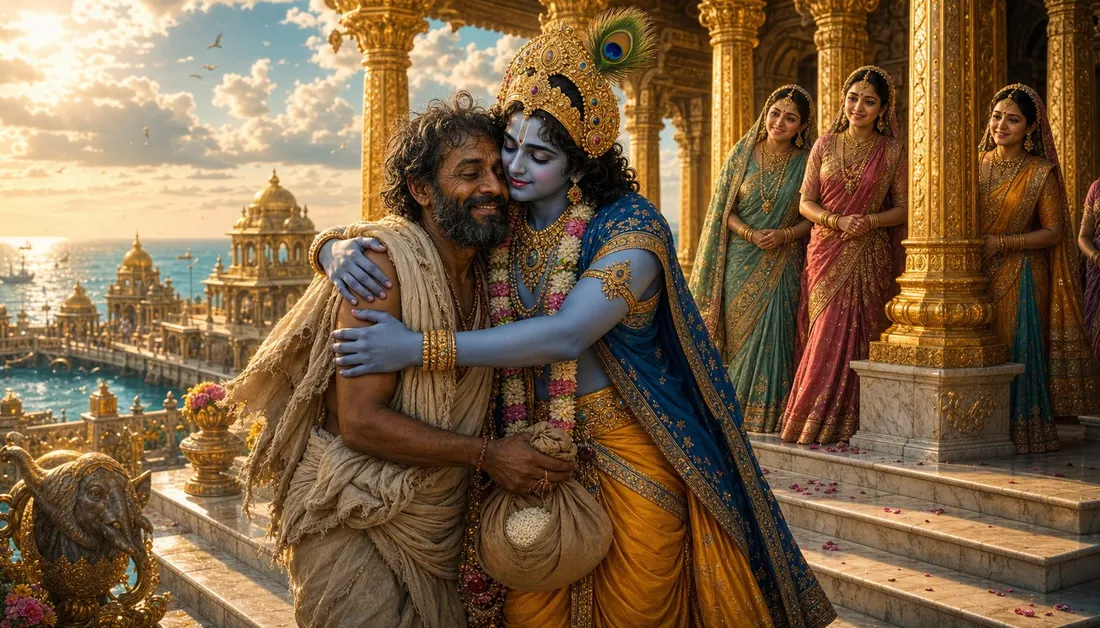
Years passed. To spare Mathura the endless retaliation of Kamsa’s allies, Krishna moved his people across the country to a golden city on the western sea: Dwarka. There he lived as prince, statesman and householder, never by choice as king: the counsellor whose advice kingdoms sought and whose friendship was the age’s most valuable possession.
One day a brahmin in torn clothes appeared at the gates: Sudama, Krishna’s inseparable friend from their student days, now sunk in a poverty so complete his children went hungry. His wife had pressed him to go to Dwarka and ask his old friend for help. He had come. But at the palace doors, shame closed his throat. All he carried was the poor man’s gift his wife had tied in a rag: a few handfuls of beaten rice.
Krishna saw him from the terrace and came running, barefoot, through the court; embraced him, seated him on his own couch, washed his feet with his own hands while queens looked on. And then he spotted the little bundle Sudama was trying to hide. “What have you brought me?” He snatched it like a boy stealing butter, ate one handful of the dry rice with delight, reached for a second, and his queen Rukmini caught his hand: enough, Lord. With one handful you have already given him both worlds.
Sudama, too full-hearted to ask for anything, walked home with empty hands, and found, where his broken hut had stood, a house full of light, his children fed, his wife weeping with joy. Krishna had said nothing, promised nothing, and given everything.
Why this story matters
Hinduism’s most beloved teaching on friendship with God is a story about snacks. Krishna does not weigh the gift; he weighs the giving. The beaten rice, offered with embarrassment, out of poverty, out of love, outvalues the treasuries of kings. For anyone who has felt they have too little to bring to God, too little faith, too little practice, too little worth, Sudama’s bundle is the answer: bring the little, honestly. It is received like a feast, and repaid like an ocean.
Chapter 8 · The Charioteer
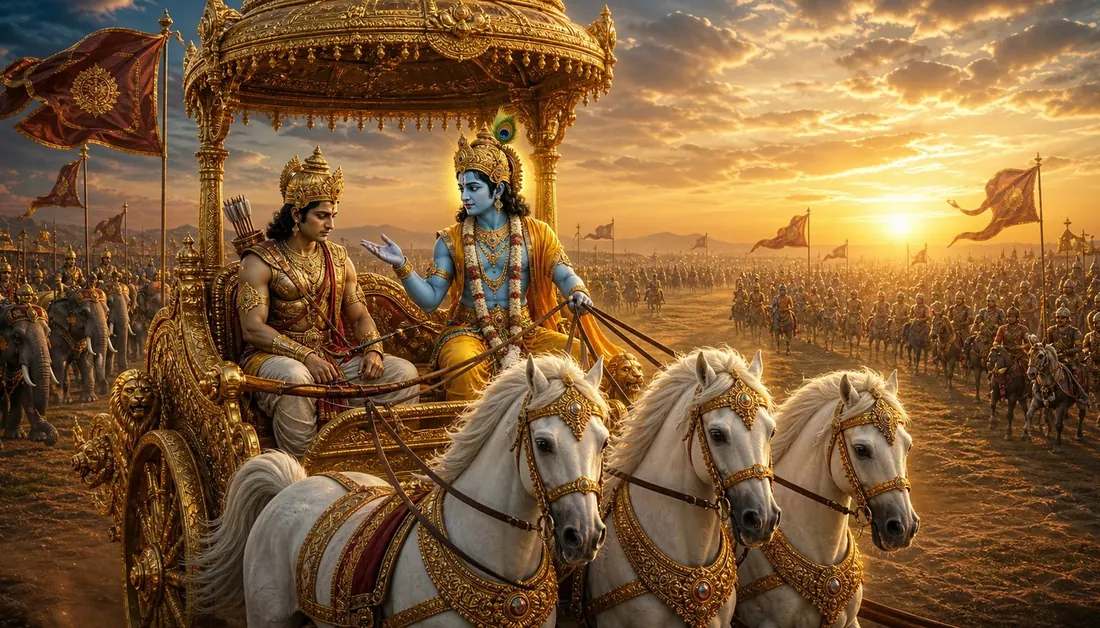
The last act of Krishna’s story belongs to the Mahabharata, the epic of two branches of one royal family: the five Pandava brothers, upright and wronged, and their hundred cousins the Kauravas, who stole their kingdom by a rigged game of dice and refused to return even five villages. Krishna, kinsman to both sides, tried peace to the end; he went himself as an envoy and was nearly seized at court. War became certain.
Both sides came to Dwarka for his help, and Krishna offered a choice that reveals everything: on one side, my whole army; on the other, myself alone, and I will not lift a weapon. The Kaurava prince grabbed the army, delighted. Arjuna, the greatest archer of the age, chose Krishna, and asked him only to drive his chariot.
On the morning of battle at Kurukshetra, Arjuna asked to be driven between the two armies. And there, seeing grandfathers, teachers and cousins on both sides of the coming slaughter, the great warrior broke. He sat down in the chariot, dropped his bow, and said: I cannot.
What Krishna spoke to him then, in the space between two armies, is the Bhagavad Gita: the Song of God, seven hundred verses that have become the spiritual backbone of Hinduism. Its heart can be held in a sentence: you have a right to your work, but not to its fruits. Act, because action done as duty and offered to the divine is worship; and the Self within you, unborn and undying, was never slain and never slays. And when Arjuna asked to see who was really speaking, Krishna granted him the Vishvarupa, the universal form: all worlds, all beings, all time, arising and dissolving in one boundless body, until Arjuna begged to have his gentle friend back.
Arjuna picked up his bow. The war was won, dharma restored at terrible cost. And Krishna, his work of an age complete, withdrew in time to a forest by the sea, where a hunter’s arrow, mistaking his foot for a deer, became the door by which the Lord left a world that could no longer hold him.
Why this story matters
Everything Krishna is comes to a point here: God does not fight our battles for us, and does not abandon us to them: he takes the reins beside us. The Gita is not spoken on a mountaintop to a monk; it is spoken in traffic, between two armies, to a person having a breakdown at work. That is its permanent address. Read one verse of it and you are hearing the same voice that held up Govardhan, steady, amused, infinitely near, saying: stand up, I am with you, act.
यदा यदा हि धर्मस्य ग्लानिर्भवति भारत ।
अभ्युत्थानमधर्मस्य तदात्मानं सृजाम्यहम् ॥
yadā yadā hi dharmasya glānir bhavati bhārata
abhyutthānam adharmasya tadātmānaṃ sṛjāmy aham
“Whenever righteousness declines and unrighteousness rises, O Bharata, then I bring myself into being.”
Bhagavad Gita 4.7
Small Glossary
- Avatar
- A “descent”: the divine taking birth in the world to protect goodness. Krishna is the eighth avatar of Vishnu.
- Bhakti
- The path of loving devotion; relating to God through love rather than ritual or philosophy alone.
- Darshan
- “Seeing and being seen” by the divine; the blessing of beholding a sacred image or presence.
- Lila
- Divine play; the stories of Krishna’s life understood as God’s joyful, purposeful theatre.
- Janmashtami
- The midnight festival of Krishna’s birth (August/September).
- Gopi
- The cowherd women of Vrindavan, the tradition’s great exemplars of pure devotion.
- Radha
- First among the gopis; devotion so complete that she and Krishna are worshipped as one: Radha-Krishna.
- Dharma
- Right living; the order that upholds the world, and each life’s duty within it.
- Bhagavad Gita
- The “Song of God”: Krishna’s 700-verse teaching to Arjuna at Kurukshetra.
- Yamuna
- The sacred river of Krishna’s homeland, sister-river of the Ganga.
Retold in original words from the Shrimad Bhagavatam (Book 10), the Vishnu Purana, the Harivamsa and the Bhagavad Gita.
Test yourself
Think you know Krishna? Ten questions, no sign in.
Carry this darshan with you.
The Bhakti Angan app brings a new darshan each morning, simple mantras, a japa counter and the daily Panchang.