
The Complete Story · For First-Time Readers
ShivaFrom Sati’s fire to the Lord of the Dance: the whole story of Mahadev, told gently, for someone meeting him for the first time.
Who is Shiva?
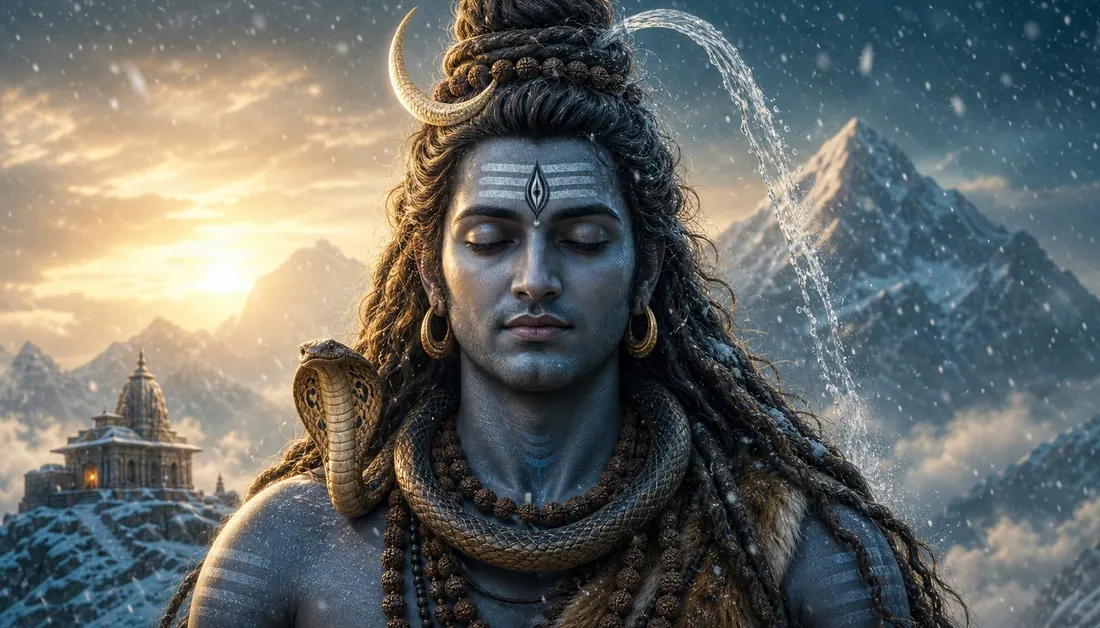
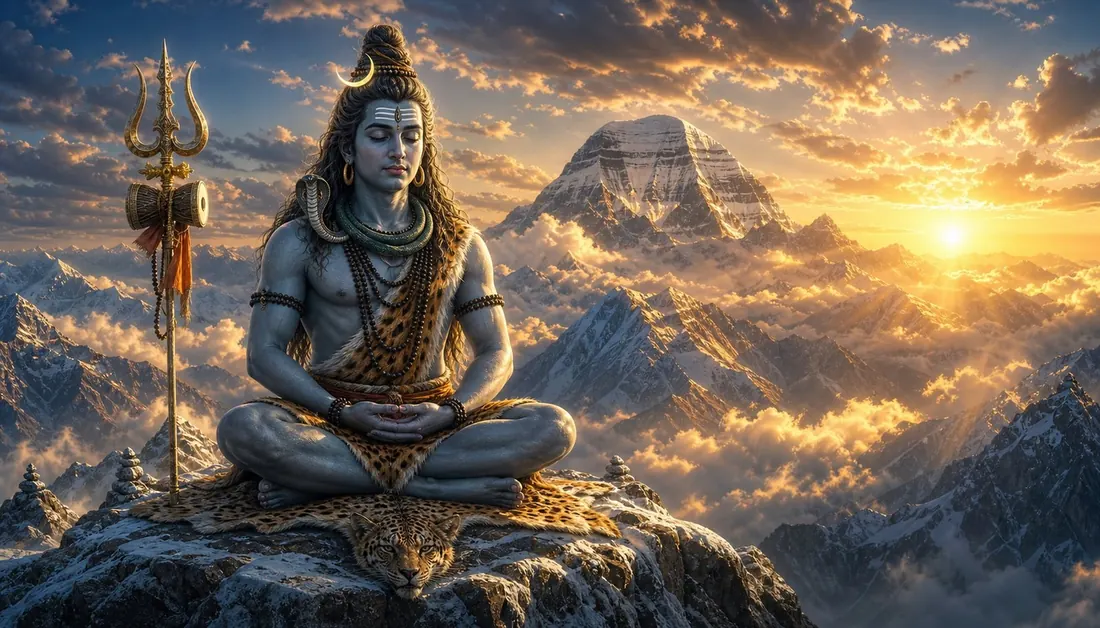
Somewhere in your mind there is already a picture of him: a still figure seated in meditation on a mountain of snow, ash-pale skin, matted locks piled high with a crescent moon caught in them, a river spilling from his hair, a serpent calm around his throat, and a third eye, closed, in the middle of his forehead. That is Shiva: Mahadev, the Great God, the most worshipped and most misunderstood figure in all of Hinduism.
In the great trinity of Hindu thought, Brahma creates, Vishnu preserves, and Shiva… destroys. The word alarms newcomers, and it should not. Shiva destroys the way a farmer clears a field, the way night dissolves the day, the way silence ends a noise: so that something new can begin. He is the god of endings that make beginnings possible, which is why the devout who fear every other loss run toward him with theirs.
And here is the paradox that makes him beloved rather than terrifying: this Lord of endings is famously the easiest of all gods to please. The tradition calls him Bholenath, the innocent lord, the simple one. Kings win his favor with kingdoms and demons with penance, but so does a poor devotee with a single wild leaf and a cup of plain water offered with a whole heart. He keeps no court and needs no gold. He lives outside the village, on the cremation ground, on the mountain, with the outcasts and the wanderers no one else will have.
His story, told across this page, is not a war epic like the Ramayana or a life-story like Krishna’s. It is something stranger and more intimate: the story of how the wildest, most solitary force in existence was, again and again, tamed by love.
Chapter 1 · Sati and the Fire
In the beginning of things, Shiva belonged to no family and wanted none. He meditated alone on Kailash, clothed in ash and sky, so absorbed in the depths of his own being that ages passed him like afternoons. The gods found him magnificent and unsettling in equal measure. And nothing unsettled them more than the question of what would happen if such power ever loved.
It happened. Sati, daughter of the proud god-king Daksha, chose Shiva against every wish of her father, who saw in the ash-smeared ascetic everything his glittering court despised: no palace, no manners, no throne. Sati saw what her father could not, and she left his palace to live with Shiva on the mountain, and for a time the solitary god knew household happiness.
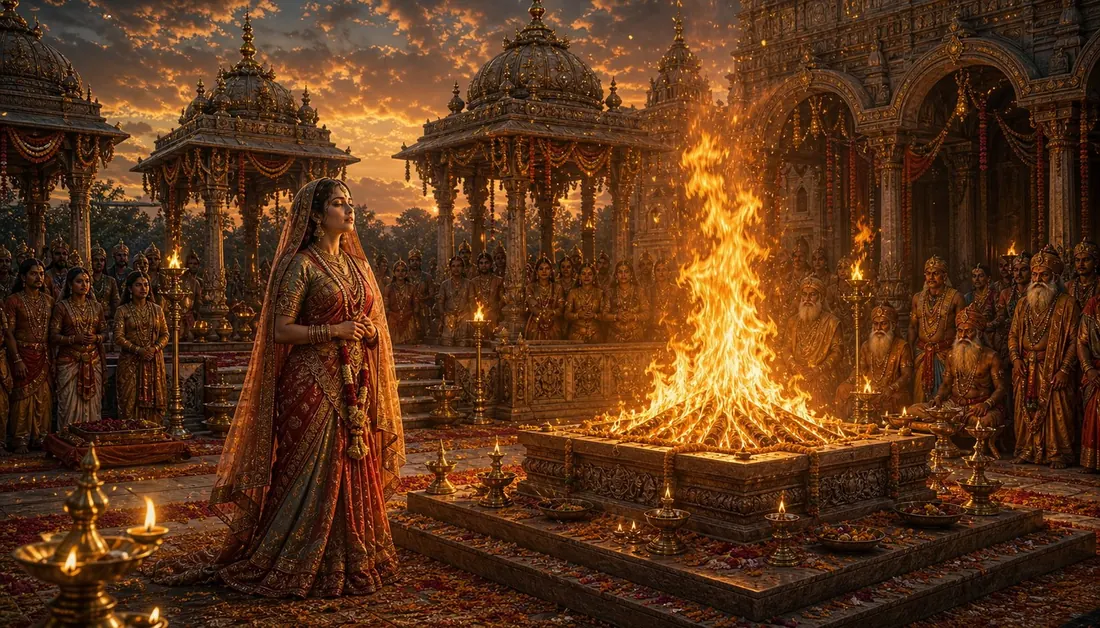
Then Daksha held a great yajna, a fire ceremony to which he invited every god, every sage, every king… except his own daughter and her husband. Sati went anyway, unwilling to believe a father could shut a door on his child. He could. Before the entire assembly Daksha mocked her husband: the beggar, the ghoul, the ash-covered haunter of cremation grounds. And Sati, unable to bear her father’s contempt for the lord she loved, and unwilling to keep a body born of a man who could speak so, walked into the sacrificial fire and gave it back.
What came to that yajna next, the scriptures describe with awe. Shiva’s grief split into fury, and from that fury rose Virabhadra, a being of storm and flame who scattered the assembly and brought Daksha low. And then, grief outlasting anger, Shiva lifted the body of Sati onto his shoulder and walked the worlds, inconsolable, the universe trembling under the sorrow of the god who was never supposed to need anyone. Where the pieces of her fell, the earth itself became holy: the Shakti Peethas, seats of the Goddess, pilgrimage places to this day.
Then he returned to his mountain and closed his eyes, and this time the meditation was a wound. The wildest force in existence had loved once, and lost, and would not be reached again.
Why this story matters
Newcomers are often startled that a god’s story holds this much pain, and that is exactly why it is told. Hindu tradition does not pretend that love is safe, or that even the divine escapes grief. Sati’s fire is the dignity of one who will not live where her beloved is insulted; Shiva’s wandering sorrow is every mourner’s, made cosmic. And the Shakti Peethas teach something extraordinary: the places where grief fell to earth did not become cursed ground. They became the holiest ground of all. Loss, this story insists, is where the sacred enters.
Chapter 2 · The Penance of Parvati
The universe, meanwhile, had a problem only Shiva could solve. A demon named Taraka had won a boon that he could die only by a son of Shiva, and then set about conquering the three worlds, secure in the knowledge that the great ascetic, sealed in grief, would never father anyone. Heaven’s hope came to rest on something apparently impossible: the heart of Shiva would have to open again.
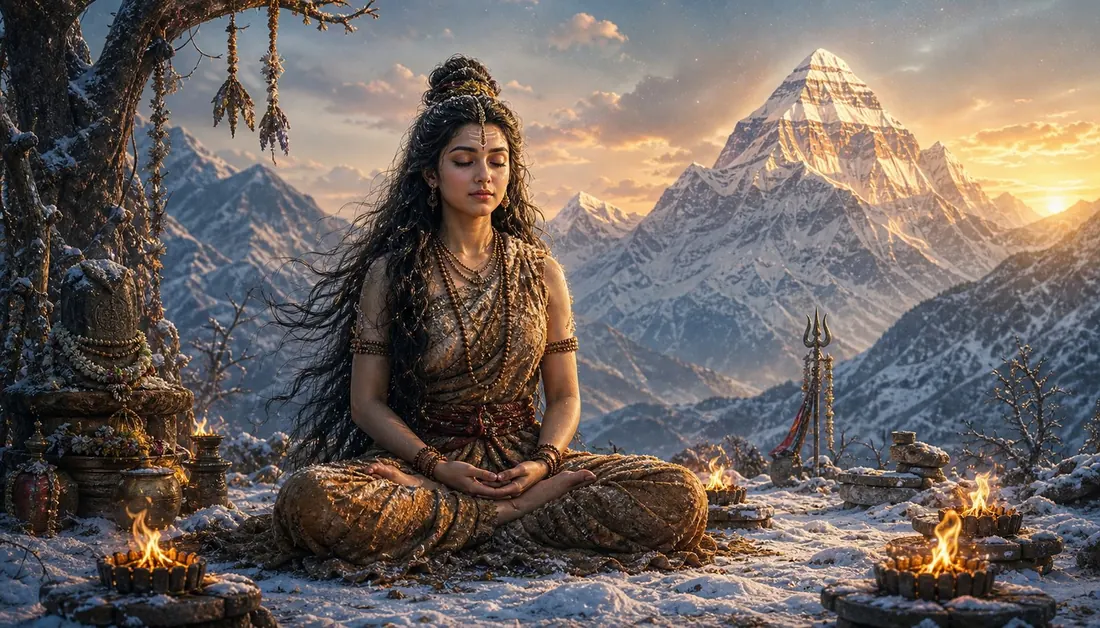
Sati returned. She was born as Parvati, daughter of Himavan, lord of the Himalaya, the same soul come back to finish what fire had interrupted. She grew up within sight of Kailash, and loved Shiva from childhood with a quiet certainty that puzzled everyone around her. The meditating god, of course, never once looked up.
The gods tried a shortcut. They sent Kamadeva, the lord of desire himself, to wake Shiva with his flower-arrow. The arrow flew, the god stirred, and for one instant his concentration broke. Then the third eye opened, the eye that sees things as they are, and Kamadeva was ash on the wind before the birds had finished startling. The lesson stands for all time: desire cannot force open what only devotion can.
So Parvati did the unthinkable. The princess left her palace and went into the high mountains as an ascetic, matching the great ascetic himself: standing through summers among fires, sitting through winters in frozen streams, eating leaves, then eating nothing, until the sages called her Aparna, she who lived on not even a leaf, and the heat of her penance began to warm the worlds. Shiva, who could ignore desire, could not ignore tapasya. He came to her disguised as a young brahmin and spent an afternoon listing every dreadful thing about Shiva: the ash, the snakes, the ghosts, the homelessness. Parvati rose to leave rather than hear another word against her lord. The disguise fell away, and the god who had sworn never to love again asked for her hand.
Their wedding is the tradition’s great comedy and its great consolation. The bridegroom arrived at the palace gates on a bull, dressed in ash and serpents, trailed by his ganas, a procession of ghosts, goblins and holy madmen, and Parvati’s mother fainted outright. Parvati only smiled. She had not fallen in love with a costume. Every year at Maha Shivaratri, the great night of Shiva, devotees keep vigil remembering this wedding: the night the recluse of Kailash became a householder.
Why this story matters
This is the tradition’s deepest teaching on how the divine is won. Kamadeva’s arrow is every shortcut we hope will work on what matters: charm, luck, technique. It burns. Parvati’s penance is the only thing that has ever opened Shiva: patient, self-forgetting constancy that asks nothing and outlasts everything. And notice what she refused: she would not listen to her beloved being mocked, even by a stranger, even when agreeing might have served her. Love that will not trade its object’s honor for its own advantage: that is the love that turns the ascetic into a bridegroom.
Chapter 3 · The Blue Throat
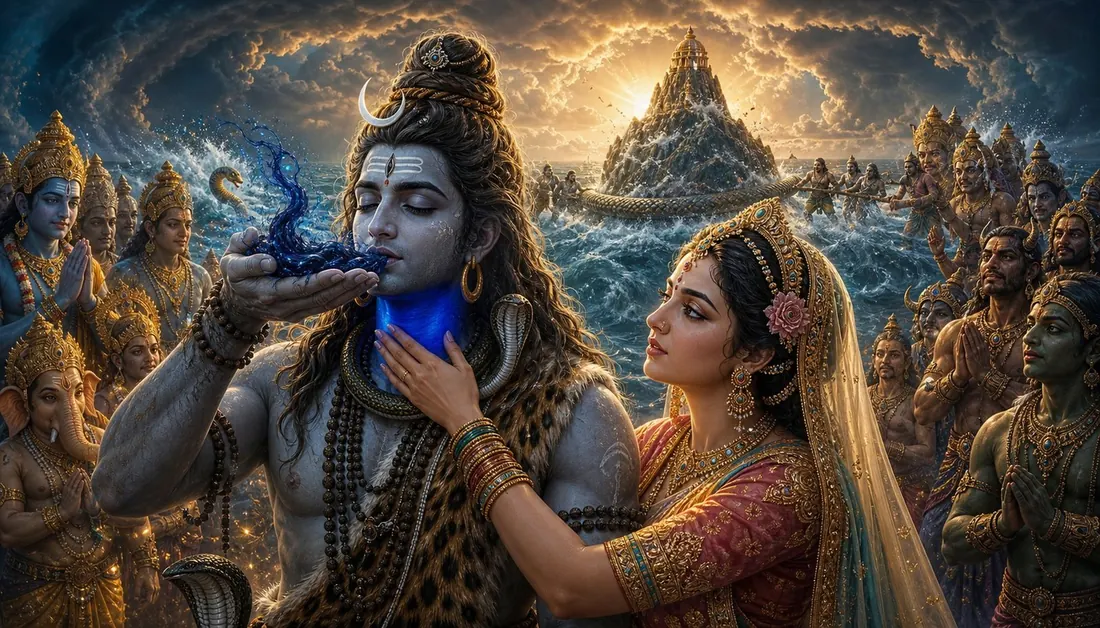
Of all the stories of Shiva, the one the world most needed happened far from Kailash, at the churning of the cosmic ocean. Gods and demons together churned the sea of milk for the nectar of immortality, and before any treasure rose, the ocean yielded halahala: a poison so total that its first fumes began to blacken the three worlds. Gods and demons alike, allies of convenience, fled the thing they had made together.
They fled, as the desperate always do, to the one who keeps nothing and therefore fears nothing. And Shiva did not hesitate, did not weigh, did not negotiate terms. He gathered the world’s death into his cupped palm and drank it.
It was Parvati who moved fastest: she pressed her hand to her husband’s throat and held the poison there, where it could reach neither the Lord’s heart nor the worlds the tradition says are contained within him. The halahala lodged and burned and stayed, and his throat turned the deep blue of a rain cloud, and the worlds were saved. From that day he is Neelkanth, the blue-throated one, and the mark of the deadliest thing that ever existed sits on him like an ornament.
He did not swallow the poison, and he did not spit it out. This detail is the whole theology. The poison is real; it does not vanish; it is held, transformed by the holding, worn forever as a sign of what love is willing to carry. The full story of that churning is told in our short katha, The Story of Neelkanth.
Why this story matters
Every tradition must answer the question: what does greatness do when the poison surfaces? Shiva’s answer is not to assign blame (the churners made it), not to protect himself (he had the least to gain from the nectar), but to take the world’s worst into his own throat so that everyone else may live. And the throat matters: real pain is neither swallowed into denial nor spat out onto others. It is held, consciously, at the throat, between heart and speech, until it becomes a strength others can recognize you by. The blue throat is the tradition’s highest image of what it costs, and what it means, to absorb suffering for the sake of the world.
Chapter 4 · The River in His Hair
A king named Bhagiratha had an impossible inheritance: sixty thousand ancestors reduced to ash under a sage’s curse, whose souls could find no peace until the celestial river Ganga herself washed their remains. But Ganga flowed in heaven, and heaven does not drain to earth on request. Bhagiratha did what the desperate faithful do in these stories: he gave up his throne and performed tapasya for a thousand years.
Ganga was ordered down, and she came… furious. A goddess-river does not take demotion kindly, and she resolved to fall on the earth with her full celestial force, enough to shatter the land into the underworld and drown the very ancestors she was meant to save. There was exactly one being in existence who could break the fall of a river falling from heaven.
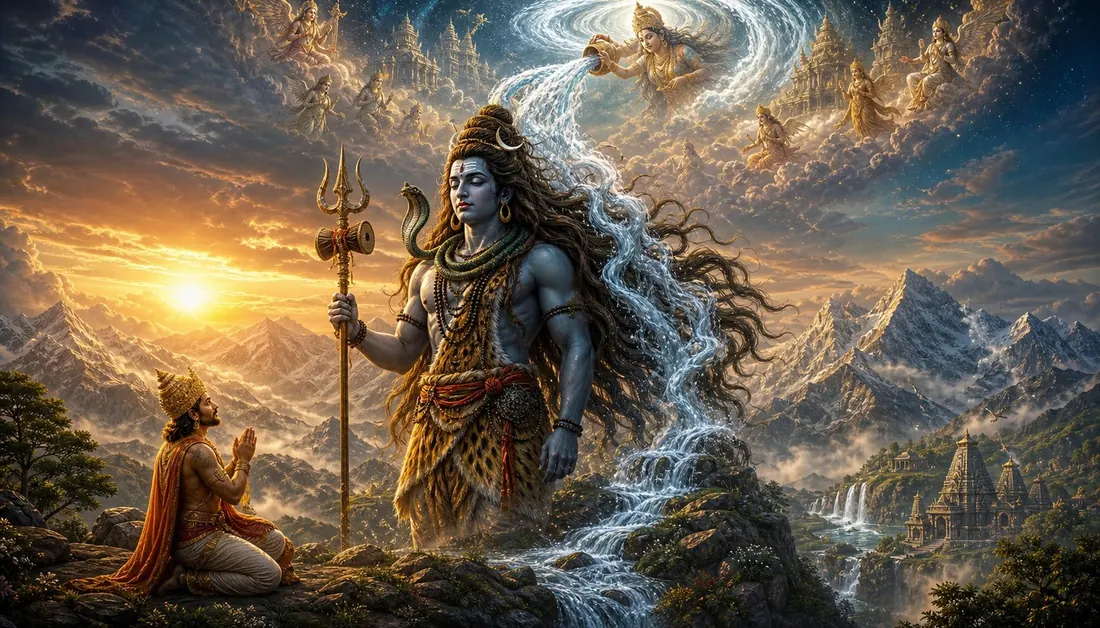
Shiva stood beneath the descending flood and caught the goddess in his matted locks. The hair of the great ascetic, wild and vast as a forest, swallowed her raging descent entirely; the torrent that would have cracked the world wandered his locks like a stream lost in wilderness, and could not find its way out. Proud Ganga, tamed not by force but by absorption, emerged at last as seven gentle rivers, and followed Bhagiratha’s chariot meekly across India, washing the ancestors into peace as she went.
This is why every image of Shiva shows a small stream leaping from his hair, and why the Ganga is addressed in prayer as living in his crown. The wildest river wears him as her source; he wears her as an ornament. Neither diminished the other.
Why this story matters
Grace, this story says, must be caught, or it destroys. Ganga is real power, real blessing, genuinely descending in answer to genuine prayer, and unmediated she would have annihilated everything she came to save. Shiva’s locks are the container that turns catastrophe into nourishment: the discipline, the stillness, the practice into which raw force can fall and become gentle. The tradition reads this everywhere: knowledge without a teacher, energy without a path, even love without patience, all fall like uncaught Ganga. Find the head that can bear the river, and the same force waters the world.
Chapter 5 · The Household on the Mountain
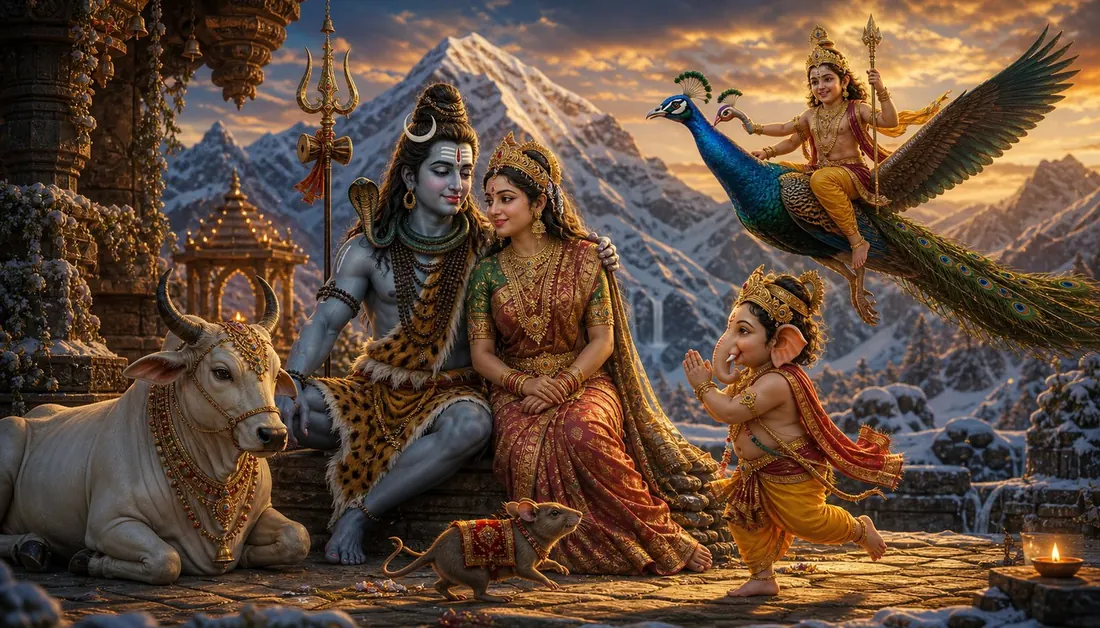
The marriage of the ascetic and the mountain’s daughter produced the most beloved family portrait in Hinduism: Shiv Parivar, the household of Kailash. Its two sons could not be less alike, and every Indian child knows them both.
Kartikeya, the elder, was born for war: the radiant six-faced commander the gods had begged for, who led heaven’s armies against the demon Taraka and ended his tyranny. Ganesha, the younger, was made by Parvati herself, from the sandal-paste of her own body, to stand guard at her door. The story of how that guardian boy lost his head to Shiva’s wrath and gained an elephant’s, becoming the remover of obstacles and the first-worshipped of all gods, is told in our katha, The Birth of Ganesha.
One family story stands above the rest. A divine fruit arrived on Kailash, one fruit, two boys, and it was decreed it would go to whoever circled the world first. Kartikeya leapt onto his peacock and streaked across the continents and oceans. Ganesha, plump, small, mounted on a mouse, looked at his impossible odds… then walked slowly around his seated parents, folded his hands, and said: you are my world. He was eating the fruit when his brother returned.
And so the strangest of all divine families became the model one: the renunciate father who owns nothing, the mother who is the energy of the universe, one son who commands armies, one who removes obstacles, a bull, a peacock, a mouse and a serpent living in impossible peace on a mountain of ice. Every Indian household with its clashing temperaments has looked at Kailash and taken heart.
Why this story matters
Ganesha’s circle is the story India tells its children first, and it never stops being true: the race does not always go to the swift; it goes to the one who understands what the race was about. Wisdom beats speed, devotion redefines distance, and the whole world, truly, is sitting at home waiting to be honored. And the household itself teaches quietly: holiness does not require sameness. The family of Kailash holds opposites together, ascetic and mother, warrior and sage, and its peace comes not from uniformity but from each being wholly what they are, in love.
Chapter 6 · The Conqueror of Death
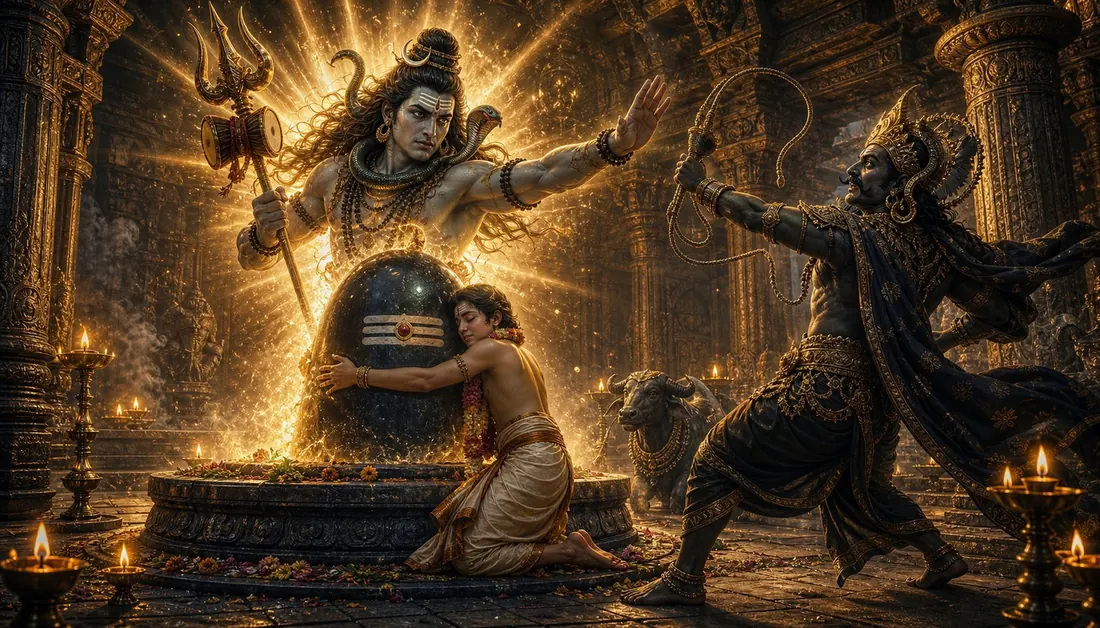
A sage and his wife, childless for years, were offered a choice by Shiva’s grace: a hundred dull sons, or one luminous boy who would live only sixteen years. They chose the one, and Markandeya grew into a boy of such devotion that visiting sages wept at the sight of him, and then remembered his horoscope and wept differently.
On the appointed day of his sixteenth year, Markandeya did not run. He sat before the Shiva linga, wrapped his arms around it, and gave himself to the name of the Lord. When Yama, the god of death, threw his noose, it closed around boy and linga together… and the stone split, and Shiva came out of it.
Not calm, this time. The scriptures give him a name for this moment: Kalantaka, the ender of Death itself. Yama, who ends all things, was struck to the ground for daring to touch what had taken refuge in Shiva. The boy was granted sixteen years of age, forever: an eternal youth who, tradition says, walks the world still. Death was revived, chastened, and sent back to work with a new law written over his old one: what shelters wholly in the Lord is not his to take. The full katha is told in The Story of Markandeya.
From this moment comes the most repeated prayer for protection in the tradition: the Mahamrityunjaya mantra, the great death-conquering chant, whispered over hospital beds and long journeys and frightened nights across the Hindu world for three thousand years.
Why this story matters
Every devotional tradition eventually faces its follower’s real question, which is not philosophical: I am afraid of death; can anything be done? This story is the tradition’s answer, and its honesty is striking: the horoscope was real, the noose was real, the sixteenth year arrived on schedule. Grace did not prevent the appointment. It changed who was present at it. The boy did not become strong enough to fight death; he became surrendered enough that death touched the Lord when it touched him. That is the only immortality this story promises, and for the devotee it has always been enough.
Chapter 7 · The Lord of the Dance
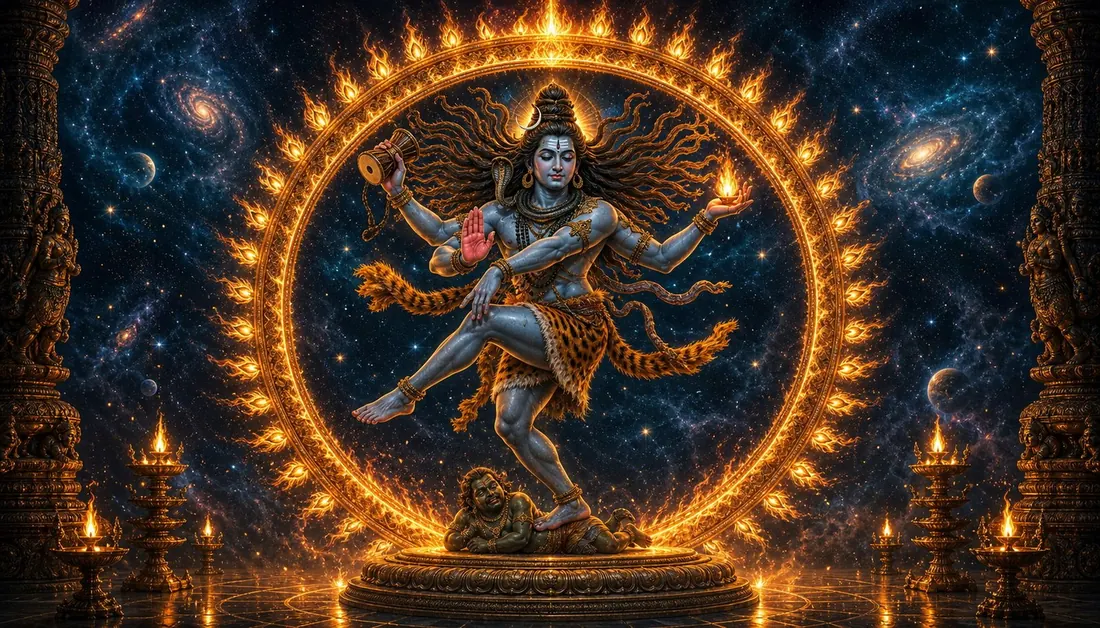
There is a form of Shiva so complete that when Western sculptors and physicists first encountered it, they simply stood still. It is Nataraja, the Lord of the Dance: Shiva with four arms and flying locks, dancing in a ring of fire, one foot planted on a struggling dwarf, one raised in impossible lightness.
The bronze is a complete theology you can hold in two hands. In one hand the damaru, the two-headed drum whose beat is creation itself, the first vibration from which the worlds condense. In another, fire: the flame of dissolution that takes them back. The third hand rises open-palmed: do not be afraid. The fourth points down at the raised foot: here is refuge. The dwarf beneath his planted foot is Apasmara, forgetfulness, ignorance, the shrunken self, not killed (ignorance is never killed) but danced upon, held under, made the platform. And the ring of fire is the universe itself, blazing around a dancer so absorbed he does not notice it.
This is the tradition’s boldest statement about reality: the universe is not a machine and not a courtroom. It is a dance: rhythmic, terrible, joyful, creating and destroying in the same gesture, going nowhere, meaning itself. Ends and beginnings are not opposites but the left and right foot of one movement.
They say Shiva dances the gentle ananda tandava, the dance of bliss, in the golden hall of Chidambaram, and a wilder tandava when an age must end. The devotee’s hope is not to escape the dance. It is to see the dancer, and stop mistaking the whirling for chaos.
Why this story matters
For a newcomer, Nataraja is the answer to why Hinduism can call its “destroyer” beloved. Destruction inside a dance is not malice; it is rhythm. Everything the drum creates, the flame will take, and the drum will sound again, and none of it, not one step, is out of control. The raised palm in the middle of all that fire says the one thing every human heart needs said: even here, do not be afraid. Grief, endings, the collapse of what you built: the dance has never once stopped mid-figure, and the foot pointing down is pointing at the way through.
Chapter 8 · Half of Him Is Her
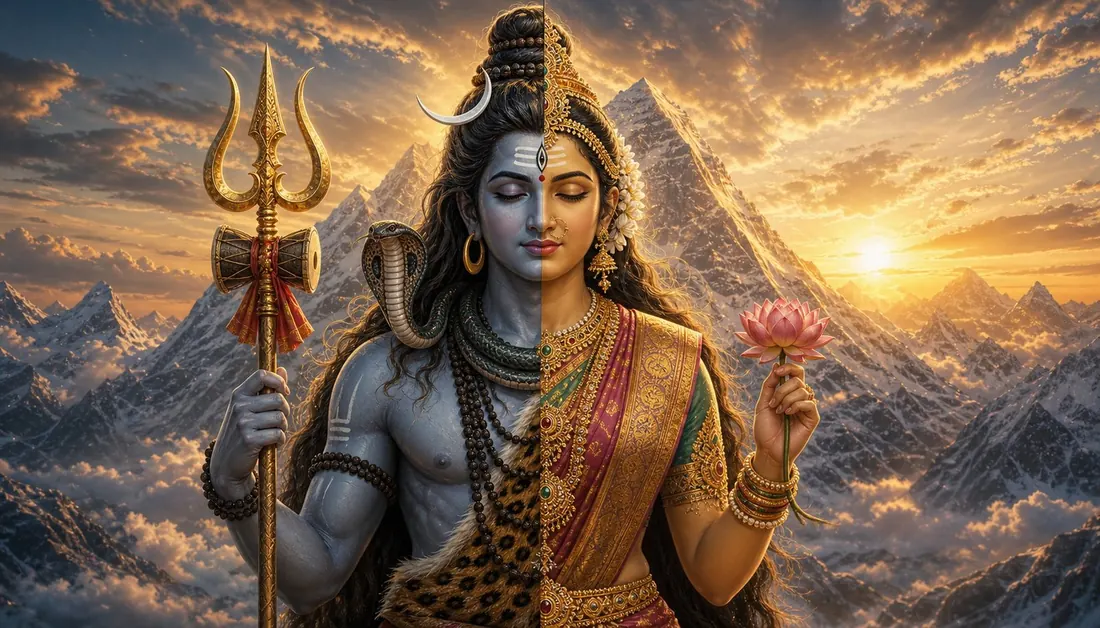
The last form in Shiva’s story is the quietest and, many say, the truest. It is called Ardhanarishvara: the Lord who is half woman. One being, divided down the center line: the right side Shiva, ash-pale, matted locks, serpent and drum; the left side Parvati, golden, silk-clad, jasmine in her hair, a lotus in her hand. Not a couple standing together. One body.
The stories reach for explanations: that the sage Bhringi tried to worship Shiva alone, circling only him, refusing the Goddess, until the two fused into one form that could not be circled separately. But the image is older and deeper than its anecdotes. It says what the whole tradition believes underneath everything else: Shiva and Shakti are not two. Consciousness and energy, stillness and movement, the meditator and the dance, the mountain and the river: divide them and both die; unite them and the universe happens.
The philosophers put it in a famous sentence: without Shakti, Shiva is shava: a corpse. The words differ by one letter, and by everything. All his grandeur, the poison-holding, the river-catching, the death-conquering, the world-dancing, happens because the recluse of Kailash was loved into wholeness, twice, by the same soul who would not give him up.
And so his story ends where every seeker hopes to arrive: not on the battlefield, not even on the mountain, but in union. The wild god is home. Har Har Mahadev.
Why this story matters
Ardhanarishvara is the tradition’s final word against every idea that the sacred is only fierce, only male, only renunciate, only one thing. Completeness is a marriage inside the self: strength married to tenderness, discipline to beauty, silence to song. A devotee bows to this form and is reminded that whatever they have exiled, in the world or in themselves, the feminine, the emotional, the still, the wild, is not an obstacle to the divine. It is the missing half of it.
कर्पूरगौरं करुणावतारं संसारसारं भुजगेन्द्रहारम् ।
सदा वसन्तं हृदयारविन्दे भवं भवानीसहितं नमामि ॥
karpūra-gauraṃ karuṇāvatāraṃ saṃsāra-sāraṃ bhujagendra-hāram
sadā vasantaṃ hṛdayāravinde bhavaṃ bhavānī-sahitaṃ namāmi
“White as camphor, compassion incarnate, the essence of the world, garlanded with the king of serpents: to Shiva, dwelling forever in the lotus of the heart together with Bhavani, I bow.”
Traditional Shiva aarti shloka
Small Glossary
- Mahadev
- The Great God: Shiva’s most common title. The cry “Har Har Mahadev” invokes him.
- Tapasya
- Intense spiritual austerity; the heat of discipline that even gods cannot ignore.
- Yajna
- A Vedic fire ceremony; offerings made into sacred fire.
- Third eye
- Shiva’s eye of pure seeing on the forehead; opened, it burns illusion (and Kamadeva) to ash.
- Linga
- The aniconic pillar-form in which Shiva is most widely worshipped: the sign of the formless.
- Shakti Peethas
- The holy sites where parts of Sati fell; principal seats of Goddess worship.
- Maha Shivaratri
- The great night of Shiva (February/March): an all-night vigil of fasting and chanting.
- Nataraja
- Shiva as Lord of the Dance, dancing creation and dissolution inside a ring of fire.
- Tandava
- Shiva’s cosmic dance; ananda tandava is its blissful form.
- Ardhanarishvara
- The half-Shiva, half-Parvati form: consciousness and energy as one body.
- Mahamrityunjaya
- The “great death-conquering” mantra of Shiva, chanted for protection and healing.
- Ganas
- Shiva’s motley attendants: spirits and oddballs no one else would keep, led by Ganesha.
Retold in original words from the Shiva Purana, the Skanda Purana, the Shrimad Bhagavatam and the Ramayana.
Test yourself
Think you know Shiva? Ten questions, no sign in.
Carry this darshan with you.
The Bhakti Angan app brings a new darshan each morning, simple mantras, a japa counter and the daily Panchang. Using Android? Join the waitlist.